
Looking forward
Yes, democracy was victorious in Israel
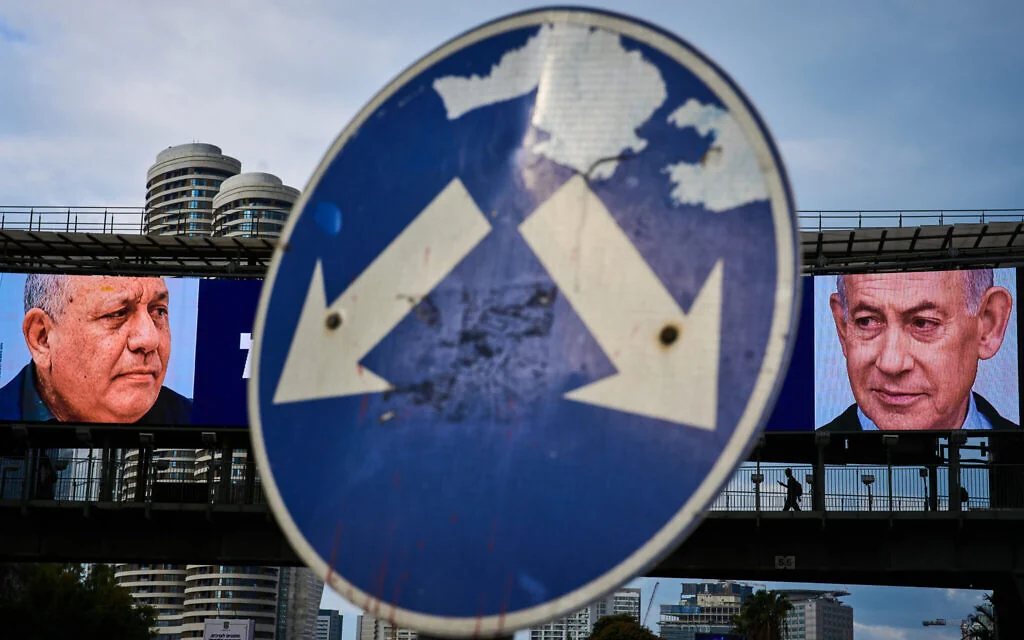
People cross a bridge beneath a campaign advertisement featuring Israeli Prime Minister Benjamin Netanyahu, right, and his main rival, opposition candidate Gadi Eisenkot, ahead of Israel’s general election in Ramat Gan, Israel, October 18, 2026. (AP Photo/Oded Balilty)
A brief guide for the perplexed about Israel’s electoral results and what happens now
On October 27, 2026, Israeli citizens voted in a new parliament and began the process of removing the current government after four years of strife, chaos, bloodshed, and destruction. In the wake of that historic vote, the leader of this outgoing government, Benjamin Netanyahu, and his vassals across politics and media, have sought to muddy the waters and confuse the public about the results. Their mission: to cast doubt on the election outcome and create an illusion of inevitability that Netanyahu will remain the king of Israel. Spoiler: he won’t.
This short article is meant to help those who remain perplexed to understand what has happened, what is happening, and what will happen in Israel’s political system. It will stick to the facts, link to articles and data so that you don’t need to take my word for it, and end with my personal predictions of what could come next along with a timeline for when it will happen.
First, a quick review of how Israel’s parliament (the Knesset) works: Israeli democracy is a party-based parliamentary system. When Israelis vote, they technically do not vote for a leader (prime minister or president). They vote for a party and empower that party to negotiate on their behalf over who will sit in the government and who will lead it. After the ballots have been counted, Israeli citizens have no say as to which government will be formed out of a coalition of the parties they voted for. They must trust the parties to represent their wishes, and can only punish them with their vote in a subsequent election.
This is why it is a fact that the coalition of parties led by Netanyahu lost this election. When that coalition won 64 seats in Israel’s 120-seat Knesset in 2022, everyone recognized their victory. The fact is that the parties that made it their mission to replace this outgoing government have won 67 seats, and Israel’s citizens suitably punished Netanyahu’s coalition and its anti-democratic, authoritarian, and destructive policies that have roiled the country since Jan. 4, 2023.
It is also a fact that Netanyahu and his circle have sought to delegitimize the results and have been rebuffed. As was widely reported in Israel, the plan to do so was outed two weeks before the election and has been followed to the letter since. Netanyahu used his loyalists in Israel’s secret service to cast a fog over the results, and his party has sought to incite the public against election officials. Fortunately, Israel’s election commission stood strong and did not bow to the pressure. The election results have been certified ahead of the swearing-in of a new parliament on Nov. 10.
Much of the cognitive warfare originating in the Netanyahu campaign is focused on delegitimizing the votes of Israel’s Arab citizens. One way they are doing so is by grouping all of the parties that received a majority of votes from Israel’s Arab citizens into a group that they call the “Arab Parties,” or “the Arabs” for short. The fact is that there are no Arab parties. There are four separate and distinct political entities (whose recent history is described well by Calev Ben-Dor), three of which have made up one political party called the Joint List, each of which has different ideological and political goals, and all of which are committed to the democratic process in Israel and especially to ousting the current government.
By grouping these parties together, and lying about their positions and even the songs they sang and when, Netanyahu’s campaign has successfully created the impression that there will not be a government formed without him. This is wrong.
First, because one of those four parties is Ra’am, which sat in government before and plans to sit in government again. Its leader, Mansour Abbas, was vocal in condemning the attacks of Oct. 7th in Arabic and Hebrew, has been vocal about recognizing Israel as a Jewish and democratic state in Arabic and Hebrew, and has been outspoken in his commitment to replace the current government. He also called for national service for Israel’s Arab citizens, meaning that he accepts all of Gadi Eisenkot’s four requirements for entering his government. With his party, the potential coalition has 56 of the needed 61 votes to form.
Second, because the parties that make up the Joint List have clearly indicated they would support any effort to replace the current government and do not need to be included in the coalition. While certain members of the erstwhile liberal democratic coalition, specifically Avigdor Liberman, have publicly stated that they will not accept a minority government and said they would prefer a government without Ra’am or the Joint List, all accept that the safety net these parties provide will make it much more comfortable for other parties or individuals from other parties to join the coalition.
Consider, for example, a reconstituted Shas, a party built to empower Moroccan Jews in Israel, which is reportedly in the process of replacing its long-serving chairman, Aryeh Deri, because of the historic failure of the election campaign. This renewed Shas would join Eisenkot in order to establish Israel’s first Moroccan prime minister, and because it will seek to have a seat at the table as this government undertakes the historic mission to integrate Israel’s ultra-Orthodox into Israeli society. In one fell swoop, the Change Government would have 62 members with another 11 votes to support it from the outside to hedge against potential threats from Shas if they do not like the bill advanced for conscription, for a total of 73 votes.
Alternatively, consider disgruntled Likud members who thought they would be rewarded for their unwavering loyalty to Netanyahu in this outgoing government but instead were bumped far down the Likud list after Netanyahu re-engineered it. There are at least five of these — Nir Barkat, Gila Gamliel, Haim Katz, David Bitan and Etty Atia, to name a few — some of whom opposed Mr. Netanyahu’s attempts to exempt the ultra-Orthodox from service, some of whom grew frustrated with the terrorism his government supported in the West Bank, and some of whom simply want to improve their chances of political longevity. So even without Shas, if these individuals could be recruited with the promise of a ministry or embassy and future inclusion in political lists, the Change Government would have 61 members with another 11 votes to support it from the Joint List, and possibly six from Shas, totaling 67 to 78. Or if Mr. Liberman actually prevails on a government without Ra’am, but with its Jewish member, Yoav Segelovitch, 48 in the core plus six from Shas, Segelovitch, and five from Likud make 60, with 18 supporting from the outside — a network 78 strong.
And then there is the option that Maariv journalist Ben Caspit explains: In the worst-case scenario, if Eisenkot is unable to build a government in the 42 days after he is given the mandate (28 days by law plus a 14-day extension period he can request), he can bring the matter to a vote in the new Knesset. All he needs is a majority vote of Knesset members to get the approval to instate any government he wishes (which, one can assume, will pass by 67 votes or more, given whatever compromises he may make on key issues).
To summarize: Netanyahu lost, and Israel’s citizens clearly expressed their rejection of his political platform and priorities. Which government will be tasked with fixing what Netanyahu broke will become clearer in the coming weeks. The key dates to watch are Thursday, Nov. 5, when the president of Israel is expected to announce whom he empowers to try to form a government (likely Eisenkot); the swearing-in of the new Knesset on Nov. 10 (after which a new speaker of the Knesset will be sworn in and Netanyahu will lose control of the legislature); and Dec. 17, 42 days after the mandate is given, when Eisenkot could be made the new prime minister. Until then, hold on tight. Autocrats and their allies are loath to give up power, and all gloves have proven to be off.
Related Topics
Related Posts