


Yes to freedom. Absolute freedom…to refuse
Yes to freedom. Absolute freedom… to refuse.
PROLOGUE: TWO JOKES, ONE SCHEMA
There is an old Russian joke about an execution. The condemned are forced to dig their own stools; the executioner builds his last. The Tsar watches. It is winter. Everyone shouts: “Faster, faster, the Tsar is freezing!” (Быстрее, быстрее, а то царь мёрзнет!)
There is another. A man walks at night across Red Square scattering leaflets from a bag. The militia surrounds him, picks up the papers, checks both sides: blank. “Where is the text?” He replies calmly: “Everything is clear.” (Всё и так ясно!)
These jokes do not really describe “Russia.” They describe a recurring human arrangement. The first is voluntary acceleration inside one’s own apparatus of coercion: work faster so the sovereign is comfortable. The second is a luxury version of censorship: no need for letters because the required meaning has already been installed. Together they form a diagram of modern power: obedience as tempo, and obedience as pre-read obviousness.
Seen through that lens, Peter Thiel’s famous line—“I no longer believe that freedom and democracy are compatible”—is not a provocation. It is an operating manual.
FREEDOM AS A VETO RIGHT
In a certain Silicon Valley dialect, “freedom” often means something very precise: the right to refuse accountability. Freedom is not plural speech. Freedom is not dispute. Freedom is not the inconvenient procedure of having to justify decisions to people you did not choose but who nonetheless exist.
Freedom, in this version, is the sovereign’s right to end the conversation. It is the founder’s right to say: I will not explain. Democracy becomes “incompatible” not because it is an unattainable ideal, but because it forces friction: questions, oversight, transparency, slowness, compromise, sometimes even elementary modesty.
To be clear: this is not a critique of technology or entrepreneurship as such. It is a critique of the political fantasy in which society should function like a company and the company should function like a state—except without elections, without procedural constraints, and without the burden of explaining itself.
MAKE PEACE WITH THIEL: HE’S NOT GOING AWAY
The incompatibility thesis does not arrive from outside liberal civilization. It arrives from its profitable interior: from places that live off contract stability, legal order, state infrastructure, and the global financial system. Thiel matters here not because he is uniquely powerful, but because he articulates a logic many institutions quietly practice.
We do not need to turn him into a demon. It is enough to treat him as a symptom: a public version of a private wish—governance without friction, sovereignty without questions, “freedom” as the ability to refuse.
NORTH KOREA AS A MANAGEMENT DIAGRAM (NOT A MORAL EQUIVALENCE)
At a distance, one can risk an uncomfortable observation: certain authoritarian regimes function as grotesque, but clarifying diagrams for a particular managerial fantasy. North Korea is an extreme case, and that is why it teaches. One absolute decider. One executive line. No need to answer the demos. Opposition treated as noise, then as error, then as deletion.
This is not a comparison of suffering, and it is not a claim about intentions. It is a comparison of structures: a world where dissent is framed as system failure, not as political life. In that world, “absolute freedom” becomes freedom to refuse—refuse negotiation, refuse explanation, refuse being constrained by those deemed less competent.
The costume changes—uniform or hoodie—but the temptation is stable: the sovereign’s comfort becomes the measure of everything.
POL POT AS A DARKER PRECURSOR: THE RESET AS A PROGRAM
If North Korea illustrates the fantasy of a frictionless executive line, Cambodia under the Khmer Rouge illustrates the fantasy of the reset. “Year Zero” was not rhetoric. It was an attempt to erase mediating institutions: memory, expertise, professional ethics, plural speech.
The reason to invoke this is not to sensationalize. It is to name a blueprint that returns in milder and “civilized” forms: when complexity is treated as contamination and institutions of mediation are treated as obstacles, violence does not need a spectacle. It can be administrative. It can be gradual. It can be done with forms, budgets, and compliance.
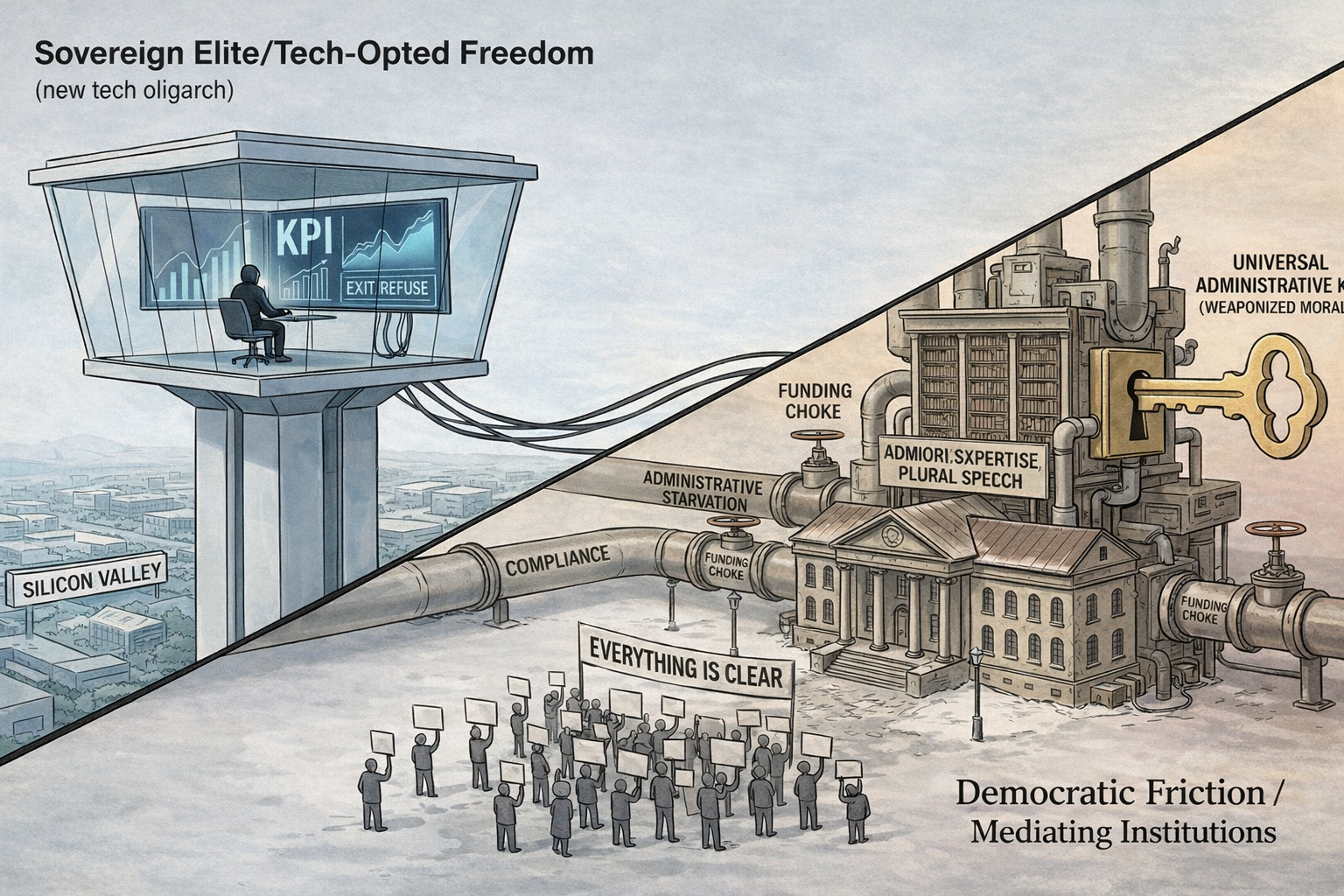
AMERICA: DISMANTLING BY SUFFOCATION
The United States offers a contemporary version of the same logic in a slow register: dismantling by suffocation. Not necessarily abolition, but the strategic removal of oxygen.
Universities and other mediating institutions can be weakened through conditional funding, contracting uncertainty, accreditation pressure, and the steady expansion of compliance regimes that redefine what counts as legitimate research, legitimate speech, legitimate professional life. The building remains; the breath is removed. Programs shrink. Planning collapses. People leave. The institution becomes cautious, then hollow.
This matters beyond American domestic politics because it is an exportable governance style: weaken mediation, accelerate execution, and call the result “efficiency.”
A HARD WORD FOR JEWISH READERS: ANTISEMITISM IS REAL—AND CAN STILL BE WEAPONIZED
Here a Jewish reader deserves a clear distinction.
Antisemitism is real. It must be confronted directly and without euphemism. But the weaponization of antisemitism as a universal administrative key is a different operation. It turns a moral imperative into a general-purpose lever for disciplining institutions—sometimes for goals that have little to do with Jewish safety and a great deal to do with control.
When a moral claim becomes a master key, the question is not only which door it opens today, but which doors it will open tomorrow, and against whom. Jews have enough historical memory to recognize this pattern: the tool used “for protection” can become the tool used for targeting, once the political wind shifts.
A HARD PARAGRAPH ON “MARXISM” THAT COMES TOO EASILY
“Marxism” is being used here the way a drunk uses a streetlamp: not for illumination, but for support. It props up an unwillingness to look at how power actually operates—through tempo, compliance keys, funding valves, and the sovereign’s privilege to refuse accountability. If you need a label, call it what it is: a doctrine of executive impunity dressed up as freedom.
THIS IS NO LONGER AMERICA’S “INTERNAL AFFAIR.” IT IS THE PROBLEM OF EIGHT BILLION.
The central point is global.
What happens in the United States is not merely an elite quarrel in one country. It is a prototype. If a set of governance technologies emerges that does not need to justify itself—predictive surveillance, automated administrative decisions, scoring systems, risk profiling, database integration, “efficiency” as moral cover—then it will not remain a local eccentricity of Silicon Valley or Washington.
Eight billion people live under governments that do not dream of better democracy; they dream of better impunity. They are waiting for tools that act quietly, without open decrees, without debate, without responsibility—because the tool is framed as technical.
If this model is normalized at the perceived center of the West, it becomes an argument for every authoritarian project elsewhere: if they can, we can. The label will not matter—Marxism, libertarianism, nationalism, security. The social effect will be the same: the shrinking of the space where a person can ask “why?”
And here the Tsar joke returns with a warning. Those who reflexively shout “Marxism” at this analysis should remember what they are volunteering to do. They are chanting, by choice: “Faster, faster, the Tsar is freezing.” When the stools are already dug and the executioner finishes his last, even the loyal discover that the sovereign does not recognize gratitude. He recognizes only the temperature of his own comfort.
EPILOGUE: ABSOLUTE FREEDOM TO REFUSE, OR FREEDOM WITH OBLIGATION
If someone insists that “democracy and freedom are incompatible,” we should ask: whose freedom?
The freedom of the demos is always inconvenient because it contains dissent. The freedom of the founder can feel seductive because it contains refusal. But a society that chooses refusal as its political ideal ends with a blank leaflet: “everything is clear,” because writing has been replaced by obedience.
We do not need formal censorship to achieve silence. Tempo is enough. Sovereign comfort is enough. It is enough that we start digging the stools ourselves.
Blank paper is not innocence. It is trained consensus.
Yochanan Schimmelpfennig