Yitzhak Rabin’s vision is alive
On November 4, 1995, I was in Washington, DC. It was a sunny, cool day. Since it was a Saturday, I was at home with my family. There was internet, and, of course, there was news, but very far from the real-time updates we get today. We were totally unaware of the three deadly shots fired at 9:42 p.m. Israeli time — until the phone rang.
I cannot recall my exact reaction, but I do remember the feeling that one can associate only with certain events in life: nothing will be the same.
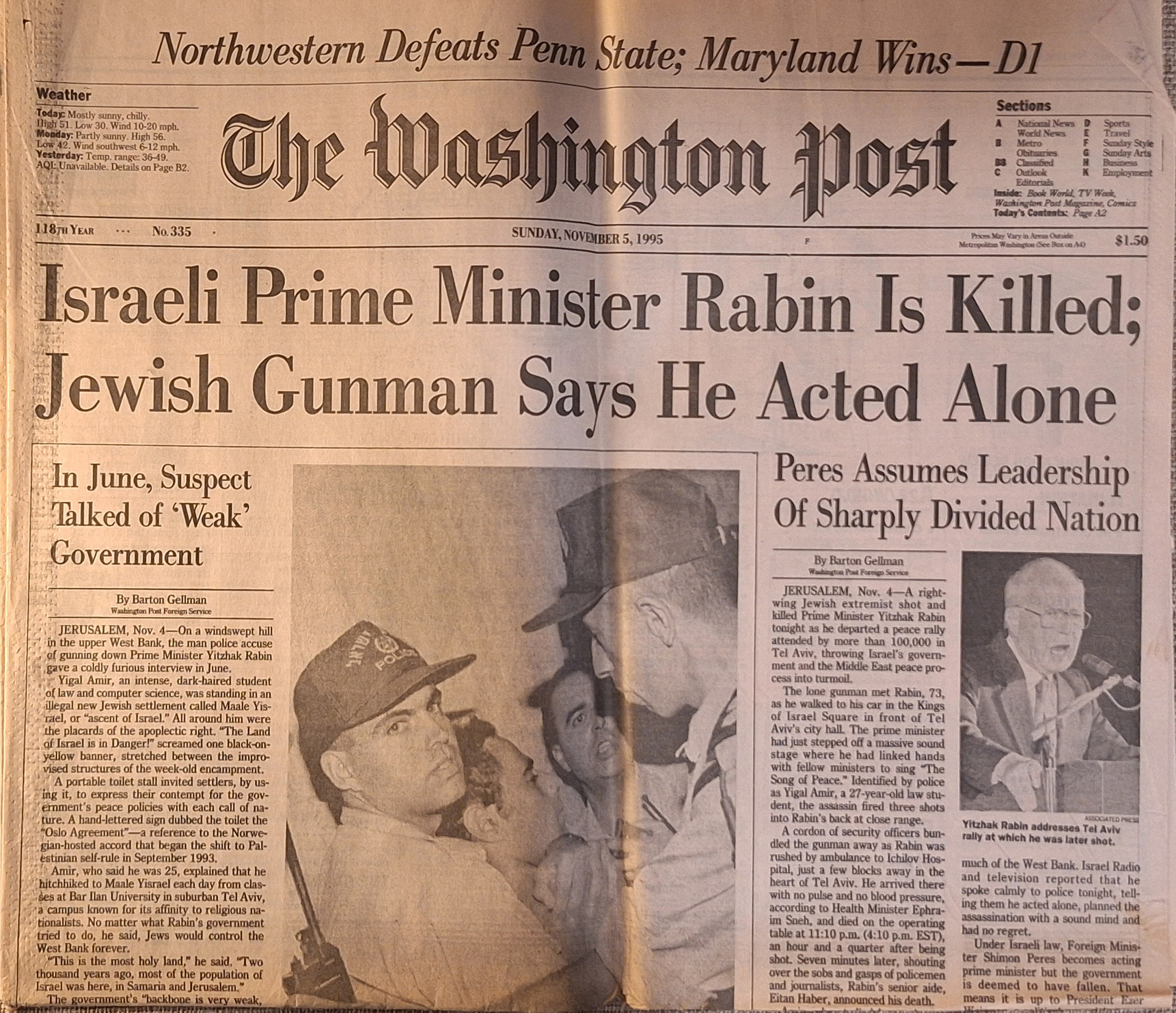
The next day, we received the Sunday edition of The Washington Post, thick as usual on Sundays. However, for us, there was nothing usual about this edition. I kept the front page. The headlines read:
Israel Prime Minister Rabin Killed;
Jewish Gunman Says He Acted Alone
Below the headlines were two photos: one of the “suspected gunman,” Yigal Amir, and another of Yitzhak Rabin addressing the rally at Kikar Malkhei Israel (Kings of Israel Square), now Kikar Rabin (Rabin Square).
On Saturday (November 1), a rally was held at the same spot to commemorate the 30th anniversary of the assassination that changed so much for Israel and the region. Prime Minister Rabin, a war hero and military commander of the highest rank, made a personal decision as leader of the nation: to change course and take the risks of peace by confronting the core problem of this region: the Israeli-Palestinian conflict, the roots of which are as old as the Zionist movement.
More than 150,000 people gathered to pay tribute to Rabin, to say and sing the word Shalom – Peace, which, as one of the speakers noted, has become for some an almost dirty word, identified with the “Left.” Since October 7, 2023, thoughts of peace with the Palestinians are considered by most Israelis a very unrealistic approach, and, by some, even a betrayal.
That is why a particularly symbolic and emotional moment came when Gadi Mozes from Kibbutz Nir Oz, who had been held hostage in Gaza by Hamas for more than a year, spoke and said (in Hebrew):
“…At the very least, we can try to reach an agreement with the Palestinians…. We must spare no effort so that our children and grandchildren will know war no more.”
On the first anniversary of Rabin’s assassination, the late Israeli poet Haim Gouri wrote:
“I knew him personally since the age of 6. We studied together in three schools.
We served together in the Palmach. I am often asked: even back then, in the days of childhood, youth, and early adulthood, did you imagine that this man would reach the pinnacle of command and national leadership? I reply that we knew he was talented, determined, thorough, and clear-sighted, one who grasped the essence of things and led others, but I cannot say that we truly foresaw that one day he would become number 1 in this country.
“Yet surely none of us could have imagined, not even in our worst nightmares, that this same man, around whom so many bullets had whistled, would be shot in the back by one of his own people, while calling upon the nation to accept his political course, which he believed with all his heart would bring peace to this land.
“A year has passed. The grief, the rage, and the terrible bewilderment have not faded.
“The land does not cover his blood.”
(Translation from Hebrew of an article excerpt, published in Ma’ariv, October 1996.)
Indeed, the land has not covered his blood.
After October 7, I understand why so many Israelis are skeptical. Yet it was encouraging that the speeches by experienced leaders — two of them veteran Israeli generals and one former Likud member — all included a message that has not been heard here for a long time: Peace is possible.