


Yom HaAliyah: Words fail me
We recently celebrated Yom HaAliyah, a national holiday dedicated to immigration to Israel. To commemorate the day, my synagogue held a Friday night mixer to encourage more interaction between Israeli and Anglo members. While I am friendly with many of the Israelis in my shul, I wouldn’t go as far as to say that we are friends. We greet each other warmly, we ask after each other’s families, but language and cultural barriers make it hard to move beyond small talk as we munch on crackers during kiddush.
So I was excited by the opportunity to get to know people better, but simultaneously dreading the moment when they got to know me better. Staying quiet in Hebrew social situations is my best bet – smile widely, nod soberly. Leave them thinking that I’m smart and interesting and that I simply ran out of time to share my poignant insights about a unity government.
My plan for the evening was to park myself near the snacks and wallflower the heck out of the situation.
Would I be the life of the party? Definitely not.
But would I be the moron that everyone would talk about later? It’s always a possibility.
The evening proceeded seamlessly until I was called up to participate in an icebreaker panel. I was instantly panicked and sweaty. There was no way I was going to understand the questions, let alone formulate intelligible answers. Disaster was imminent.
Help! I mouthed to my husband. SOS!! Code blue!!
And then the moderator posed the first question: “Tell us about a time you embarrassed your children by making a language mistake.”
To which I replied, “Hold my bamba and cancel that code blue. Am I limited to one answer?”
Instead of being awkward and painful, this was the first icebreaker in history that actually broke the ice. I used some of my best material. I told stories about Hebrew mistakes that humiliated my children, while making Hebrew mistakes that would surely humiliate my children. The Israelis talked about their own faux pas. We mixed and laughed and bonded.
The next question for the panel was:
“Do you prefer having Sundays off (like in America), or Fridays off (like in Israel)?”
Elated to have once again understood the question, I didn’t stop to think about my words.
“אני גיורת – I am a convert,” I said proudly. “I used to love Sundays, but Fridays have grown on me.”
We finished up with a few more questions, and when the panel was over, the Israelis thanked me for sharing my stories. “I didn’t realize you had converted!” one said to me with a look of newfound respect.
Apparently I had been misunderstood.
Later my husband explained that Israelis don’t use the word convert the way Americans do. “You basically told them that you underwent a complicated Jewish legal process to formally change your religion. They missed your point about Fridays and Sundays. Now they think you were born a Zoroastrian,” he said.
See what happens when your code blue response time is too slow?
Later that week, my son called to tell me that the topic of aliyah also came up in his yeshiva. He was frustrated by the way his Israeli classmates downplayed the difficulty of moving from one country to another. My son had told them, “If you were born here, you can’t understand how hard it is. We had a big house back in America. My parents had great jobs. They made real sacrifices so that we could live in Israel.”
I was touched that he had been brave enough to share our story. But I was also disturbed by the details that he left out.
It’s true that we left a wonderful house and jobs that we loved in order to pursue our Zionist dream. But would it have killed him to mention that we’re doing really well now? Our home is warm and inviting, our jobs are fulfilling. We have gained far more than we left behind.
His version makes it seem like we’re living in a van down by the river.
I imagine him telling his friends, “Sure, the van leaks when it rains, and my mom really misses the Zoroastrian festivals and has trouble communicating with the locals, but we’ve gotten better at foraging for food so the hunger isn’t even that bad. Yay Zionism!”
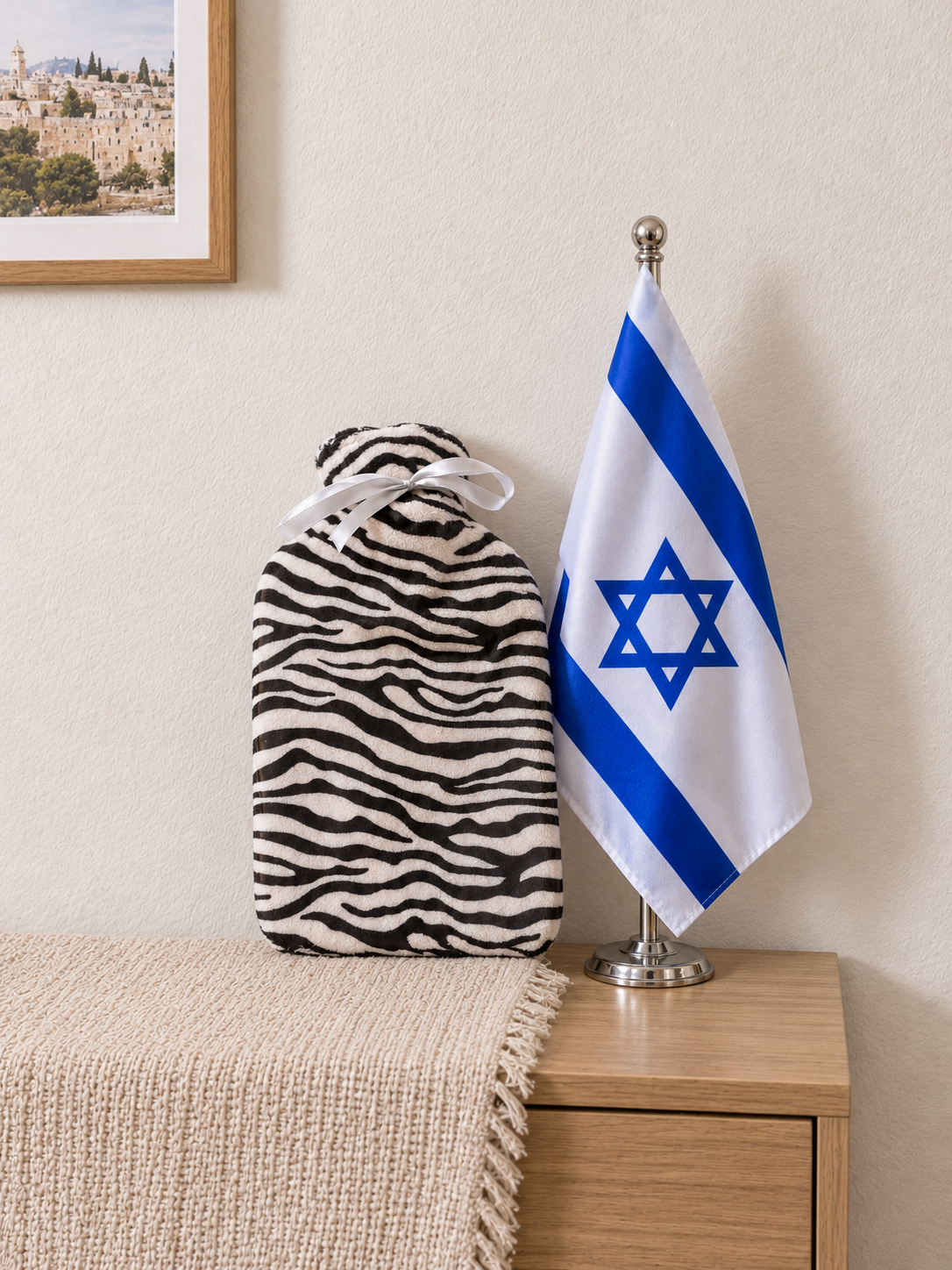
My daughter’s high school also acknowledged Yom HaAliyah by calling her up on stage in front of the whole student body to hand her a zebra-print hot water bottle. Though we are still trying to understand the connection between immigration and zebra print, being publicly singled out embarrassed her as much as any grammar mistake I’ve ever made. I appreciate the school’s partnership in this matter. As a bonus, we can use the hot-water bottle when the van gets drafty.
Sometimes I wonder if my preoccupation with our aliyah story is detrimental to my kids. They don’t struggle with questions of identity, and so they probably don’t need to hear me puzzling through my experiences out loud.
But when God took the Jewish people out of Egypt, He instructed them to recount the story to their children so that they would tell it to their children, so that it would be woven into the essence of who we are as a nation.
My children lived our story, and yet I continue to tell it so that they don’t forget where we come from, how we got here, and how many verbs were mutilated along the way.
They need to know that their mother was once a wandering Zoroastrian. She was coherent at parties and skilled at conjugation. And though she lived well, she lacked sufficient methods to embarrass her children, and so the good Lord delivered her to a new land flowing with zebra print and endless opportunities for cringe.
Yay Zionism indeed.