Perspectives from the Old City of Jerusalem
Yossi Klein-Halevi’s Questions: How Dare He Ask Them, How Dare We Not?
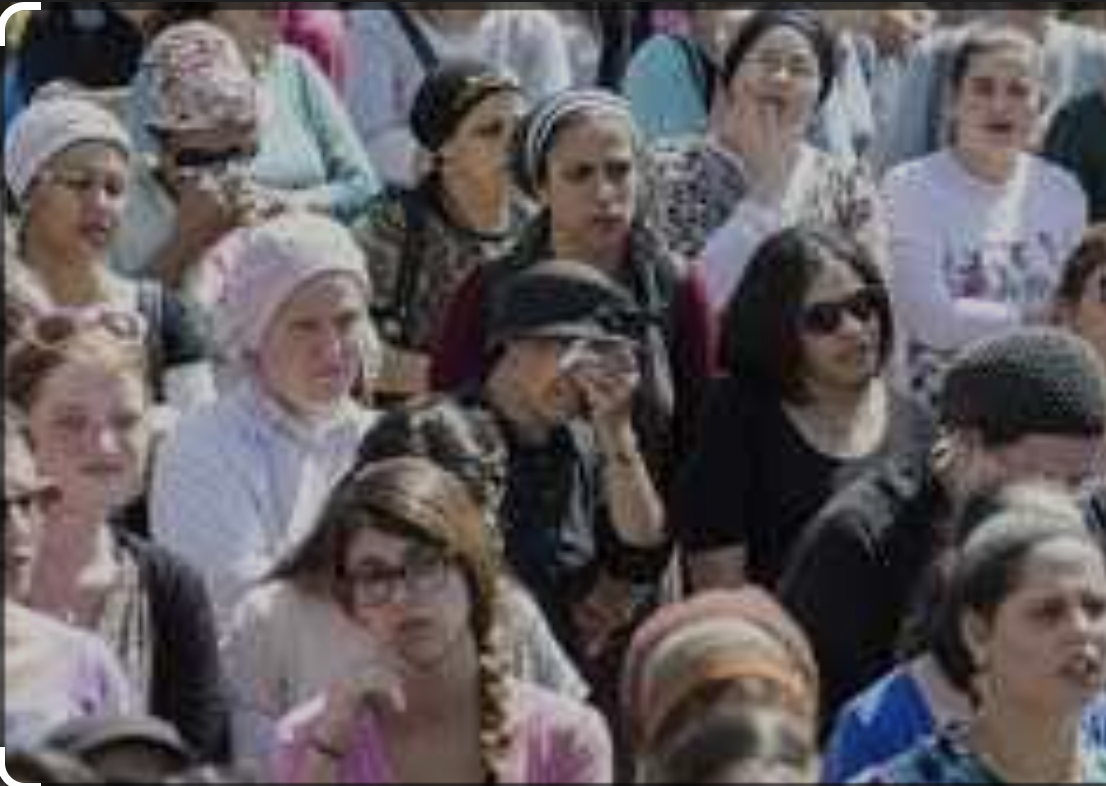
Jewish women at military funeral
My experience as an Israeli Jew
Yossi Klein-Halevi’s recent blog in ToI, in which he called for “moral self-examination among Israelis,” incited a vociferous response. Many of the 150 comments condemned Yossi for his very proposition—that Israeli Jews should be asking moral questions about the war in Gaza. Some called him “naïve” and “a liberal apologist.” Is it right or wrong for Yossi and the rest of us Israeli Jews to even ask the questions?
He claims that “Judaism demands” that we “subject ourselves to moral self-critique.” Although I am to the right of Yossi in my political opinions, in this he is correct. His detractors keep throwing up the total evil of Hamas, as if our need to protect ourselves, the necessity of our very survival, is automatic justification for our actions.
Judaism, however, conceives of three levels of soul. Nefesh, the lowest level of soul that interfaces with the physical body, is shared with animals. As with animals, the survival instinct dominates. The next higher level of soul is ruach, which makes moral choices. Ruach is distinctly human. To make choices we must weigh conflicting drives and conflicting realties, as Yossi bids us to do. The higher level of soul is neshama, the spiritual soul that connects a person to God and, for Jews, to what Kabballah explains is the collective soul of the Jewish People.
The ruach makes conscious choices, and choices must weigh alternative claims to goodness and right. Yossi’s questions are valid, even if the reader does not agree with his answers.
For example, he asks: “Why were we, the Israeli public, largely silent” about the hunger crisis in Gaza when it became clear that it was more than antisemitic propoganda? Why did I and my neighbors not care that Gazan civilians were not getting sufficient food?
As one of those Israelis whom Yossi disdains for our attitude that “there are no innocent civilians in Gaza,” I’d like to explain my own inner dialogue
Shortly after October 7, a survey revealed that 85% of Gaza’s residents supported the massacre. This is the basis for our visceral feeling that all the Gazans share the guilt for October 7. This includes women, the elderly, and, yes, even children. I keep hearing an inner voice say, The murderers and rapists of October 7 were children in 2005, when Israel left Gaza. If raised in a hateful, Islamist society, the children of today will be the terrorists of tomorrow.
Yet, I also have a rational inner voice that points out that 15% of the Gazan population of two million means that 300,000 people in Gaza did not support the October 7 massacre. So there are a lot of “innocent people” in Gaza.
Indirectly, I know at least one of them. My friends David and Naomi Geffen started an educational program called, “Loving Classroom,” based on the conviction that if you teach chidren nine “virtues,” including respect, compassion, gratitude, love, and kindness, society will be changed for the better. In a pilot program in a black township in South Africa, Loving Classroom achieved stunning results.
Several years ago, an Arab Muslim teacher in Gaza contacted David Geffen. He wanted to introduce Loving Classroom into Gazan schools. David Geffen, a British Jew who had made aliyah, could not go to Gaza to train this teacher, and the teacher could not come to Israel. So they met in London, where David instructed the teacher how to train a group of like-minded teachers in Gaza.
In March, 2023, David Geffen died suddenly of a heart attack. Then came October 7, and everything changed. A few months ago, I asked Naomi Geffen whatever happened to that idealistic teacher who wanted to implement Loving Classroom in Gaza. She replied that she had not been in direct contact with him, but she had heard from someone to whom he had written that his mother had died of starvation and he himself was sick and unable to obtain medication.
Hearing this news, I felt a tinge of sorrow. Only a tinge? I consider myself a compassionate person. Why couldn’t I summon up a single tear for this innocent Gazan? This is a question I was compelled to ask, just as we are compelled to ask the questions that Yossi Klein Halevi poses.
Here is my honest answer: I have shed so many tears for the murdered and raped victims of October 7. I have shed so many tears at funerals for our soldiers whose short lives were ended fighting to defend our people. I have shed so many tears for our tortured and starved hostages. I have shed so many tears for the third of Israel’s population who are suffering from PTSD (my son included, after serving in the reserves for five months and ten days). I have shed so many tears for my downstairs neighbor, whose son-in-law was killed fighting in Gaza, leaving a young widow with an infant and a toddler. I have shed so many tears for my friend’s precious son Moshy killed in Gaza. I have shed so many tears for the Jews killed and wounded in terrorist attacks, including today’s in Jerusalem,.
I have no more tears left to shed for the innocent Gazan teacher who is suffering. This is not a rational answer. It does not come from the ruach, the level of soul that weighs moral choices. It does not come from the nefesh, the level of soul motivated by the instinct for survival. It comes from the neshama, the level of soul connected to God and the collective soul of the Jewish People.
At our Shabbat table last week, our son’s best friend Nachi was a guest. Nachi, aged 30 and single, has spent ten months of the last two years fighting as a paratrooper in the reserves. A female guest asked him whether, if he is called up again, he can refuse to go. Nachi looked at her, puzzled by the question. Refuse to go? He replied, “I consider it a privilege to serve, to defend my family,” by which he meant the entire Jewish People.
This is not an answer based on politics. It is coming from his neshama, that highest level of soul. Yossi’s questions are political. Yossi’s answers are determined by a vision limited by politics and intellectual calculations.
Like most Israeli Jews, I have no definitive answers. But I trust that the beauty of the collective soul of the Jews of Israel will lead us to the salvation for which we all yearn.
Related Topics
Related Posts