
Sense maker, AI-augmented builder | founder @ talenthunt.work
You can’t vibe code your track record

I moved to Israel with three decades of professional experience and almost no way to prove it. Today AI writes a ‘perfect’ resume in 30 seconds, but a career record that others vouch for can be hard to show.
When I moved from Russia to Israel, I brought three decades of experience and almost no portable proof of it.
The trust and reputation I had built stayed with my former employers and, in a way, with my former country, so every conversation started from zero, with a PDF and my word.
That gap is where the idea I called Work Identity came from in 2022.
Since then, AI has made that gap wider.
You can write a great resume with AI in 30 seconds, but you can’t generate the people who worked with you for a decade and would vouch for you.
Andreessen Horowitz, the venture firm known as a16z, put the same thought about crypto into one line on November 3: “You can’t vibe code USDC.”¹
{Vibe coding means letting AI write software from a loose prompt, and USDC is a stablecoin pegged to the US dollar. — MD}
Their point: when AI writes code for almost nothing, the code stops being the moat, and the network of people and institutions behind it becomes the thing worth owning.
A second a16z piece, on how banks check their customers, describes almost the same idea, and neither piece mentions work once.
The resume is an interface, and interfaces are free now
a16z list what stays scarce once code is cheap: “the ownership, identity, liquidity, reputation, and relationships.”¹
Hiring still runs on what is cheap to copy. Its main unit, the resume, is the cheapest thing in the process to produce, and so is its mirror on the employer’s side, the job description.
These two documents carry the most weight in hiring, and neither shows the whole picture: a resume leaves out much of what a candidate can do, and a job description leaves out a lot of what the team really needs. Both sides now produce them with the same AI tools. Candidates generate applications, recruiters generate filters, and the pile keeps growing.
LinkedIn says US applicants per open role have doubled since the spring of 2022, and two-thirds of the recruiters in its survey say it got harder to find qualified talent over the last year.³ Gartner expects one in four candidate profiles worldwide to be fake by 2028⁴. I wouldn’t bet against it.
Hiring is KYC, and every employer redoes it
The second piece, from a16z crypto, is about banks and know-your-customer (KYC) checks. Every bank verifies a customer on its own, keeps its own records and repeats the process for every new relationship. In their words: “Institutions do not want to avoid KYC; they want to avoid redundant KYC.”²
Swap “institutions” for “employers” and you have hiring.
Every company checks the same candidate from scratch: identity, work history, references. Reference checks drag on, and nobody answers for what they say. Employers will keep checking. The waste is in checking the same thing again for every new role.
Their fix is one banks already understand. A trusted party verifies a person once and issues a signed credential, and the person shows each new counterparty only what it needs, sometimes as a cryptographic proof that reveals nothing else.
What Work Identity guarantees, and what it doesn’t
Work Identity applies the same model to a working life.
In 2022 I described it as a career record sealed with a real identity check, where companies, universities and other trusted parties vouch for what the person claims. I still think a blockchain is the right home for such a record: nobody, us included, can quietly rewrite it.
A resume is a flat shadow of a much bigger shape. Every job description casts it from its own angle: the same person comes up short for one role, and the skills another role would value never appear at all.
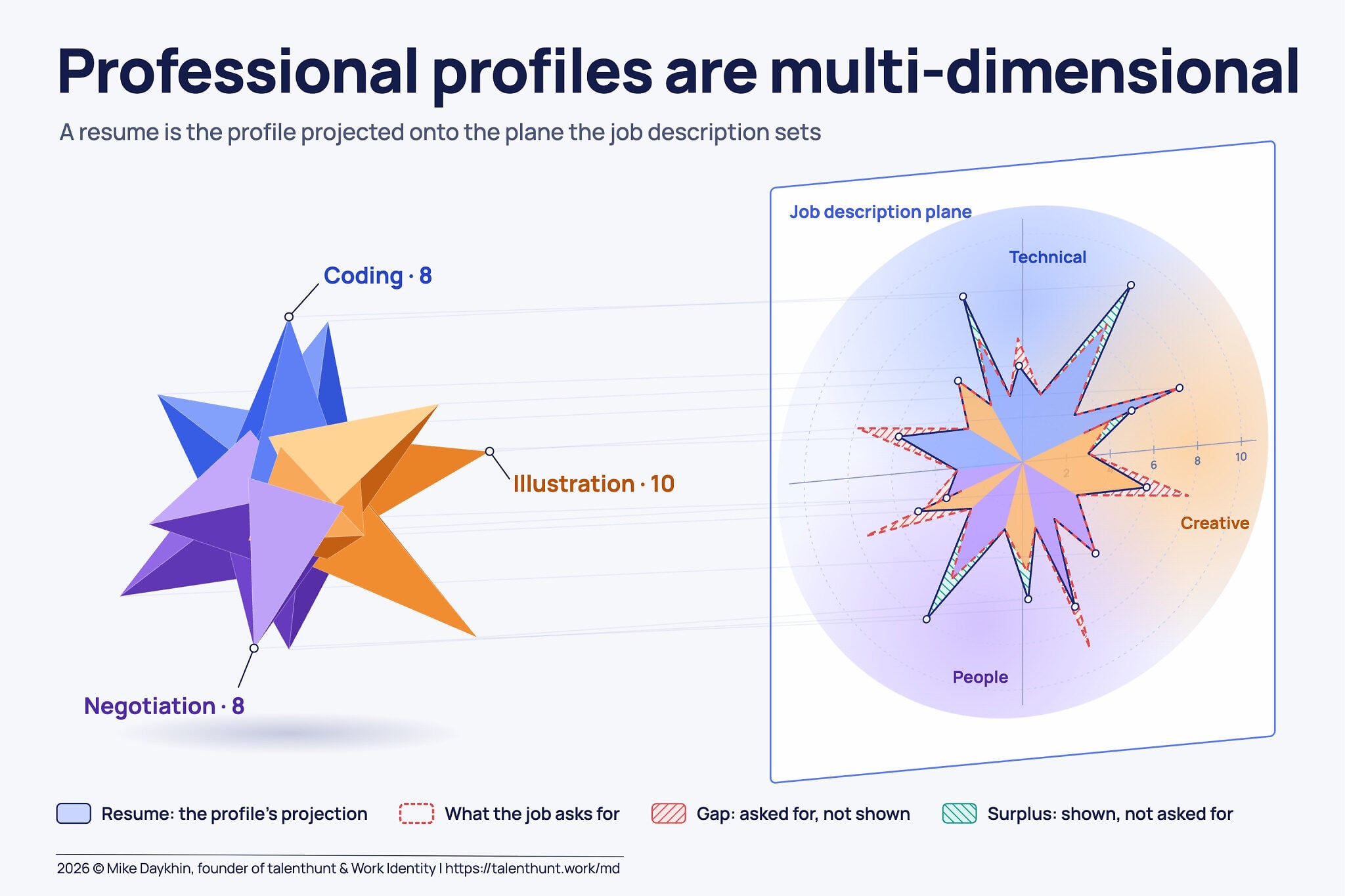
Work Identity promises less than people expect when they hear the word “verified”:
- What we guarantee: what you wrote about yourself can’t change without a trace. The record keeps its edit history, and you decide whether a reader sees all of it, part of it or none of it.
- What we don’t check: whether what you wrote is good or true. Nobody has the resources to check every claim a candidate makes, and we don’t pretend to. That part rests on the people who vouch.
- Who can vouch: an authorized organization, such as a university or a conference provider, or a fully verified person (your manager, colleague, client, etc.), who puts their own reputation behind the words.
Two agents talk, no names, humans decide
Here is how I believe hiring should work, and what I’m building toward:
- The employer’s agent carries every requirement for the role, including the ones the company never lists publicly.
- The candidate’s agent carries the full profile history, far more than a resume holds, and what the candidate wants from the next employer, which resumes usually leave out.
- The two agents talk anonymously: no company name, no personal data.
- Only when the requirements match both ways does each side hear about the other. The candidate learns that a company like this is interested; the company learns that a candidate like this may fit.
- If both say yes, names and contacts open, and the first meeting can go almost straight to the hiring manager.
a16z describes the same need from the finance side under “Know Your Agent”²: an agent should carry signed credentials that say who authorized it, on whose behalf and within what limits. Hiring agents will meet each other either way; the open question is whether they bring anything the other side can trust.
When this works, the identity check, the basic references and the proof of work come with the profile. The resume may disappear, and whole stages of the hiring funnel fall away, along with most pointless applications and wasted meetings.
Today talenthunt runs the first half of this.
Candidates build the profile, and a recruiter can attach a job description to the chat and walk the candidate’s profile through the role’s requirements: a simple version of the agents’ conversation. The anonymous match is still ahead of us.
Where this falls short
A record that can’t change can still be false.
A careful liar can document a lie and keep its edit history spotless, and the system won’t catch every case. A record with a verified change log, more context and endorsers who stand behind their words is still harder to fake than an edited LinkedIn profile or yet another version of a resume. That bar is low, but it is still much higher than where hiring sits today.
The a16z authors make the same admission about banks: “not every KYC determination can be reduced to a binary cryptographic proof.”² We also haven’t designed what happens to someone who vouches falsely, and the answer will differ by product.
Then there is the cold start: a network of endorsers is worth something only once enough people are in it. That is the hard part, and it is also the reason to start now. Each profile with a history makes the next vouch easier to give, and each employer that accepts such a profile makes the next one more useful. The pieces already exist: identity checks, signed credentials, edit histories, AI agents that can read a job description. The road ahead is to put them into one record that a person owns and carries from job to job, before hiring agents start talking to each other without it.
Until that record exists, the first copy of your reputation has to stay with you. Keep notes on what you did and what came of it: the project, the problem, the result, the people who saw it. Above all, keep the context. In the moment it seems too obvious to write down, but a few months later the details fade, some things stop looking important, and you can no longer recall them. A dated note in any app is a good start, and a talenthunt profile is one place to keep it.
The old question in hiring was “Where did you work and what did you do?”
The one that matters now is harder: “Who would vouch for you, unprompted, and how can we verify that?”
How would you answer it today?
________________________________________________
Sources
- a16z Frontier, “Reusable networks”, November 3, 2026.
- Maggie Hsu and Michele Korver, a16z crypto, “The key to getting more institutions onchain: Rethinking KYC”, October 12, 2026.
- LinkedIn Pressroom, “LinkedIn Research: Nearly 80% of people feel unprepared to find a job in 2026, as two-thirds of recruiters say it’s harder to find quality talent”, January 7, 2026.
- Personnel Today, “By 2028, one in four candidate profiles will be fake”, August 1, 2025, on a Gartner forecast.
Related Topics