

You Have Won the Chanukah Lottery
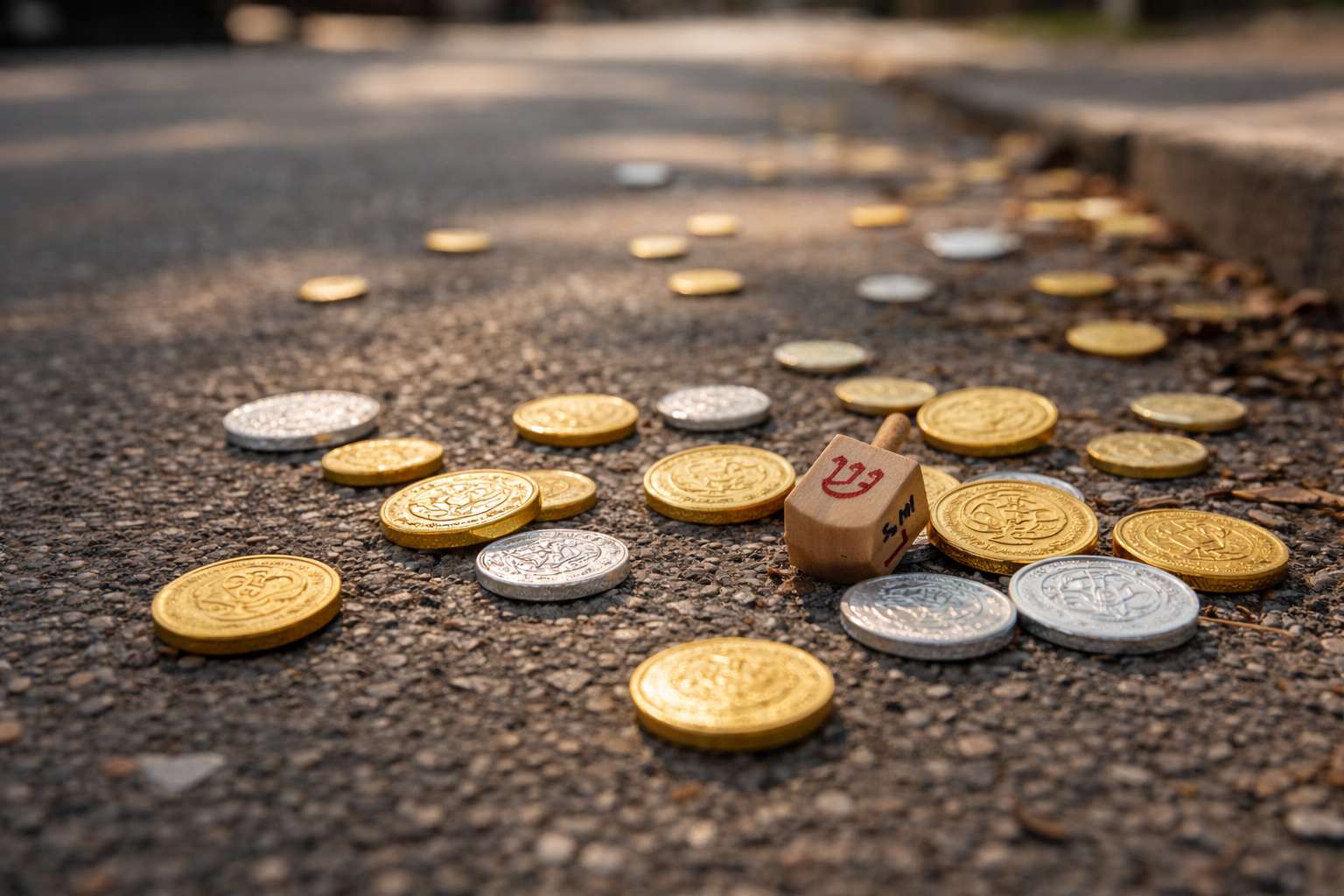
A religious guy opens the trunk of his car and chocolate coins spill out onto the street. Dozens of them. Silver and gold.
Jackpot!
What looks more antisemitic than a black-hatted Jew spilling money from his car? Except Chanukah was weeks ago, and the chocolate is stale.
Imagine a computer game. Grand Theft Auto: Tel Aviv. You’re an American tourist, forcing open the vehicles of Jews to find hidden treasures.
Stashes of gold candy in a Toyota. Dark chocolate menorahs under every Porsche. Gummy bear Torah scrolls when you flip a Kawasaki.
Ridiculous, I think. Then a car drives past blasting loud religious music through open windows. And strapped to the roof: a metre-high chanukiah. Life is stranger than fiction.
I’m standing in line for a slice of pizza. The guy behind me has thick curly hair, a lick of grey in his beard, machine gun slung over his shoulder. The owner calls out a greeting, so I guess now the soldier dude is ahead of me. He’ll be ordering olives.
No matter. He’s risking his life for the country. Pizza can wait.
Unless.
What if he’s not? What if that uniform isn’t his? Borrowed for faster service, free bus rides, attention from girls. Call-ups in the synagogue, first plate at Shabbat dinner.
What if he is a charlatan? A fake. An imposter, playing the game.
And me? Am I also phoney? A pretend Israeli, thinking loudly in English among the Hebrew nation. Never shouldering a rifle. Never doing push-ups in front of the sergeant major. Never drinking ‘milky’ chocolate by biting the corner off the plastic packet and squirting it into my mouth one-handed.
Inside, I’m still an English schoolboy. We only wore shorts for two months of the year, not year-round like Israeli lads. Yes sir, no sir, may I go to the bathroom, sir. Hands up before speaking. Waiting our turn. All that deference is a crime in Israel.
But immigrants have to adapt. I am hardly the first.
Last Shabbat, as the sun set over the fields near Negba, Ronen boiled coffee in his finjan and told us about Svitchko – I guess in Czech that’s Svičko, sounds like Sveech-ko.
Svitchko jumped out of the train, said Ronen.
He wandered in the forests, lived a little feral, got picked up by the Nazis, and somehow ended up in Auschwitz.
He arrived at the camp, got shaved, tattooed, standard procedure. A friend in the kitchen. A dose of typhus. A death march.
Then he came to Israel and fought in the independence war.
And when Svitchko – now Zvi – got his national identity number, his Teudat Zehut, guess what? The number was the same. The exact same number tattooed in blue ink on his left forearm in Auschwitz.
Svitchko was odd. Ronen used to see him swimming in the kibbutz pool, always on his back, doing backstroke with one arm.
He was frugal, had peculiar habits. When the boys were teenagers and came back late from an all-night drinking binge in Ashkelon, they’d see Svitchko at dawn, roaming the edges of the kibbutz, rustling through trash for useful things and uneaten food.
One morning, so the story goes, Ari, an elder of the kibbutz, found Svitchko in the garbage disposal by the kitchen. It was early, well before the kitchen opened.
“Zvi,” said Ari, putting his hand on Svitchko’s arm, “the war is over.”