


Yunus’s Absence From Presidential Race May Signal Better India-Bangladesh Ties
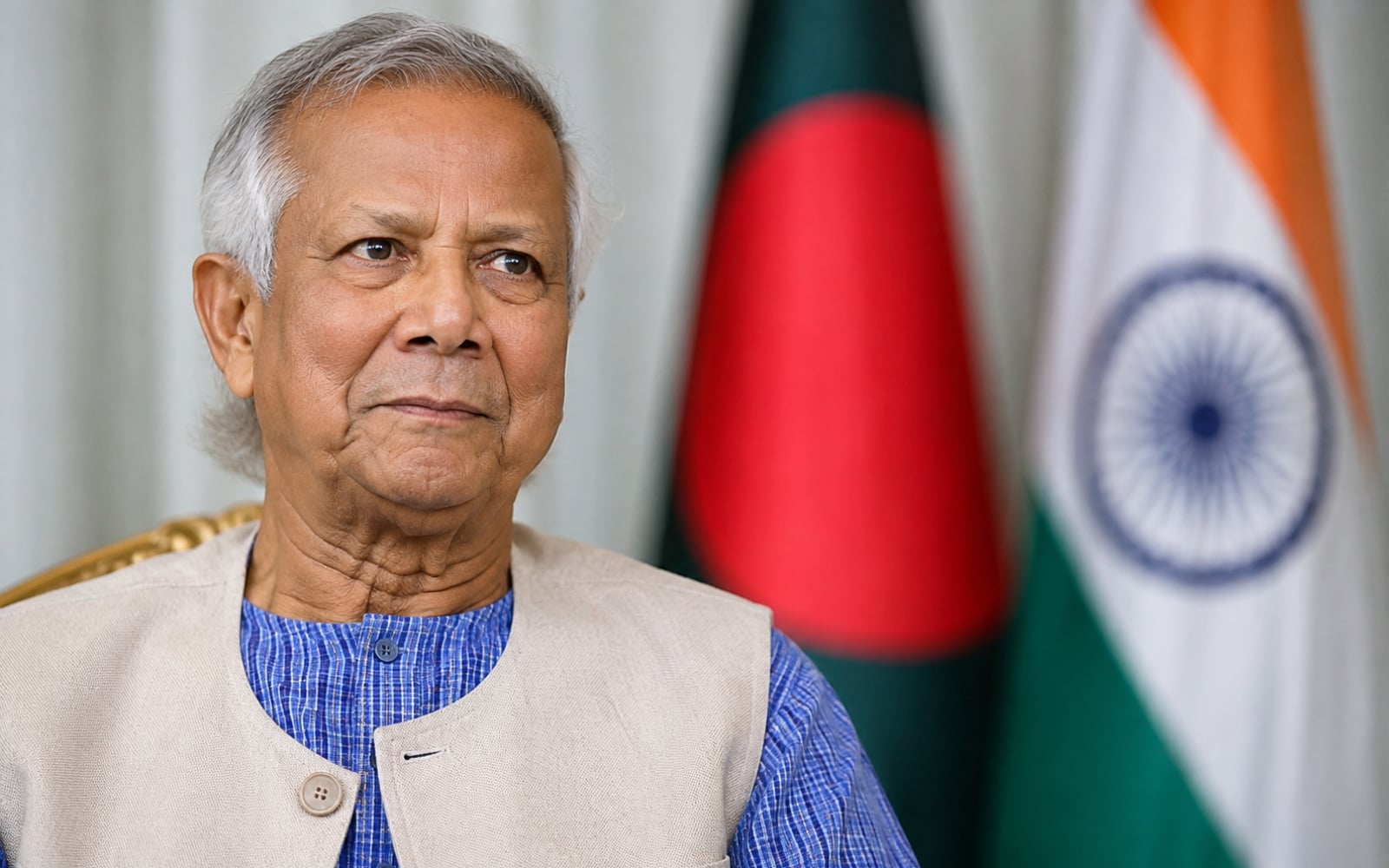
Something unusual has happened in Bangladesh’s presidential race. Muhammad Yunus, who stood at the center of the country’s political transition after Sheikh Hasina’s fall, is no longer at the center of the contest for the presidency.
The ruling Bangladesh Nationalist Party (BNP) is moving toward Mirza Fakhrul Islam Alamgir, the party’s Secretary General, as its presidential candidate. The opposition 11-party alliance has chosen veteran politician Col. (Retd.) Oli Ahmed. The election follows a change at the top of the state, with Speaker Hafiz Uddin Ahmed serving as acting president while parliament prepares to choose a permanent successor.
The election will decide who becomes president, but perhaps the more interesting story is about the man who may not become president.
For months, Yunus’s political future was widely discussed. After leading the interim government, there was speculation that the Nobel laureate could move to the presidency and remain an important figure in the Bangladeshi state. That possibility now appears to be disappearing.
This matters beyond Bangladesh’s domestic politics because the Yunus period also saw one of the most difficult phases in recent India-Bangladesh relations. After Hasina lost power in August 2024, she went to India. Yunus took charge of the interim government, and the political change in Dhaka soon changed the atmosphere between the two neighbors.
Disagreements grew over Hasina, minority rights, border issues, trade and security. Anti-India rhetoric became much louder in Bangladesh. At the same time, provocative rhetoric also came from voices in India. Social media made matters worse.
Some voices in Bangladesh began talking about India’s northeastern states, known as the Seven Sisters, and even Kolkata in territorial terms. On the Indian side, some voices responded with territorial claims involving Bangladesh, including the Chittagong Hill Tracts, a region home to several Indigenous peoples who have faced decades of conflict, displacement and discrimination. Many Indigenous communities there continue to demand equal rights, land protection and political dignity alongside the country’s Muslim majority. It was an extraordinary deterioration in the public conversation between two countries that share more than 4,000 kilometers of border.
The most sensitive moment came during Yunus’s visit to China in March 2025. Speaking about India’s northeast, Yunus described the Seven Sisters as landlocked and Bangladesh as the region’s gateway to the ocean. He invited China to use Bangladesh’s geographical position for economic expansion.
For Bangladesh, this could be presented as an economic opportunity. From India, however, it looked very different. India’s northeastern states are connected to the rest of the country through the narrow Siliguri Corridor. China is India’s most powerful strategic rival in Asia. Bringing China, Bangladesh and the geographical isolation of India’s northeast into the same conversation was therefore bound to alarm New Delhi.
This background makes Yunus’s absence from the presidential contest more interesting. Bangladesh’s presidency is largely ceremonial, and executive power rests with the prime minister. Yet the president remains the constitutional head of state and carries considerable symbolic importance.
If Yunus had become president, he could have remained at the heart of the Bangladeshi state for years. Instead, the two major political camps are looking elsewhere. Fakhrul represents the ruling BNP establishment, while Oli Ahmed represents the opposition alliance. The two camps disagree on many political questions, but neither has turned to Yunus.
There is no public evidence that India blocked Yunus from becoming president. There is also no evidence that Dhaka and New Delhi made a secret deal about his political future. That distinction is important. Speculation should not be presented as fact.
But diplomacy does not always produce a signed document that the public can see. Sometimes changing political interests produce an outcome without any formal agreement. The question, therefore, is not whether India secretly removed Yunus from the race. There is no evidence for that. The better question is whether Yunus’s absence makes an India-Bangladesh reset easier.
For New Delhi, the answer may be yes. India’s concerns in Bangladesh are much bigger than any single political leader. New Delhi wants a stable eastern border. It wants security around its northeastern states. It wants reliable road, rail and trade connections through Bangladesh. It also does not want its strategic competition with China to reach its vulnerable northeastern doorstep.
A less confrontational political climate in Dhaka would therefore serve major Indian interests. But that does not mean Bangladesh loses. Bangladesh does not need to become pro-India, nor does it need to accept every Indian demand. A sovereign Bangladesh should defend its own interests, just as India defends its own.
There is, however, a major difference between disagreement and hostility. The same principle must apply to India. Indian politicians and commentators cannot expect friendship from Bangladesh while speaking about its territory or people with disrespect. The two countries have already seen where escalating rhetoric can lead. Continuing down that road would benefit neither side.
Sheikh Hasina remains another difficult part of the relationship. Her presence in India continues to cast a shadow over ties with Dhaka. Whether she will eventually return to Bangladesh remains uncertain. Yet India does not necessarily need Hasina to return to power to secure its larger interests.
What New Delhi needs is something much simpler: a predictable Bangladesh that can disagree with India without treating India as an enemy. Bangladesh needs something similar from New Delhi: a powerful neighbor that respects its sovereignty while keeping the doors of trade, connectivity and diplomacy open.
This is where geography becomes more powerful than politics. Governments change. Leaders fall. Alliances disappear. Public anger rises and fades. But India and Bangladesh will remain neighbors.
They share rivers, borders, markets, security concerns and history. India needs cooperation with Bangladesh to improve connectivity with its northeast. Bangladesh benefits from access to the huge Indian market and from regional stability. Neither country can move away.
That is why the presidential contest may eventually matter for reasons beyond the identity of the winner. The biggest change may not be the person who becomes president. It may be the political figure who does not.
Muhammad Yunus once stood at the center of Bangladesh’s post-Hasina political order. His absence from the presidential contest does not prove an Indian diplomatic victory, nor does it prove a secret understanding between Dhaka and New Delhi. But it may remove one obstacle to a quieter relationship.
If anti-India rhetoric in Bangladesh declines, if provocative voices in India also become quieter, and if both governments return their attention to trade, security and diplomacy, the presidential transition could mark the beginning of a very different chapter.
That would be good for India. It could also be good for Bangladesh. After two years in which rhetoric sometimes moved dangerously close to territorial confrontation, perhaps the most important victory for both countries would be something much less dramatic: learning once again how to live with each other.
August 11, 2026
Tokyo, Japan