
Clinical Psychology PhD Student, Co-Founder, Chair Jewish Psychology Section, Canadian Psychological Association (CPA)
ZAKA Volunteer, 10.7 Gender Violence Expert May Help Canadian Jews with Antisemitism
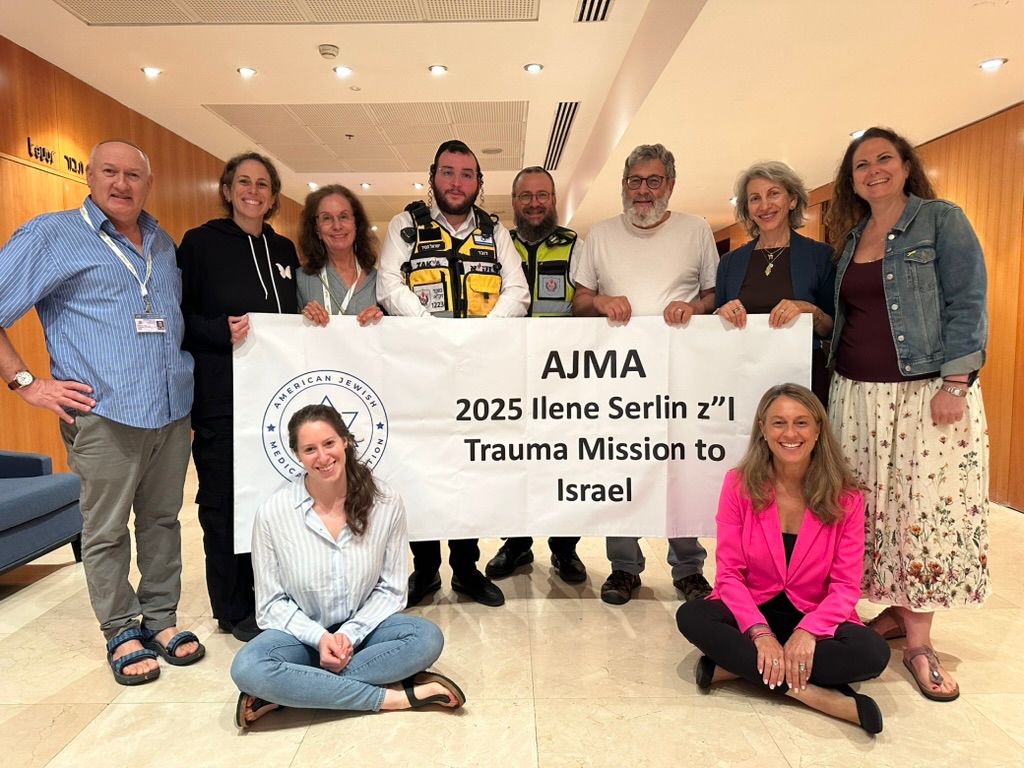
ZAKA spokesperson, Yisrael Chasid (left), and ZAKA volunteer, Simcha Yaffa (right), with American and Canadian mental health professionals, trauma experts, and students on the AJMA Israel Trauma Mission.
“How do you do it?” we asked Israel Chasid, a volunteer with ZAKA who spent the last 18 months going into the areas decimated by Hamas to salvage what was left of the bodies and prepare them for Jewish burial. “When I put on the vest, I’m working. When I take it off, I’m not. We don’t ask too many questions about what happened or how it happened. We don’t want to know the details. When my daughter sees the news and that ZAKA was there, she asks me ‘Were you there?’ I say ‘Who says so?’ Maybe I was there, maybe I wasn’t. I don’t tell my family anything. It helps that I don’t know the details.”
Perhaps this compartmentalization is something that might also help Jews outside of Israel. For Jews in Canada, going to school or work in often hostile environments, not knowing who you can trust can be extremely emotionally draining and even debilitating. As a clinical psychology PhD student studying in Ottawa, Canada I often wonder how I can continue in my program or if I can at all. For example, last week I was assigned a new placement for my clinical practicum and my first thought was how will they react when I tell them that I may be slow to respond to emails because I am currently in Israel in the middle of an active war? Or now that I am looking for practicum sites in Israel so I can complete some of my clinical training here, instead of thinking about what type of training I would like to receive, my first thought was how will the coordinator of practica and internships at my university react? Does she have anti-Israel views? Will she prevent me from having this training opportunity because of her own anti-Israel bias? I thought about how my previous work in the Equity, Diversity, and Inclusion (EDI) space might lend me some credibility, but even that might not be enough to counteract the strong anti-Israel bias among progressive faculty at my university.
But more than these fears and uncertainties is the looming question of how I can continue (with my usual enthusiasm and zeal) to work with, learn from, and treat the very people who so deeply betrayed me. The week after October 7, the co-presidents of the psychology graduate student Equity, Diversity and Inclusion (EDI) group at my university (to which I had whole-heartedly committed myself for the past 3 years) informed me that they would not be able to include Jews in the group’s mission since some Jews identify as White and they are only concerned with racialized groups. They advised me to start my own group for Jewish students.
I did. I started an antisemitism advocacy group to address the explosion of antisemitism at my university. I also started a Jewish Psychology Section within the Canadian Psychological Association. I wrote letters and petitions, attended pro-Hamas events at my university, challenged the speakers, and filed reports on antisemitic incidents. I even changed my research lab and abandoned my dissertation to focus on antisemitism research with a Jewish faculty member. But no amount of positive action could undo the harm that was done by my colleagues, supervisors, professors, and friends who responded to my pain with invalidation, silence, and exclusion.
Until the AJMA Israel Trauma Mission. This mission is named in honor of the late Ilene Serlin z”l, a psychologist renowned for her international trauma work and commitment to healing through the arts. Its purpose is to connect American trauma experts with Israeli clinicians and survivors and to learn from mental health organizations and professionals on the front lines about how Israeli society has responded with innovative therapies for trauma and resilience in the aftermath of October 7 and the new war with the Islamic Regime in Iran. Some of the incredible and creative new approaches for treating trauma included incorporating activities like horse-back riding, surfing, and retreats abroad. Israel is no doubt revolutionizing mental health care and from their pain they will provide the world with yet another gift. But beyond therapy innovations, there was something else that struck me from Israel Chasid and Ayelet Razin Bet Or’s talks that may help Canadian (and all diasporic) Jews on a more fundamental level.
Ayelet shared that since October 7, her role in the intelligence unit of the IDF has been to collect evidence (video footage, testimonials, photos, and forensic evidence) of the sexual abuse of Israeli women and children by Hamas terrorists on October 7, and when she is not doing this, she is presenting this evidence to the United Nations, politicians, organizations, and anyone who will listen. The fact that Ayelet has been exposing herself to such traumatic content for so long without reprieve and that she even chooses to engage further with this material outside of her day job is heroic and awe-inspiring. And I have no idea how she does it, especially when I am struggling simply to engage with my colleagues.
Perhaps one answer lies in Israel Chasid’s vest on / vest off system. In other words, accept that this is the work, focus on the task at hand, and don’t think too much about the details – for example, in my case, this might mean spending less time and energy worrying about the opinions and reactions of those whose eyes, ears, and hearts are already closed to my people’s pain.
Ayelet’s and Israel’s work is extremely emotionally exhausting, draining and traumatic. While our work may look very different, in many ways Canadian Jews, and academics in particular, find themselves in similar positions as their everyday work environments have turned into emotional battlefields – whether it’s trying to defeat a biased anti-Israel boycott, divestment, and sanctions (BDS) motion at a union meeting, receiving a rejection for a grant application because “the research isn’t original enough” (even though it is, it just happens to be in Israel), or voicing concerns about antisemitism only to be stone-walled, gaslit, and ostracized by the very groups whose purported mission is antiracism. Perhaps Ayelet and Israel’s resilience and coping strategies may provide some guidance for Canadian Jews also experiencing rolling trauma.
Related Topics
Related Posts