


Zionism and the Pro-Palestinian Movement: A Hofferian Contrast
Why Zionism Confronts Reality and the Pro-Palestinian Movement Refuses It
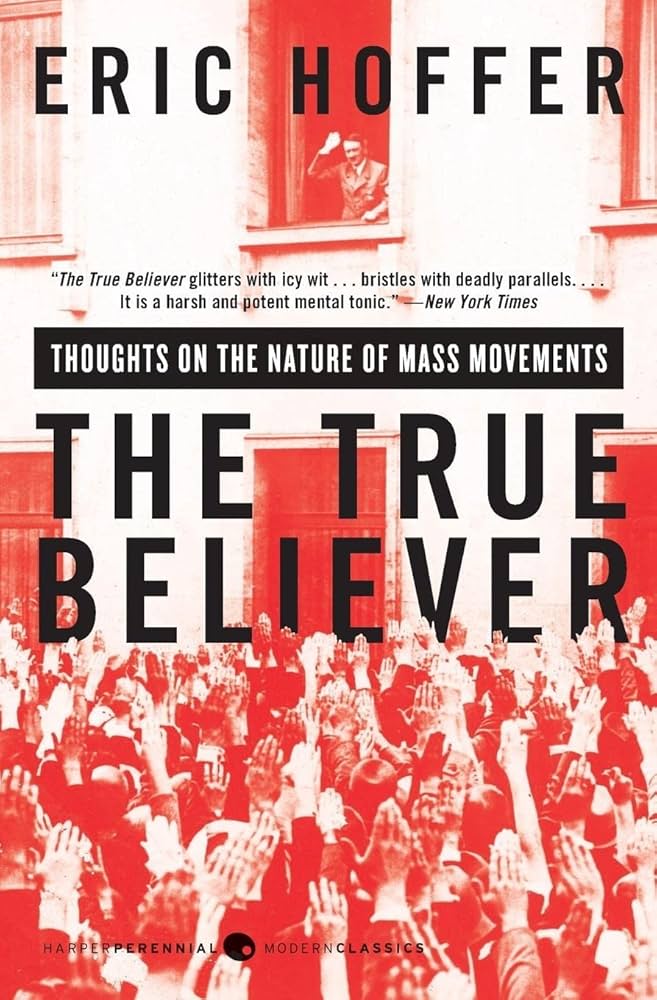
I picked up Eric Hoffer’s book The True Believer, believing it was a general warning about mass movements. It was, but even more so, it’s a book that discerns the difference between a dangerous mass movement and one that can lead to a more stabilizing and innovative society.
Hoffer considered a dangerous movement to be one whose ideals were detached from reality. He specifically emphasized a posture that despised the present. It treats compromise, facts, and complexity as betrayal and as obstacles to its mission to provoke public anger. As such, one of its most important aspects is to require a single enemy capable of absorbing all frustration, failure, guilt, and doubt. “Common hatred unites the most heterogeneous elements.” The movement no longer needs to build anything; it only needs to oppose.
In the eyes of leaders of such a movement, the ideal devil must be omnipresent, vaguely defined, and morally inexhaustible. Hoffer explains that historically, Jews have filled this role with tragic reliability.
The Pro-Palestinian Movement as Case Study
When we look at the pro-Palestinian movement, especially as it appears in Western intellectual, literary, and activist spaces, Hoffer’s framework for the most dangerous types of mass movements maps with disturbing precision.
The pro-Palestinian movement is not oriented toward building viable institutions, governance, or civic responsibility. It is oriented toward purity, outrage, and denial. It requires an enemy more than it requires a plan.
If this were actually a movement for Palestinian statehood, we would expect it to champion Palestinian leaders who tried to build one. Salam Fayyad built institutions, fought corruption, accepted Israel’s right to exist, and pursued a two-state solution. Palestinians voted for Hamas and its leader Ismail Haniyeh. In the 2006 legislative elections, Fayyad’s Third Way party received 2.4% of the vote. Hamas won outright.
The movement does not want peace; it feeds on the permanence of grievance.
The Vocabulary of Symbolic Doctrine
The most dangerous types of movements thrive on doctrines that are vague, unintelligible, and unverifiable. Any opportunity for clarity threatens to break the spell of saviorism. Complexity is artificially introduced through dense, moralized, circular language.
This is especially evident in Western activist spaces. The Palestinian cause operates primarily as a symbolic doctrine where its main arguments and slogans rely on a fixed, hollow vocabulary: colonialism, apartheid, genocide, resistance, decolonization. These words are thrown out as self-evident moral truths rather than historically or legally precise claims, serving to designate an enemy and unite disparate groups through shared hostility. The term “genocide” now applies to a war with a civilian casualty ratio lower than any comparable urban conflict, while actual genocides—Uyghurs, Yazidis, Darfur—generate no sustained campus protest. Anyone who questions the terminology or agenda is considered morally impure.
We see, specifically, that Western academic, literary, and artistic institutions have the privilege to live in spaces detached from the outcomes they endorse. Hoffer understood that these types of movements, so focused on inflating people’s feelings, would champion causes that would erode their own freedoms. He would recognize it as a hallmark of the movements’ intended abstraction. The slogans they chant, the pins they wear, and the banners they hold up do not require them to govern, compromise, or build. It demands only symbolic alignment and moral self-righteousness. Ultimately, Palestine becomes a vessel where Westerners can project their discontent and serve as an opportunity to air their unresolved frustrations about capitalism, identity, hierarchy, and meaning onto one group of people, Israelis, without any consequence. Worse, with praise and applause.
This explains why the same Western and Palestinian activists who celebrate “resistance” have no interest in Fayyad’s actual resistance. A resistance that requires building, governing, and negotiating. For the pro-Palestinian movement, that kind of resistance is insufficiently pure for the rage they feel. It requires working with Israelis. It requires accepting limits and taking accountability.
Zionism as Counter-Example
In contrast, Zionism emerged only after everything had been taken from the Jewish people: their homes, their families, their communities. Zionism does not fit the framework of escapist mass movements. Zionism and the establishment of Israel were a result of the need for safety and security. It did not come from boredom. It came from being stateless, excluded, annihilated. Its organizing logic was pragmatic: land acquisition, labor, language revival, institutions, and defense.
Most importantly, Zionism could not survive as just a symbolic doctrine. It had to build a society by governing and absorbing Jewish immigrants from all over the world who were ethnically cleansed and persecuted. Zionism had to create institutions, defend borders, negotiate internally, and bear the costs of its decisions. It had to confront the reality of survival.
Zionism is not a movement based on certainty and stifling questions. It survives and evolves precisely because it forces society to question itself, to live with life’s contradictions and constant internal arguments. The question between secular and religious visions, between democracy and peoplehood, between universalism and particularism. The creation of the state of Israel recognized the necessity of what its people had lost prior to that and what it demanded it protect: family, language, law, memory, and obligation.
This is why Hoffer describes Israel as “home and family, synagogue and congregation, nation and revolutionary party.” It is life, with all its contradictions intact.
October 7 and the Test of Reactivation
On October 7, the Zionist movement was reactivated by the existential threat to the Jewish and Israeli community. Hoffer notes that collective identities reignite most forcefully under conditions of survival. What makes the current movement even more consequential is its confrontation with the challenging questions of how a people continue to live under constant hostility from a neighbor that has no desire to make peace.
A movement that responds healthily asks questions that seek solutions and real answers. What do we do now? How do we protect people? What are we willing to sacrifice? They require internal conflict that purely symbolic movements cannot tolerate.
The questions being asked inside Israeli society today are agonizing, unresolved, and material. Both within Israel and the diaspora, dialogue and questions revolve around: How does Israel remain democratic without dissolving the logic of Jewish self-determination? How does it wage a necessary war without losing its soul? These are not the questions of a movement intoxicated by certainty. They are the questions of a society that is living with the complexities and consequences of lived reality.
The Dangers Within
This does not mean Israel is immune to the dangerous movements. In Israel today, as it faces external existential threats, it also faces internal risks that fall into the extremes Hoffer describes.
On one end of Israeli society and the Jewish diaspora, there is the radical left’s temptation toward self-annihilation: the belief that Jewish power itself is illegitimate. To many Jews, even prior to the Holocaust, power and sovereignty are moral sins. For many, the opinion is that survival must be bargained away as penance. A loss of faith in the self so complete that existence feels undeserved.
On the other end, there’s a radical right temptation toward dehumanization of the other. Those who believe they are superior to all others, that their way is the only way. That they are entitled to everything and consider all neighbors as enemies, all restraint as weakness, and any opposition as treason.
In both of these extremes, the community abandons what Zionism, at its best, insists upon: dealing with the tension between power and restraint, safety and humanity, and individuality and moral responsibility.
The danger that the Jewish diaspora and Israeli community face is forgetting what Zionism was for: the world of family, work, study, disagreement, creativity, and community. The world of ordinary moral effort, not righteous display.
Zionism, at its healthiest, insists on life, responsibility, and continuity.
The pro-Palestinian movement, by contrast, needs none of these things. It needs only an enemy. And in championing the forces that destroyed Fayyadism, it has done its part to ensure that enemy remains available indefinitely.