
Sharing the Jewish story with the Arab world
Featured Post
Zionism ‘without Arabs’ isn’t Zionism at all
Politicians who say they won't sit with Arab parties aren’t just betraying Israel's principles; they are planning for their own defeat
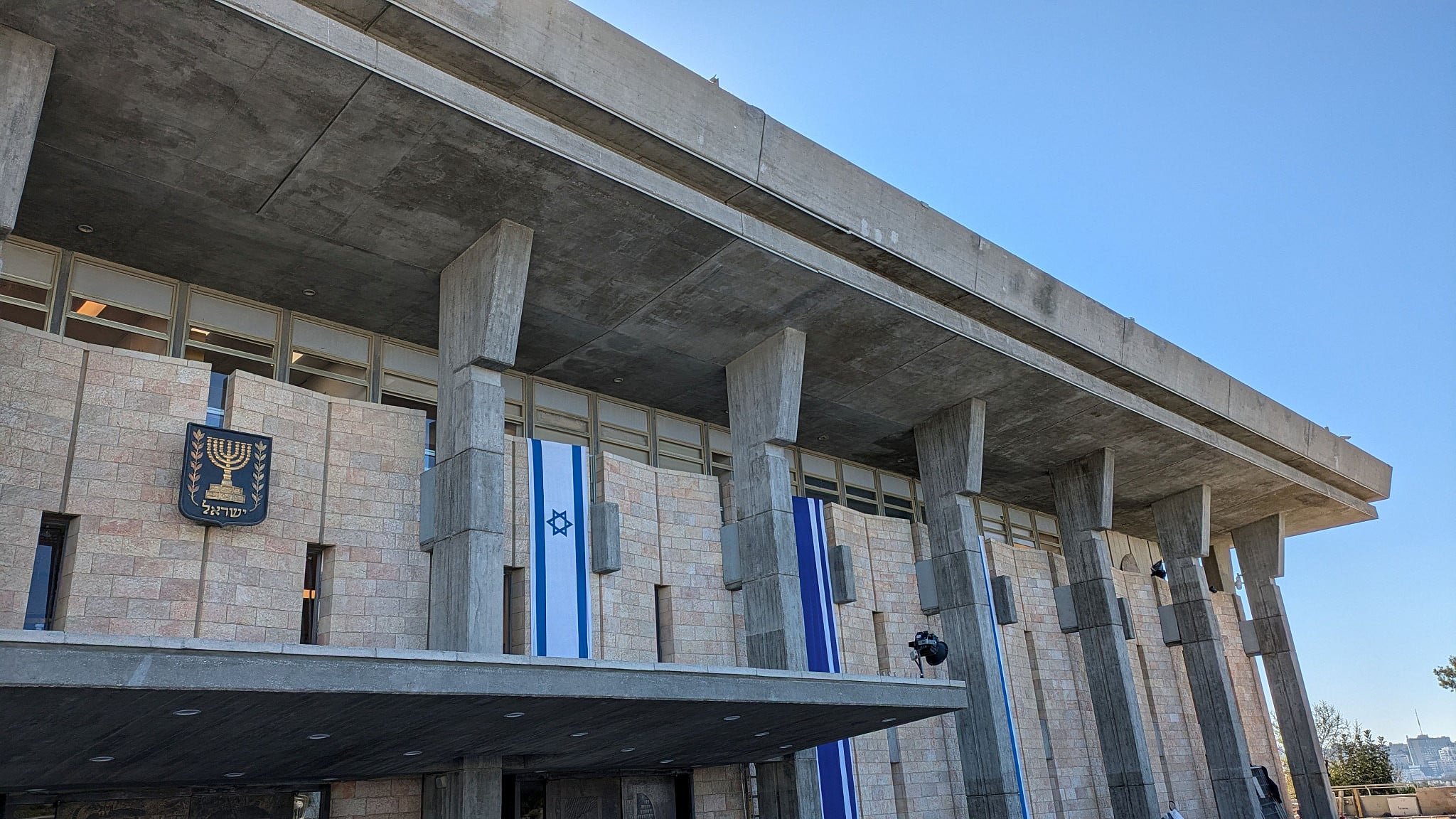
The Israeli Knesset (photo credit: Elhanan Miller)
Many times over the past year, our opposition party leaders have expressed their desire to form a “Zionist government,” while clarifying that such a government could not include ultra-Orthodox or Arab parties. Such a statement not only denies the opposition its best ability to form a government, it contradicts the very principles of Zionism itself. In other words, a “Zionist coalition without Arabs” isn’t a Zionist coalition at all.
In a meeting with Jewish students at Columbia University in March, former prime minister Naftali Bennett claimed that the war in Gaza and current composition of the Arab parties meant “it doesn’t make sense” to incorporate Arab parties in his government. Bennett’s position is strange given the fact that he himself formed a coalition with the help of the Arab Ra’am party just four years ago.
Following the collapse of his government in June 2022, Bennett published an opinion piece in the New York Times titled “A Good-will Government Was Possible in Israel.” In the article, Bennett praised his cooperation with MK Mansour Abbas, whom he described as a “brave leader.” Abbas, Bennett notes, was surprised when he informed him that their meeting would take place openly and not in secret, as Netanyahu had requested of Abbas. “You are not second-class,” Bennett told Abbas. “I am not ashamed to meet you.”
Where has the goodwill Bennett boasted about gone? Or is it his political courage that has faded, unlike that of his Arab interlocutor?
Yisrael Beytenu Party Chairman Avigdor Liberman recently said something similar. In an interview on Israeli public radio in September, the former senior minister explained his refusal to accept Arab partners in his coalition to their unwillingness to serve in the IDF.
“Believers don’t dodge the draft,” he declared, paraphrasing a popular religious pop song. Unfortunately, the interviewer didn’t challenge Lieberman on the injustice and folly of tying the loyalty of Palestinian citizens of Israel to the demand that they fight against their own family members across the Green Line. We Jews are rightly dismayed when the label “Zionist” is cunningly used by our adversaries to mask antisemitic positions. It turns out that we are less bothered by the use of the label “Zionist” in our own political discourse to exclude 20 percent of the country’s citizens on an ethnic basis.
A “Zionist government without Arabs”? That’s an oxymoron. After all, what could be more Zionist than Altneuland, Theodor Herzl’s utopian novel from 1902. One of the leaders of the “new society” that Herzl describes in his book is Rashid Bey, an Arab engineer from Haifa. A fundamentalist rabbi named Dr. Geyer seeks to deny the political rights of non-Jewish citizens in the new state, but loses the election. When Rashid is asked whether he views Jewish immigrants as invaders, he gives an answer that today seems tragically naïve: “The Jews have enriched us. Why should we be angry with them? They lived with us as brothers. Why should we not love them?”
About half a century before the establishment of Israel, Herzl understood that no real difference exits between the rejection of partnership with Arabs as Arabs, and discrimination against Jews as Jews, which he experienced firsthand.
This attitude, we must recall, was not limited to the Zionist left. Ze’ev Jabotinsky, the father of the right-wing Revisionist Movement, argued that the Jewish majority which would eventually take root in the land had an obligation to enact full political equality with the Arab minority:
“The status of an Arab in the Land of Israel should be exactly equal to the status of a Scot or Welshman in Great Britain,” Jabotinsky wrote in an article title Our Land of Israel. “Balfour is a Scot and is proud of his race, Lloyd George is a Welshman and is proud of his race, and both were prime ministers in Great Britain, and so it should be in the future Hebrew Land of Israel. Moreover, we will create an even better situation in the Hebrew Land of Israel: we will not only give citizens complete equality as individuals, but also grant linguistic and national equality.”
And what about our Declaration of Independence? Did Bennett and Liberman forget the clause that states that Israel “will ensure complete equality of social and political rights to all its inhabitants irrespective of religion, race or sex”? Or does “complete equality” between Jews and Arabs only apply to two of the three branches of government, namely the legislature and the judiciary, but not to the executive branch, i.e. the government?
If the Gaza War has hampered the willingness of our leaders to implement our core Zionistic values, then Hamas won the war in the deepest sense.
So far, I’ve only addressed the principled level. But on the practical level too, the exclusion of the Arab parties — a year before the scheduled election date — is nothing less than an act of political madness. Has Netanyahu ever volunteered to declare that he will never sit with Arab parties in the future? I don’t recall that.
Nevertheless, our “center” or “soft right” opposition parties, scared of their own shadows, are already preparing the ground for defeat in the upcoming elections. This is Netanyahu’s true legacy: convincing almost all of his opponents that there is a significant camp in Israel that would rather preserve the October 7th government than vote for a party that does not rule out partnership with an Arab party in principle.
Poll after poll shows that the current opposition has no chance of forming an alternative government without the Arab parties. Therefore, cooperation with at least one such party (the final composition of the Arab lists is still unclear) is a necessity, not a choice.
But why not treat such a partnership as a blessing, rather than an unfortunate imperative? The widespread public disgust with the conduct of the ultra-Orthodox parties during the war has created a rare opportunity for the opposition to do away with Haredi parties as a mainstay of any coalition government. For the first time in years, the “natural partners” of the Israeli right do not seem “natural” to many right-wing voters. Honestly, what makes Mansour Abbas, a dentist by training, a worse health minister than current minister Uriel Bosso of the Shas? If military service the decisive factor, less than half of the coalition Knesset members ever served in the IDF!
Finally, the positive effect that Jewish-Arab partnership could have on Israel’s tarnished international image cannot be overstated. A country accused of genocide against the Palestinians by some of its closest allies, Israel could become a model of political pragmatism and Jewish-Arab political coexistence. Zionism — as our ambassador to the UN, Chaim Herzog, so emphatically argued in late 1975 — is not racism. Here is the opposition’s opportunity to prove it.
Related Topics
Related Posts