
Russian-American-Israeli Palestinian. Palestine is Israel.
Zionistish and Ziophobish: Why the World Needs a Spectrum
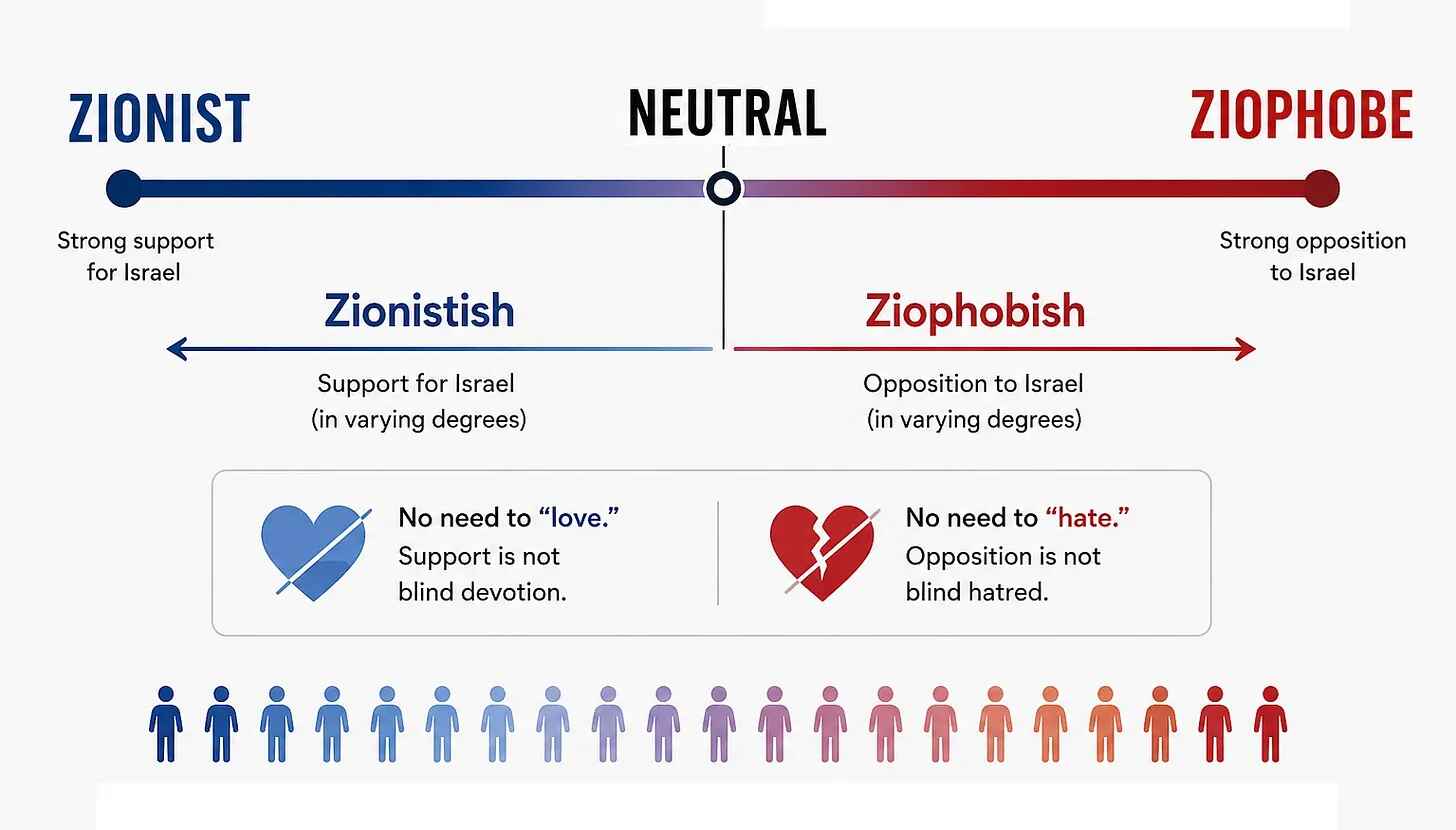
Not everyone needs to “love” or “hate” Israel. Sometimes people are simply… Zionistish or Ziophobish. Image © Ivan Bassov, 2026. Licensed under CC BY 4.0.
Love and hate are extremes. Support and opposition are the reality.
In my somewhat satirical article — satirish, if you will — “I’m Not a Zionist, I’m a Zionistish Person,” I introduced two terms: Zionistish and Ziophobish. I wrote:
We must avoid binary frameworks such as ‘Zionist’ and ‘Ziophobe’ in favor of a more nuanced spectrum of Zionistish and Ziophobish positionalities across the ideological experience continuum. After all, categorical nouns are increasingly discouraged in favor of softer, more gradient-compatible formulations. Nobody should be reduced to a single clearly defined position when a sufficiently long adjectival construction is available.
At the time, it was meant as satire. But let’s face it—perhaps it shouldn’t be. Perhaps these are real terms we need.
In another article, “Why Israel Is Treated Differently,” I wrote:
I do not divide human beings by race, ethnicity, religion, or ancestry. I divide people into only two categories: those who love Israel and those who hate it. Zionists and Ziophobes. Everything else is secondary. And I have far more in common with Arabs who love Israel than with Jews who obsessively demonize it.
Then a reader wrote:
I don’t love. I support. Where would you put me and millions like me?
Exactly. Most of the world cannot be expected to “love” or “hate” Israel—or any country, for that matter. These are extremes, edges that define only a minority of positions. The vast majority live somewhere in between. And that is precisely where Zionistish and Ziophobish come in.
Consider my own experience: I have never been to Taiwan, have no personal ties to it, and have no reason to “love” it. Yet I support it in the context of the Mainland China–Taiwan conflict.
I don’t “love” Ukraine—especially given its history of antisemitism, pogroms, and the tragedy of Babi Yar—but I support it in the context of the Russo-Ukrainian war.
In fact, I do not “love” any post-Soviet country. I never “loved” the USSR or Russia, even though I was born in a part of the USSR now occupied by Russia. See how easily words like “occupied” can be used.
As I argued in “Soulmateland. Bashertland,” birthplace is not necessarily soulmateland.
Love and hate are too strong. Perhaps the same goes for the terms “Zionism” and “Ziophobia.” They are categorical, limiting, and inadequate for describing most people’s relationship to Israel. Zionistish and Ziophobish are useful precisely because they capture the spectrum between full endorsement and outright opposition. They are not just sarcasm—they are descriptive.
Imagine a line, with “Zionist” at one end and “Ziophobe” at the other. Draw the midpoint. One half becomes Zionistish, the other Ziophobish. Support for Israel places you on the Zionistish side. Opposition places you on the Ziophobish side. No need to “love” or “hate.” Most people simply fall somewhere along the spectrum of support or opposition.
This also provides a convenient rhetorical escape hatch for Ziophobes accused of Ziophobia. Imagine Zohran Mamdani saying: “No, no. I’m not a Ziophobe. I’m merely Ziophobish.”
So let me rewrite my previous statement more accurately:
I do not divide human beings by race, ethnicity, religion, or ancestry. I divide people into only two categories: those who support Israel and those who oppose it. Zionistish and Ziophobish. Everything else is secondary. And I have far more in common with Arabs who support Israel than with Jews who oppose it.
With respect to Israel, the world does not need more binaries—despite my earlier temptation to use them. It needs adjectives. It needs Zionistish and Ziophobish. After all, if a sweater can be “-ish,” why not the way we describe ideology? Language evolves, and so should our frameworks for understanding reality. Extremes are rare. Most of us live in the comfortably nuanced middle.
Zionistish. Ziophobish. Finally, words for the rest of us.
As for me, I remain a dyed-in-the-wool Zionist.
—
See Also
Related Topics
Related Posts