
Writing on Jewish life, relationships, trauma, and resilience
Zohran Mamdani’s Selective Outrage: A Disturbing Double Standard
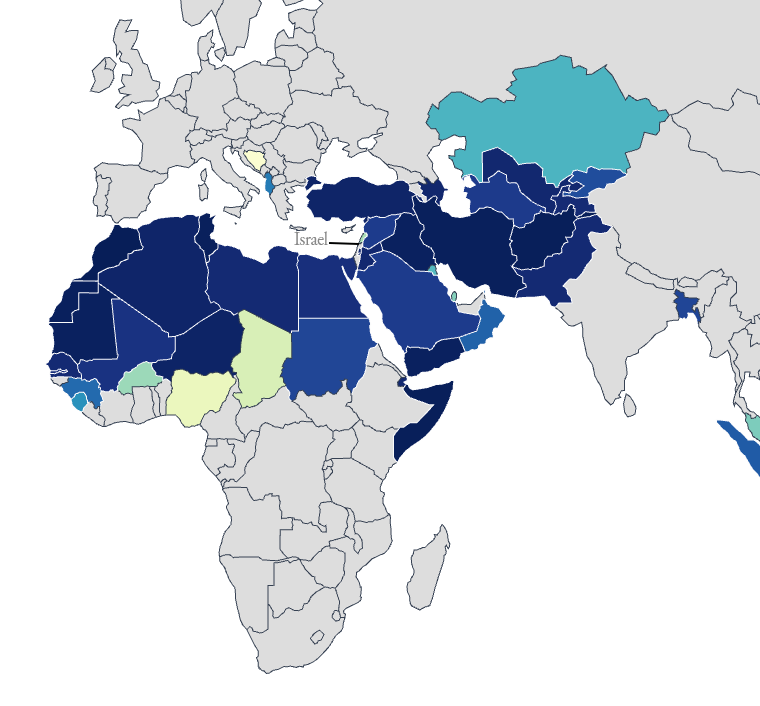
Muslim-majority nations surrounding Israel. Statistics from CIA World Factbook (2020); Graphic courtesy of World Population Review.
“I’m not comfortable supporting any state that has a hierarchy of citizenship on the basis of religion or anything else,” said Zohran Mamdani, the New York City mayoral candidate, in an interview with Ezra Klein at The New York Times published this weekend.
It’s the kind of statement that would seem principled—if it weren’t so selectively applied.
Mamdani, a rising voice in American progressive politics, has been a vocal critic of Israel, advocating for the Boycott, Divestment, and Sanctions (BDS) movement, accusing Israel of apartheid, and refusing to recognize it as the nation-state of the Jewish people. But when it comes to the 50 Muslim-majority countries across the Middle East, Southeast Asia, and Africa—many of which formally enshrine Islam as the state religion and legally marginalize religious minorities—Mamdani’s record is silent.
To be clear, Israel’s policies should be open to debate. Israelis themselves argue vigorously over government decisions, social justice, civil rights, and the role of religion in public life. That is the hallmark of a vibrant democracy. But Mamdani’s unwillingness to apply his stated principles universally raises legitimate questions. It’s not just inconsistency—it’s a double standard that most likely reveals the candidate’s anti-Semitic prejudices.
A Blind Spot in Progressive Politics
Mamdani’s worldview reflects a broader pattern that has emerged among segments of the progressive left: the singular condemnation of Israel while turning a blind eye to far more severe human rights abuses committed by authoritarian regimes—especially when those regimes are Muslim-majority.
Consider the following examples:
-
Saudi Arabia prohibits public worship of any non-Islamic religion. Possession of a Bible can be grounds for arrest. Women were only recently granted the right to drive, and the country continues to be governed by a strict interpretation of Sharia law.
-
Iran systematically persecutes Baha’is, executes homosexuals, and has a legal framework that subordinates non-Muslims. The regime’s slogans still call for the destruction of Israel—a U.N. member state.
-
Pakistan enforces blasphemy laws under which Christians and Ahmadis can be imprisoned—or lynched—for as little as a rumor.
-
Qatar and Kuwait openly bar Jews from citizenship, while Egypt and Syria have witnessed the near-total disappearance of their Jewish populations, not by law, but by the consequence of relentless discrimination, threats, and state-sanctioned incitement.
None of these governments allow internal opposition remotely resembling the freedom Israeli citizens enjoy—Arab and Jewish alike—to protest, publish, or participate in democratic elections.
And yet Mamdani has never publicly challenged these nations. His outrage, it seems, is reserved for the world’s only Jewish state.
The Historical Context: Dhimmitude
This selective concern is not new. Historically, Jews in Muslim lands were not equal citizens, but tolerated subjects—dhimmis—permitted to live under Islamic rule so long as they accepted inferiority. They paid a jizya tax, were barred from bearing arms or building new synagogues, and often lived at the whim of local rulers.
In many cases, they were spared the worst forms of violence—but only if they accepted a rigid caste-like system that placed Muslims at the top and Jews at the margins. That centuries-old precedent remains largely unacknowledged by those who accuse Israel of ethno-religious supremacy.
It’s a bitter irony: Israel’s critics use the language of human rights to condemn Jewish self-determination, while ignoring the systematic religious hierarchies enshrined in many of its neighbors.
Why the Double Standard Matters
Some may argue that criticizing Israel more intensely is justified because of U.S. support or the perceived expectations of a Western democracy. But this reasoning collapses under scrutiny. No one claims that Norway, Denmark, or the United Kingdom—each with official state religions—should be boycotted or delegitimized. No one calls for their dismantlement because bishops sit in Parliament or Christianity is enshrined in the state.
The issue, then, is not a religious hierarchy—but who is practicing it. When the Jewish people do so—especially in the one tiny state that provides them refuge and safety—they are uniquely condemned.
That is not principle. That is prejudice.
It’s the kind of prejudice that, over centuries, denied Jews the right to belong anywhere. It forced them to live on sufferance, subjected to expulsions, pogroms, and genocide. Zionism emerged not as a supremacist ideology, but as a survival movement—an affirmation that the Jewish people, like every other nation, deserve a home where they are not at the mercy of others.
A Call for Moral Consistency
If Mamdani truly believes that religion-based hierarchy is wrong, he should speak out with equal passion against all governments that enshrine such systems—especially those where minorities face systemic persecution, not merely political disagreements.
He should demand accountability from states that stone women, outlaw gay relationships, or arrest converts to Christianity.
And if he does not—if his concern applies only to Israel—then he is not acting from principle, but from bias in the best case. In the worst case, his views and politics are shaped by deeply held anti-Semitic values.
As citizens of a world where antisemitism is again on the rise, where Holocaust denial and Jewish scapegoating are resurgent in both subtle and overt forms, we must insist that critics of Israel be held to the same ethical standards they claim to uphold.
Criticism is welcome. Hypocrisy inspried by anti-Semitism is not.
In the end, Mamdani’s discomfort with Israel says less about the Jewish state and more about a mindset that still struggles to accept one basic truth: that Jews, like everyone else, have the right to be free and secure in their own land.
Related Topics
Related Posts