שְׁמַע בְּנִי מוּסַר אָבִיךָ וְאַל תִּטּוֹשׁ תּוֹרַת אִמֶּךָ
In 1999, Dr. Irene Pepperberg published a study of the research she had conducted proving that parrots have the actual capacity to speak as opposed to just imitate, as was previously thought. The young scientist purchased a one-year-old parrot, and over the course of Alex’s thirty-year life span, Irene worked with him to develop his ability to speak. She succeeded. The implications of this study made a significant splash in a world that had, until then, considered speech the single factor that distinguished humans from animals.
While Pepperberg’s research may have in fact challenged what we thought we knew, the impact of this discovery was minimal. Alex’s ability to speak died along with him. Starting over with another parrot would likely take another 30 years and yield similar results. The investment, both on the side of the scientist and on the side of the animal, bears no perpetual fruit.
Animals are born with instincts that will provide them with all of the information and skills they need to survive. Humans, on the other hand, are born with very few instincts and therefore depend on learning from those who came before them to thrive. This process not only gives them tools to survive, but it also allows them to develop the world around them. Imagine if we could not rely on the accomplishments of the former generations. We, like Alex, would work our whole lives and not get very far, and any progress we would make would die along with us. We would literally have to reinvent the wheel in every generation. Every generation would be a blank slate.
It is not speech that separates us from animals, but rather our ability to communicate in a way that fosters growth. Our capacity to take the knowledge that we have amassed, the experience that we’ve gained, and the achievements that we have attained in our lives, and pass all of that along to the next generation, is what distinguishes us from animals. In short, our potential to first learn from those who preceded us, and then to build on the achievements of others to develop them further, is inherently tied to our ability to communicate.
There are those who like to argue that there is no intrinsic connection between them and anyone else. They assert that they are simply born free, and as such, they can do whatever they please. This is totally false. If you are free, then I must be free as well. What if what I want and what you want are conflicting? Who is “more free”?
This attitude just leads to chaos. It is completely unsustainable because this approach is built on a fallacy. We are not born free. We are born into a preexisting chain, and we must work together to keep this chain going. This “free” man who insists that there is no connection between him and those who came before or after is a hypocrite. He rejects the chain and sees himself as completely independent. He vehemently denies that this chain exists, and yet, he has no problem benefiting from a world that was developed by others. You can’t have it both ways.
עשו was the first to assert that he was a free man. He rejected his place in the chain, the בכורה, and sold it, along with his right to עולם הבא. Taking your part in the chain is what gives you life beyond this world. עשו was more interested in his life here and chose that at the expense of everything else. His descendants עמלק, made this their battle cry. They witnessed the undeniable reality of ה’ being the master of the world, and instead of embracing this reality, they chose to say, “We don’t care; we will make our own reality.” ה’s שכינה can never truly rest in the world as long as עמלק exists because their rejection of reality is the ultimate שקר. This imposes on אמת’s ability to be revealed.
When something is true, it exists, and it will continue to exist forever. Fallacy, on the other hand, will always die out.
The reality is that we are born into a chain that started with the beginning of creation and that will continue until משיח. Our DNA is the physical manifestation of this truth. DNA itself is a chain, a collection of genes passed along continuously for generations. But like our world, which we continue to develop, DNA develops from generation to generation with the addition of new genes.
In this week’s פרשת נצבים, we are given a choice. We can embrace this reality and take on our role as a link in this chain, or we can be like עשו, and cut ourselves off from that which is eternal.
הַעִדֹ֨תִי בָכֶ֣ם הַיּוֹם֮ אֶת־הַשָּׁמַ֣יִם וְאֶת־הָאָ֒רֶץ֒ הַחַיִּ֤ים וְהַמָּ֙וֶת֙ נָתַ֣תִּי לְפָנֶ֔יךָ הַבְּרָכָ֖ה וְהַקְּלָלָ֑ה וּבָֽחַרְתָּ֙ בַּחַיִּ֔ים לְמַ֥עַן תִּֽחְיֶ֖ה אַתָּ֥ה וְזַרְעֶֽךָ׃
We are urged to choose the truth- life, so that by taking on this role of being a link, we and our children have access to eternity. If G-d forbid we choose not to, the chain ends. We are lost, and our children will be too.
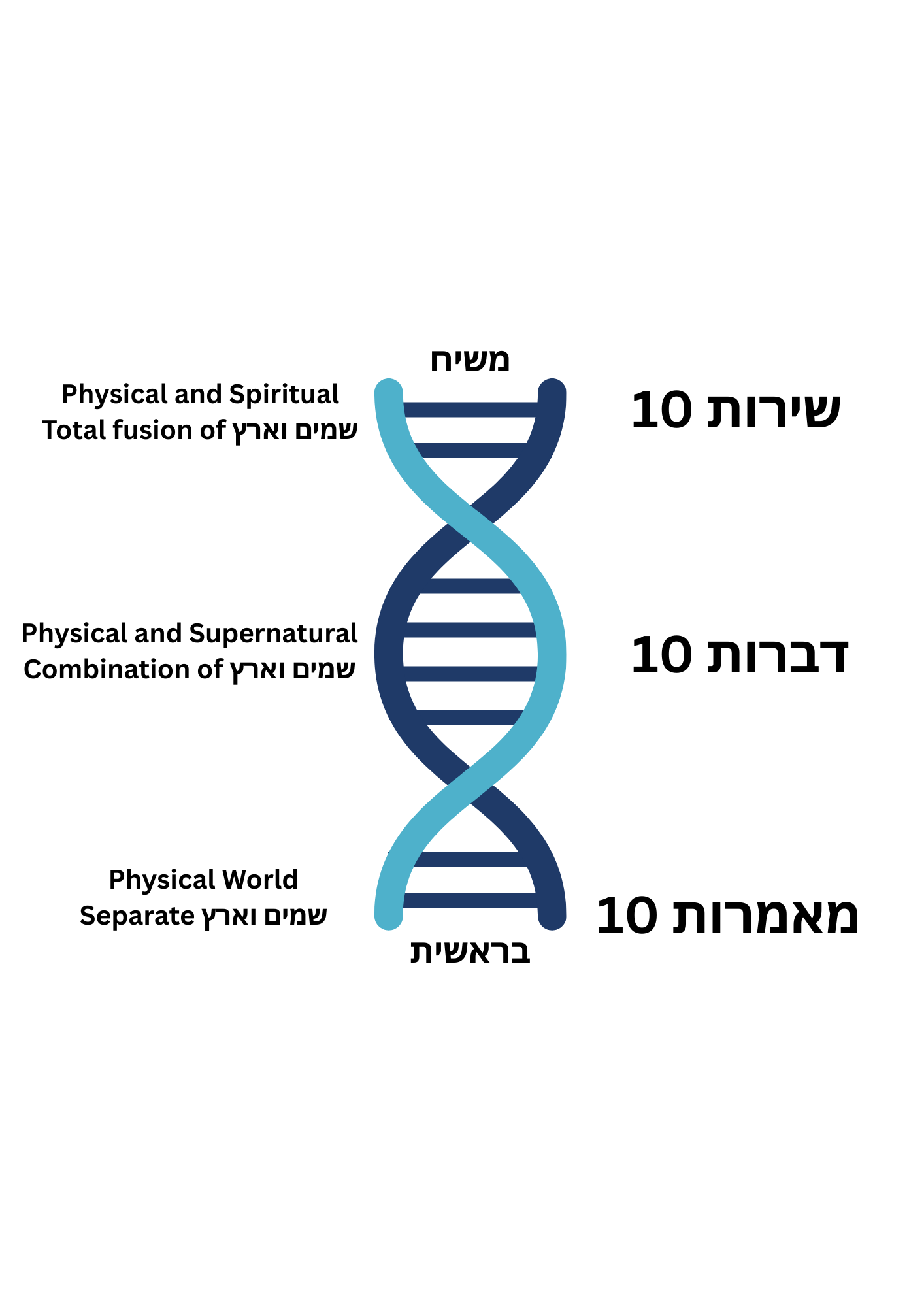
We must embrace our ability to communicate and continue to build. But how do we do this? First, let us acknowledge where this ability comes from. If we go back to creation, we see that creation itself was built through communication. The זוהר teaches that ה’ looked into the Torah and then created the world. פרקי אבות tells us that ה’ used communication- 10 מאמרות to create the world. I understand this to mean that ה’ took the Torah and translated it into the language of Physics. What resulted is the physical world we live in. That is to say that all of the rules of physics, and every manifestation of that, is ultimately a physical expression of the Torah. The chain starts here, with the first expression of Torah on Earth being the physical world. ה’ created the שמים and the ארץ as separate worlds, with the intention that we, over the course of our chain building, will successfully merge the two, resulting in an עולם.
We can only truly build when we have someone else to help us. When we are alone, we max out at our own limitations. When we introduce someone else, suddenly, we have the capacity through a relationship to build something beyond ourselves. The שמים and ארץ are two separate entities, just as a man and a woman are completely independent. And yet, when a couple builds their relationship, they manage to create a child, something beyond either one of them. We are meant to fuse the שמים and ארץ the same way, and the fruit of this relationship will bring about the birth of עולם הבא.
At the base of every relationship is communication. It is what allows us to build. ה’ used it to create the world, and us being created in His image, also build through communication. By engaging with the people who came before us, in order to learn from them and then later to continue their work, and by interacting with the people who come after us to give over what we’ve learned, is what keeps the building going. The reason why generations overlap is because we must all work together in order to bring the world closer to an עולם. We do this through building relationships with one another. By being a link in the chain. We change the world through bonding in the same way molecule bonding results in chemical changes.
One of the primary ways that we pass along information and make it available to the next generation is through writing, which is another form of communication. Writing is great for preserving information; however, it comes with its disadvantages. Firstly, it is one-dimensional. There is no interaction between the writer and the reader. This means that the reader is limited to his understanding of the written word. Secondly, when trying to communicate through writing, one must limit the information to a central line of thinking to make it accessible to a reader. If the writer includes too much information, inevitably, the reader comes out with nothing.
The גמרא in ערבין says that because the Torah has no end, it would be impossible to write it all down. The beauty in our written Torah is that it is written in a way that it is clear that there is much more to it. Through learning and engaging in the Torah and asking questions, we reveal much more than is written down.
Up until our פרשה, the last updated expression of Torah was at מתן תורה when we received the 10 דברות. The לוחות themselves were an expression of Torah that took a more advanced form than the 10 מאמרות. Those, we said, resulted in a strictly physical expression; the לוחות however, were physical and spiritual. They were physical stones with supernatural qualities. This inherent aspect of two separate things working together is also manifest in the fact that they were written לוחות, but accompanied by קולות- speech. Again two things coming together. This expression of the Torah was a reflection of the progress we are making in our chain to connect heaven and earth. But we had a regression. The sin of the golden calf shifted reality back to a place that could not support this expression of Torah. The לוחות had to be broken in order to survive in the new reality.
In this week’s parsha, משה has reached his last day. He knows that his death will shift reality once more. Until now, משה has been essential to Bnai Yisrael’s access to Torah. The last thing he does before he dies is to set Bnai Yisrael up so that they can retain their access to Torah in every manifestation of reality. He must make sure that they have everything they need to keep building the chain. So he writes a sefer Torah, but as we have already established, that is not enough. So משה רבינו gives us the oral Torah as well. The oral Torah fills in the gaps that the written Torah leaves. It also demands effort on our part to make it a part of us. If we can always run to look something up, we never truly make it ours. Oral Torah requires us to relate to the generation that came before us. They learned the Torah when reality took a different form. Because they understood it then, and are living with us in a different reality, they are uniquely suited to give us an updated expression of it. It is their job to translate the Torah into terms that are relevant for us, in our current times. This is essentially what משה רבינו is doing throughout ספר דברים. He is taking the Torah of the בראשית – במדבר and translating it to be relevant to us after his death. The word Hayom appears 11 times in this parsha, as if to impress upon us that the Torah is relevant every day. And then משה tells us, לא בשמים היא! We have all of Torah already. We shouldn’t think we don’t have access to it without him. All we need to do is continue to pass the Torah along the generations, being careful to relate to the next generation and translate it into modern terms that they can understand and connect, allowing them to do the same thing for the next generation after them. משה demonstrates this process in פרשת וילך when he gives the Torah over to יהושע. He empowers him to be the next link in the chain responsible for the next generation. And once he does that, he teaches Bnai Yisrael a song.
The מדרש תנחומא tells us that there will be 10 songs. We have sung 9 of them already, and the last one is known as the “Song of משיח.” The גמרא in סנהדרין says that חזקיהו could have been משיח if he would have sung שירה.
Song is the highest form of communication. It is the ultimate combination of the body and soul. The music is the language of the soul, and the words are the language of the body. We will finally reach עולם הבא when we can express the Torah completely in song. Our chain began with ה’ uttering the 10 מאמרות. He reached out to us first, giving us the world. That was His gift to us. Over time, we became partners with Him and the 10 דברות are in expression of the collaboration between us. Spirituality relating to physicality. Ultimately, when we sing the 10th שירה, we will reach the total fusion of שמים and ארץ into an עולם because this time it will be us giving to ה’, closing the circle of this grand project He set out with in בראשית. A relationship is only truly fulfilling when both parties give to each other, and when they do, magic happens.