London based entrepreneur, cybersecurity analyst doing a PhD in AI
איפה משה היום? | أين موسى عليه السلام اليوم؟ | Where Is Moses Today?
A Clarion Call to all Journalists and Newsrooms - are you Pharoah's press office or giving a voice to Moses عَلَيْهِ ٱلسَّلَامُ ?
Pharaoh’s Guide to Modern Political Leadership
When you cannot answer the accusation, commission a biography of the accuser. A satire on the “modern” press “office”.
The first rule of machiavellian political leadership is straightforward: when someone asks what you have done, explain what is wrong with them.
Have they raised questions about your treatment of civilians?
Investigate their temperament.
Have they produced documents?
Investigate their marriage.
Did the Journalist ask a question about your leadership that touched a “nerve” or you have no answer to?
What a terrible journalist. What a terrible news channel. A gross distortion. “Frankly” if you asked the right questions, your news channel would do better. What a “terrible” question. Which news channel are you from? Which country are you from? Who are you representing? This is “Fake news”.
It doesn’t matter if you wear a Tie or religious dress, a T-shirt or Military stripes, in whatever area or field of choice, the infrastructure of power does not like questions which challenge it’s authority especially when the challenge is correct.
This could be academia, military, politics – and irrespective of country, religion, geography, economic state of the country. I am by no means singling ANY leader out. It applies to all of them, equally, if they behave in this way.
Have they identified a contradiction between your speeches and your conduct?
Find a photograph in which they look unpleasant.
Imagine a modern communications consultancy discovering Pharaoh. Here, at last, is a client who understands the fundamentals: impressive buildings, an uncompromising personal brand, and absolutely no confusion between the national interest and himself.
His difficulty is Moses عَلَيْهِ ٱلسَّلَامُ .
Moses عَلَيْهِ ٱلسَّلَامُ keeps raising the question of oppression. Pharaoh would prefer to discuss Moses.
The Qur’anic account supplies the template.
Pharaoh asks:
“Did we not raise you among us as a child”
— Qur’an 26:18, excerpt, Sahih International
He then brings up Moses’ earlier deed. Moses acknowledges it—“I did it”—before returning to the reality behind Pharaoh’s supposed generosity:
“that you have enslaved the Children of Israel?”
— Qur’an 26:22, excerpt, Sahih International.
Pharaoh wants the conversation to concern an ungrateful individual. Moses عَلَيْهِ ٱلسَّلَامُ brings it back to an enslaved people.
Translated into the language of an imaginary press office:
Before we address these allegations concerning forced labour, the public deserves to know why this individual has failed to express sufficient gratitude for his upbringing.
An excellent opening.
The enslaved remain enslaved, but the conversation has become a discussion of manners.
By nine o’clock, a briefing note has reached selected journalists.
By ten, an anonymous palace source has expressed “serious concerns” about Moses’ character.
By noon, a television panel is asking whether his hostility towards Pharaoh stems from unresolved personal grievances.
Nobody representing the enslaved has been invited. The programme already has a panel: a palace adviser, a former palace adviser, and an independent commentator whose forthcoming book launch is at the palace.
The caption beneath them reads:
MOSES: LIBERATOR OR DISGRUNTLED INSIDER?
The original question has disappeared.
This is the achievement. You need not persuade everyone that oppression is acceptable. You need only persuade enough people that the person mentioning it is suspicious.
When biography proves insufficient, move to presentation.
Pharaoh boasts of his dominion over Egypt and its rivers. Then he turns to Moses:
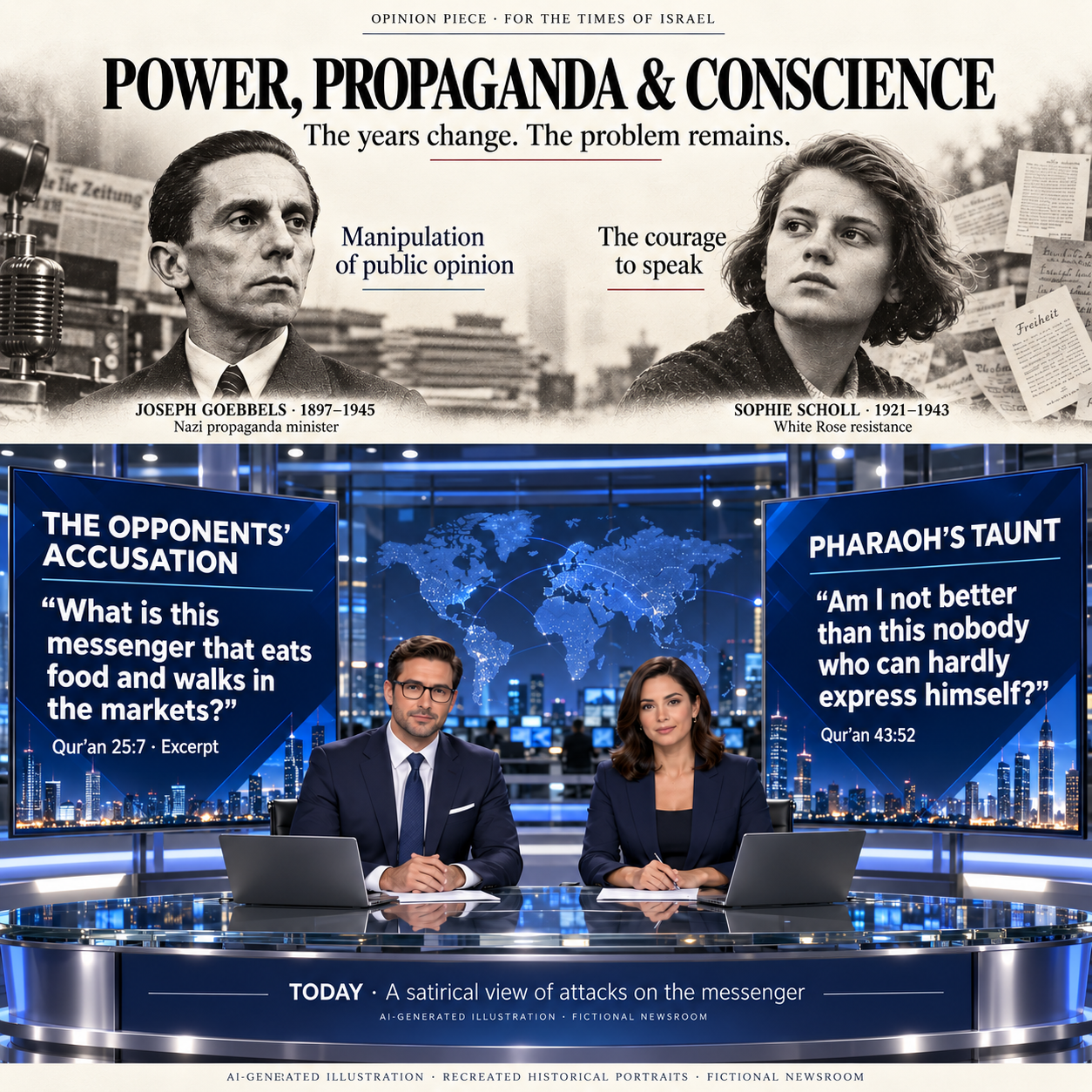
“Am I not better than this nobody who can hardly express himself?”
— Qur’an 43:52, The Clear Quran.
There it is: the sneer, the status comparison, the attack on delivery.
Look at my assets.
Listen to his voice.
Would a credible challenge to injustice really arrive without executive presence?
In the following verse, Pharaoh questions the absence of gold bracelets and an angelic entourage. Status must apparently authenticate truth before truth may question status.
For context, Moses عَلَيْهِ ٱلسَّلَامُ said this famous Dua (prayer) when confronting Pharoah, repeated by Muslims often (especially before exams).
Rabbi ishrah li sadri, wa yassir li amri, wahlul uqdatan min lisani yafqahu qawli. [“My Lord, expand for me my chest, and ease for me my task, and untie the knot from my tongue so they may understand my speech.” — (Surah Ta-Ha, 20:25-28)]
The modern communications team knows what to do.
Find the awkward pause. Crop out the answer. Slow down the hesitation. Select the least flattering frame.
Put the leader beside flags and polished furniture. Put the critic beside a question mark.
Give the leader a statesman’s portrait. Give the critic a thumbnail.
By evening, the public knows everything about Moses’ speaking style and remarkably little about the people he wants freed.
Then comes the diagnosis:
“Indeed, your ‘messenger’ who has been sent to you is mad.”
— Qur’an 26:27, Sahih International.
How convenient. A moral challenge has become a medical suggestion.
An imaginary spokesperson would, of course, express this with considerable sensitivity:
We are concerned for his wellbeing.
So concerned that the remark is distributed to every newsroom before anyone thinks of offering assistance.
The intention is to make listening to him seem irresponsible. His evidence can remain unanswered because his very insistence on presenting it has become evidence against him.
He is angry? Unstable.
He is calm? Calculating.
He repeats himself? Obsessive.
He stops speaking? Clearly, he has nothing more to say.
The beauty of this system is that it cannot lose. Every possible response has already been assigned a damaging interpretation.
The Qur’an records a related repertoire of accusations against Prophet Muhammad ﷺ.
His opponents said:
“This is a magician and a liar.”
— Qur’an 38:4, excerpt, Sahih International.
Elsewhere, the Qur’an answers the allegation of madness:
“You are not, [O Muhammad], by the favor of your Lord, a madman.”
— Qur’an 68:2, Sahih International.
Different labels, the same desired result: make the audience recoil from the speaker before considering the speech.
Consistency is optional.
If he persuades people, he is manipulating them. If he does not, nobody takes him seriously. If he speaks forcefully, he is dangerous. If he speaks gently, he is concealing his intentions.
Whatever happens, the conclusion has already been approved.
One objection is especially revealing:
“What is this messenger that eats food and walks in the markets?”
— Qur’an 25:7, excerpt, Sahih International.
Even ordinary human life becomes grounds for dismissal.
A contemporary headline practically writes itself:
Exclusive: Man Delivering Moral Message Also Requires Lunch.
There would be photographs.
There would be a map of the market.
An investigator would establish that several people who had previously purchased food had also expressed support for him.
An infographic would connect these individuals with red lines.
By the weekend, a columnist would explain that, while eating is not technically prohibited, the optics raise troubling questions.
All this effort, all this ink, all this airtime—and still no answer to the message.
The absurdity belongs to those doing the evading. The prophets’ عَلَيْهِ ٱلسَّلَامُ humanity becomes something their opponents inspect obsessively, hoping never to confront what they are being asked to change.
Our hypothetical modern leader can improve on the ancient model.
Pharaoh had a court. Today’s leader can have a communications director, a research unit, sympathetic influencers and a professionally lit interview about how painful it is to be held accountable.
The operation need not issue a single explicit instruction to lie.
One person circulates a rumour.
Another reports on that rumour.
A third demands answers to the questions raised by the reporting.
The next morning, the original rumour returns wearing a suit: mounting concerns.
By then, the critic is spending every interview denying something unrelated to the evidence they produced.
Their report concerned public money. Their interview concerns their divorce.
Their testimony concerned civilian deaths. Their interview concerns whether they have always used an appropriately measured tone.
The press office calls this “moving the story forward.”
The people affected might reasonably wonder in which direction.
Throughout, maintain two standards.
For the leader, context.
For the critic, perfection.
The leader’s failures require a sophisticated appreciation of difficult circumstances. The critic’s failures reveal everything we need to know.
The leader must be judged over a lifetime of service. The critic can be judged by eleven seconds.
The leader’s private affairs are private. The critic’s private affairs are an urgent matter of national concern.
And if the critic has genuinely done something wrong?
Investigate it.
Misconduct does not become imaginary because someone has challenged powerful interests. A complainant does not lose the right to be heard because their allegations inconvenience a political cause.
People who demand accountability must also face it.
But their wrongdoing cannot automatically absolve everyone they have investigated.
A government cannot answer a case against itself simply by presenting a different case against its accuser.
Both questions may require answers.
There is a further inconvenience for Pharaoh: this principle travels.
It applies to presidents, prime ministers, generals, religious leaders and prosecutors.
It applies when we admire the accused.
It applies when we dislike the accuser.
And it applies to self-described truth-tellers. Being attacked does not prove someone right. Their claims must survive examination.
Ask whether the document is authentic. Ask whether the witness is reliable. Ask whether the quotation is complete. Ask whether the alleged conduct occurred.
Where character bears on those questions, explain the connection. Where it does not, stop presenting gossip as a rebuttal.
The public’s most useful response to an elaborate character assassination may be an unusually short sentence:
And what is your answer to the allegation?
Repeat it after the childhood anecdote.
Repeat it after the attack on the critic’s tone.
Repeat it after the patriotic speech.
A leader who can answer should welcome the opportunity.
At this point, history demands that the satire pause.
The Holocaust—shows the catastrophic consequences of dehumanisation backed by state power. Its history deserves precision, rather than casual comparisons with every political controversy.
Joseph Goebbels, Hitler’s propaganda minister, presided over a system that carried Nazi ideology through newspapers, radio, cinema, books and cultural life. Antisemitic propaganda portrayed Jews as dangerous enemies and helped create public acceptance of exclusion, persecution and violence. Propaganda worked alongside censorship, repression and terror.
This went beyond protecting a leader’s reputation. It helped determine whose suffering the public would recognise, whose testimony it would distrust, and whose disappearance it would accept.
The regime also concealed its crimes. The United States Holocaust Memorial Museum documents how press controls obstructed access to Allied condemnations of Nazi atrocities, while official language disguised murderous deportations as “resettlements.”
Language could make a crime sound like an administrative procedure.
And a carefully arranged spectacle could make persecution look like care.
Before the June 1944 Red Cross visit to Theresienstadt, Nazi authorities ordered an elaborate beautification of the ghetto. They deported prisoners to reduce overcrowding, prepared appearances and staged what visitors would see. The resulting inspection helped conceal the reality of persecution and mass murder.
There is a terrible lesson here for anyone who mistakes access for verification.
A camera can record exactly what stands before it and still convey a lie about everything kept outside the frame.
But there were Germans who refused the regime’s account of reality.
One was Sophie Scholl.
She belonged to the White Rose, a resistance group whose members included her brother Hans, fellow students and a university professor. They produced and circulated leaflets challenging Hitler’s regime. The group explicitly opposed Nazi genocidal policies and confronted their fellow Germans’ indifference to the regime’s crimes.
Against a state commanding broadcasting, newspapers, police and prisons, they distributed sheets of paper.
A propaganda ministry on one side.
A leaflet on the other.
The White Rose declared:
“We will not be silent. We are your bad conscience.”
— White Rose leaflet, quoted by the United States Holocaust Memorial Museum.
On 18 February 1943, Hans and Sophie distributed leaflets at the University of Munich. Sophie pushed a stack into the central hall from above. A janitor saw them and reported them; they were arrested.
Four days later, following proceedings before the Nazi People’s Court under Roland Freisler, Sophie, Hans and Christoph Probst were sentenced to death and executed by guillotine.
The regime treated their resistance as treason.
Today, the Scholls are commemorated in Germany through schools, streets and memorials.
But Sophie did not act with a memorial behind her.
She acted with the Gestapo ahead of her.
We encounter her story knowing how history will judge the regime. She had to make her choice while that regime still possessed the power to kill her.
That is the difference between admiring courage afterwards and exercising it at the time.
The White Rose did not overthrow Hitler. Its members nevertheless demonstrated that recognising evil and refusing cooperation were possible, even under terrifying conditions.
Their example leaves us with an uncomfortable question.
When we celebrate people who resisted yesterday’s propaganda, are we also learning to examine the claims that flatter our loyalties today?
Remembering the Holocaust demands that we confront antisemitism, preserve historical truth and take dehumanisation seriously. Remembering those who resisted also asks something of our conduct: whether we will defend another person’s humanity before doing so becomes safe, respectable and universally applauded.
It is easy to lay flowers where courage once stood.
The harder task is to stand beside it while it is still being accused of betraying the nation.
There are the likes of Pharaohs and the likes of messengers عَلَيْهِ ٱلسَّلَامُ holding the truth amongst us today.
These are moral archetypes; no contemporary official acquires prophetic authority by opposing a government. The comparison asks us to recognise conduct: the arrogance that demands submission, and the courage that challenges oppression.
We can recognise something of Pharaoh wherever power treats accountability as an insult, confuses the ruler with the nation, and makes the critic’s destruction more urgent than the public’s protection.
We can recognise something of Moses’ عَلَيْهِ ٱلسَّلَامُ courage in those who speak for people whose suffering the powerful would prefer to keep off the agenda.
The difficult part is recognising either when they stand among our own friends.
Everybody enjoys finding Pharaoh in another country, another party, another religion.
Few imagine themselves in his briefing room.
Yet helping those like Pharaoh is often easier.
Pharaoh has the invitations, the introductions, the contracts and the reassuring majority. His version of events arrives on headed paper. His supporters call compliance maturity and silence good judgement.
Helping those like Moses عَلَيْهِ ٱلسَّلَامُ may cost something. They may not be perfect, and they don’t have to be today. I am not comparing an ordinary human being holding the truth to the examples of the messengers عَلَيْهِ ٱلسَّلَامُ. But they carry the same kernel of truth, the same irritation to injustice, the same passion to see a better, more just society. Give them a chance to speak, to hold office, listen to their ideas of a better future. Don’t dismiss them.
They are still standing like a shield in front of the vulnerable, those that don’t have a voice, often at the cost of their own lives, families, and reputation.
It may mean asking an unwelcome question in a room where everyone else has agreed to applaud. It may mean defending a person’s right to be heard when joining the mockery would be socially convenient. It may mean preserving evidence, correcting a falsehood, or refusing to forward an insinuation about someone you already dislike.
It also means correcting the person you support when they are wrong. Loyalty to truth requires that much. And you are doing that person and the world a favour. Even if they don’t like your advice, you may stop them standing in front of a Tribunal one day. Medicine cannot always be “sugar coated”.
Our responsibility is to stand on the right side of history while the choice is still difficult—to help those holding the flag of Moses عَلَيْهِ ٱلسَّلَامُ of truth and justice, when helping those like Pharaoh is easier.
History becomes comfortable once the monuments are labelled and the villains safely dead.
The test comes earlier, when Pharaoh is respectable, the palace is hiring, and Moses عَلَيْهِ ٱلسَّلَامُ is being described as a problem.
Sophie Scholl could not wait for history to make her choice respectable.
Neither should we wait for universal approval before defending the truth.
We should ask whose burden our words lighten, whose suffering our silence prolongs, and whether our appetite for scandal has helped someone powerful escape an answer.
Pharaoh’s greatest public-relations asset is an audience delighted to discuss Moses indefinitely. Do not be of those people. Consider this your “intellectual vaccine” against such propaganda.
His upbringing. His past. His speech. His standing.
Everything except the people he came to speak for.
So, by all means, leave no stone unturned.
Begin with the one covering the evidence.
Author’s note :-
I don’t recommend reading Machiavelli’s Prince or condone any of these practices.
None of this is directed at any country, government, or group of people directly.
The second thing to note, amongst the oppressed, there may be people who “pay no heed to their plight” but enrich themselves instead.
The Quran addresses this :-
To be sure, Qarun (Korah) was one of Moses’ people; then he transgressed against them. We had bestowed on him such treasure that their very keys would have been raised with difficulty by a whole group of strong people. Once when his people said to him: “Do not exult, for Allah does not love those who exult (in their riches). Quran (28:76)
So, truth is always not linear.
Countries & News Channels need to seriously consider why traditional “news broadcasts” are not being consumed and people are turning to social media instead which opens them to the risk of even more false information, echo chambers and manipulation due to the unregulated nature of these channels despite governments doing their utmost to sanitise them.
A big thank you to the Times of Israel for publishing this and other similar pieces from me and other authors – which helps balance power, create a more just society, and helps people from all around the world learn religious and secular knowledge.
Related Topics
Related Posts