
1,000 Days Since Oct. 7 & the Torah Study Law
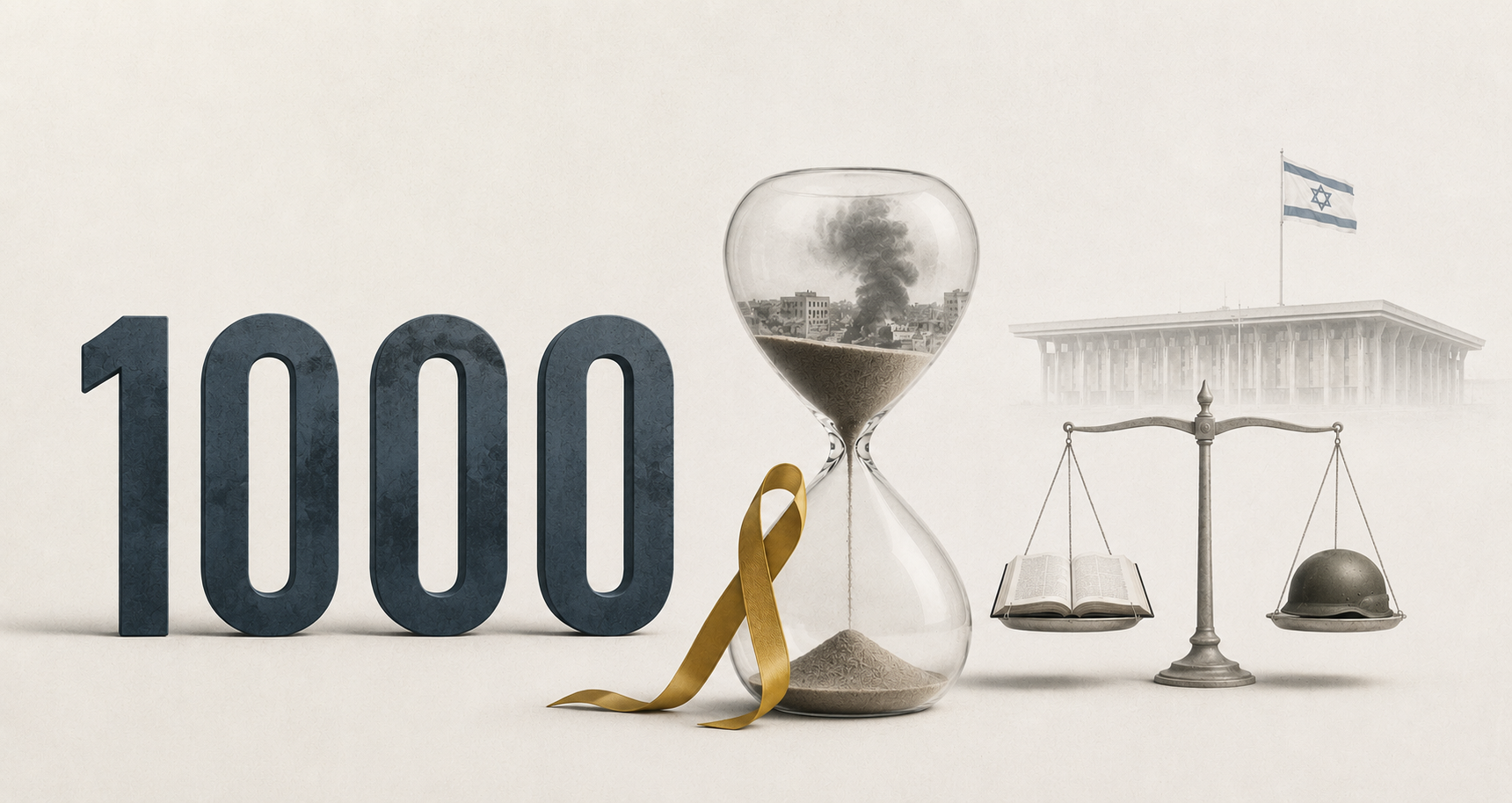
Today marks 1,000 days since the tragic events of October 7, 2023. It has been 1,000 days since the failure that led to the massacre. We remember the hostages and honor the heroism of hundreds of ordinary citizens who saved dozens of young people from the hands of Hamas. Moreover, these are 1,000 days of an ongoing war, with grueling, open fronts in Gaza, the West Bank, Lebanon, Syria, and Iran.
Passing a Law That Deepens the Wound
In this painful and volatile context, yesterday, July 1, 2026, the Knesset plenum passed the controversial Basic Law: Torah Study (Hok Yesod: Limud HaTorah) in its first reading, with 63 votes in favor and 53 against. Promoted by MKs Moshe Gafni and Yaakov Asher, this legislation seeks to establish a constitutional precedent with profound implications.
Declaratively, the law establishes Torah study as a fundamental value in the heritage of the Jewish people and the State of Israel. However, the underlying intent is to use this declaration to create an artificial “balance of justice” against other constitutional values and rights in the country.
In practice, by legislating Torah study as a fundamental value, the true goal is to constitutionally anchor the military draft exemption for yeshiva students. This ensures they continue receiving state financial benefits.
Jewish Identity vs. Civic Duties
Anyone can understand why, in the Jewish State, Torah study holds an incalculable and unquestionable value as a pillar of national identity. Yet, a valid question arises: Why should this noble pursuit exempt students from their civic duties and from defending their country? Furthermore, who claims that the Haredim are the only ones studying Torah? The law’s phrasing suggests the State of Israel views a very small group of people as the sole, authentic bearers of Jewish tradition. This assumes a monopoly on religious interpretation, ignoring the fact that Torah study belongs to the entire nation.
Sectoral Anarchy and Political Priorities
It is no coincidence that, 1,000 days after the terrible October 7, the current coalition government focuses its greatest efforts on self-preservation. We are witnessing the Likud -a party with liberal and secular roots- systematically caving to the constant pressures of the different coalition sectors. A dangerous sectoral anarchy plagues this government. Each coalition faction operates as an independent fiefdom, prioritizing its own interests over the rule of law, democracy, and the lives of our soldiers.
We have witnessed this dynamic through severe incidents. MK Zvi Sukkot entered Nablus for a political campaign, unnecessarily risking the lives of IDF troops. Similarly, Haredi extremists have attacked the home of a Supreme Court justice to intimidate the judiciary. Meanwhile, the Likud party itself demanded its MKs violate the secret ballot law during the State Comptroller election by having them photograph their ballots to prove “loyalty”—despite explicit prohibitions from the Knesset’s legal counsel.
Abandoning the Reservists and Public Backlash
However, the Basic Law: Torah Study is even more sensitive because it strikes a nerve that hurts the vast majority of Israelis, including Likud voters. According to polling by the Israel Democracy Institute (IDI), an overwhelming 84% of the non-Haredi Jewish population supports and demands the drafting of Haredi men into the military. This national consensus stems from a matter of strict survival: Israel urgently needs soldiers. IDF Chief of Staff, Lt. Gen. Eyal Zamir, has warned that the military immediately requires some 15,000 additional soldiers.
How does this government respond to this crisis? Not only does it refrain from drafting the Haredim -condemning reservists to accrue more days of exhausting frontline service- but it also elevates the legal status of Torah students to guarantee their continued state funding.
It is worth mentioning the harsh words of Likud MK Dan Illouz, who stated that “the purpose of this law is to allow continued benefits for draft evaders”. He argued this is the near-literal definition of using the Torah for personal gain and desecrating God’s name (Hillul Hashem).
Illouz voices the astonishment of many Israelis facing a government that passes such a highly unpopular law, with a virtually dissolved Knesset and elections just around the corner.
The Radicalization of the Haredi Leadership
Against this backdrop, it is imperative to analyze what is happening with our Haredi brothers. The ultra-Orthodox leadership views this legislative battle as an authentic holy war. This is reflected in one of its main daily newspapers, HaMevaser, which adopts an extremist editorial tone whenever the Supreme Court or the government attempt to advance the draft. They deliberately deploy terminology drawn from the darkest eras of Jewish persecution such as “evil decrees” (gzeirot), crusades, or wars of survival to mobilize their community against what they perceive as the secular state’s attempt to destroy their identity.
This rigid, confrontational stance extends beyond the newspapers. At a rally in Bnei Brak this week, Israel’s former Chief Rabbi, Yitzhak Yosef, insinuated that Torah students are the true defenders of the country, and that wartime casualties are likely due to the government’s “decrees” restricting religious students.
Concurrently, Rabbi Aryeh Yazdi viciously attacked IDF Chief of Staff Zamir, exclaiming: “May the curse blot out his name and memory!” (Yimach Shemo V’Zichro). He accused him of jailing a soldier over religious issues, asserting that the army of “this impure country” teaches the gravest offenses against the Torah. Alarmingly, four Shas MKs attended the event and listened to these remarks.
Although Prime Minister Benjamin Netanyahu condemned Yazdi’s statements, it is clear that the Haredi leadership has escalated its rhetoric to a dangerous point where civil violence could be the next step.
The Immense Challenge of Staying Together
The social tear we are witnessing today adds immense weight to the collective trauma of these 1,000 days of war. Fury and anger are entirely natural reactions to the brutal inequality in shouldering the nation’s burden, but clinging to resentment will not offer us a way out. The supreme challenge of the State of Israel today lies not only in defeating external enemies on multiple borders, but in discovering how to live together harmoniously within them.
Despite the deep discrepancies and painful political maneuvering that divide us, we cannot allow our shared home to collapse from within. Continuing to live together will require a monumental effort of mutual empathy. We must recognize and respect the immense value of preserving Jewish spiritual tradition, but always under the unwavering understanding that the burden of sustaining and defending national life must fall equitably on everyone’s shoulders. Israel’s true survival will depend on its capacity to be, truly and practically, one single people.