
12 Years Later: Europe’s Energy Paradox, Tusk Return and Just Transition
In September 2014, over a hundred meters below ground in the historic salt chambers of Wieliczka, Poland, a remarkable dialogue took place. Convened by the Rosa Luxemburg Foundation, climate scientists, progressive thinkers, and representatives of Polish coal mining trade unions sat together to confront Europe’s gathering storm. The discussions centered on a foundational premise that mainstream Brussels technocrats frequently overlooked: energy policy cannot be treated as a detached macroeconomic exercise; it is intrinsically tied to social structures, regional identity, and distributional equity.
A few months later, in December 2014, on the eve of COP20 in Lima and amidst Donald Tusk’s departure from Warsaw to assume the presidency of the European Council, I published an analysis titled European Climate and Energy Policy from a Social Perspective. In that essay, I framed the continent’s climate dilemma through two premises: C is for Climate and E is Principally Europe—the latter deliberately echoing the social justice ethos that “housing and basic dignity precede abstract mandates.” During that subterranean conference, when I asked a union leader whether Tusk’s move to Brussels presented a strategic window to negotiate a funded, equitable national transition, his dismissive retort captured the chasm between industrial labor and European institutions: “Who is Tusk? He is just an economic migrant in Brussels.”
Twelve years later, in November 2026, history has turned full circle—yet the structural contradictions have only sharpened.
The Full-Circle Odyssey of Donald Tusk
Donald Tusk is no longer the “migrant worker” directing consensus in the European Council. Returned to Warsaw as Poland’s Prime Minister, Tusk now sits precisely where the rubber meets the road. In 2014, the consensus among Polish unions was that Kaczyński’s Law and Justice (PiS) party would stall renewable adoption and shield coal—an accurate projection that dominated the subsequent decade. Today, Tusk’s coalition faces the formidable task of steering Poland through an accelerated phase-out, targeting a coal exit while wrestling with deep political polarization, union resistance, and the fiscal realities of replacing aging thermal infrastructure.
The ironies are inescapable. The very leader who once symbolized Brussels’ top-down supranational compromise must now manage domestic industrial towns where miners still perceive climate targets as an existential economic threat rather than an ecological emancipation.
Geopolitical Shocks and the Fossil Trap
The 2014 article highlighted how external shocks and perverse price signals can distort European ambitions, recalling how cheap American coal flooded European markets as U.S. domestic shale expanded.
Over the past four years, following Russia’s full-scale invasion of Ukraine, Europe experienced an energy crisis of far greater magnitude. The sudden severance from cheap Russian pipeline gas forced a frantic continent-wide scramble. While it catalyzed unprecedented investments in wind, solar, and grid modernization, it also led multiple capitals—including Berlin—to temporarily ramp up coal and burn through emergency fossil reserves. Europe learned the hard way that when geopolitical volatility hits, abstract climate frameworks collapse into raw national energy security unless underpinned by sovereign, socially protected renewable systems.
From Carbon Budgets to Living Budgets: The Youth and Social Backlash
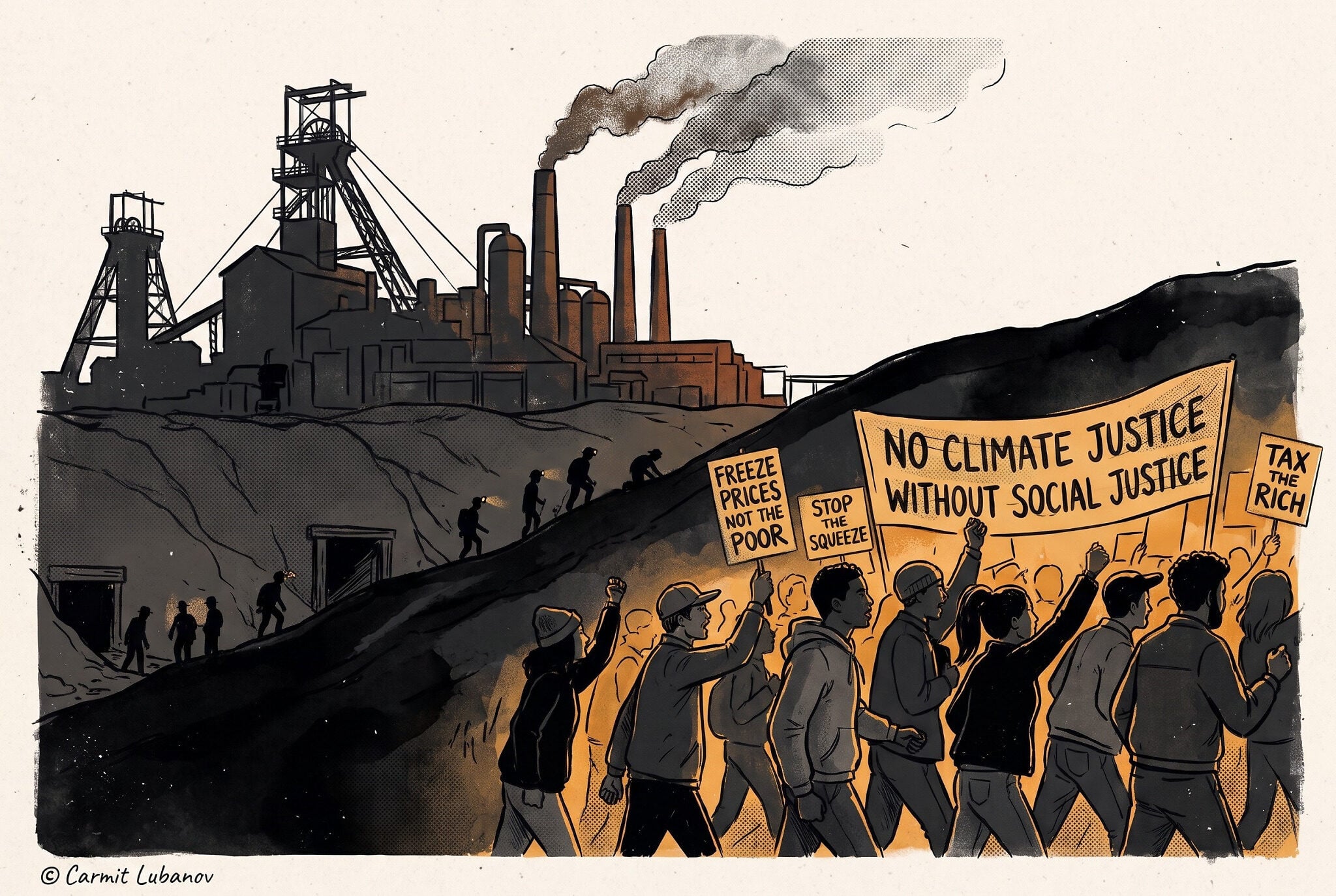
From Paris and Rome to Madrid, Brussels, and Milan—and crucially across Warsaw and the industrial heartlands of Katowice and Silesia—hundreds of thousands of citizens, students, and trade unionists have mobilized against crippling living costs, unaffordable housing, and soaring utility bills. In Poland, where Donald Tusk’s fragile governing coalition navigates a fractious domestic political landscape, the strain on working-class households rooted in legacy energy sectors is palpable. These protests reveal a decisive shift: climate concerns have converged with acute material hardship. When escalating energy tariffs inflate basic living costs, the climate crisis ceases to be a distant policy forecast; it manifests as an immediate cost-of-living emergency. The public is voicing what was forewarned in Wieliczka: durable climate progress cannot be built upon the economic precarity of ordinary citizens while fossil subsidies and speculative windfall profits remain entrenched.
Reclaiming Just Transition
Europe in late 2026 finds itself at an existential crossroads. The EU’s ambitious decarbonization pledges cannot succeed through bureaucratic directives or carbon-pricing mechanisms alone. As long as energy transition is experienced by workers in Silesia as industrial abandonment, and by households across the continent as unaffordable heating and power, climate policy will face enduring backlash.
The lesson from 2014 to 2026 is unambiguous: E is for Europe, and Europe is its people. A genuine, sustainable socio-ecological transition must simultaneously serve as an economic equalizer—one that guarantees affordable public energy, secures regional livelihoods, and recognizes that environmental justice and social justice are inseparable dimensions of the very same struggle.