A Moroccan Journalist
1948: Two Suns Over One Land
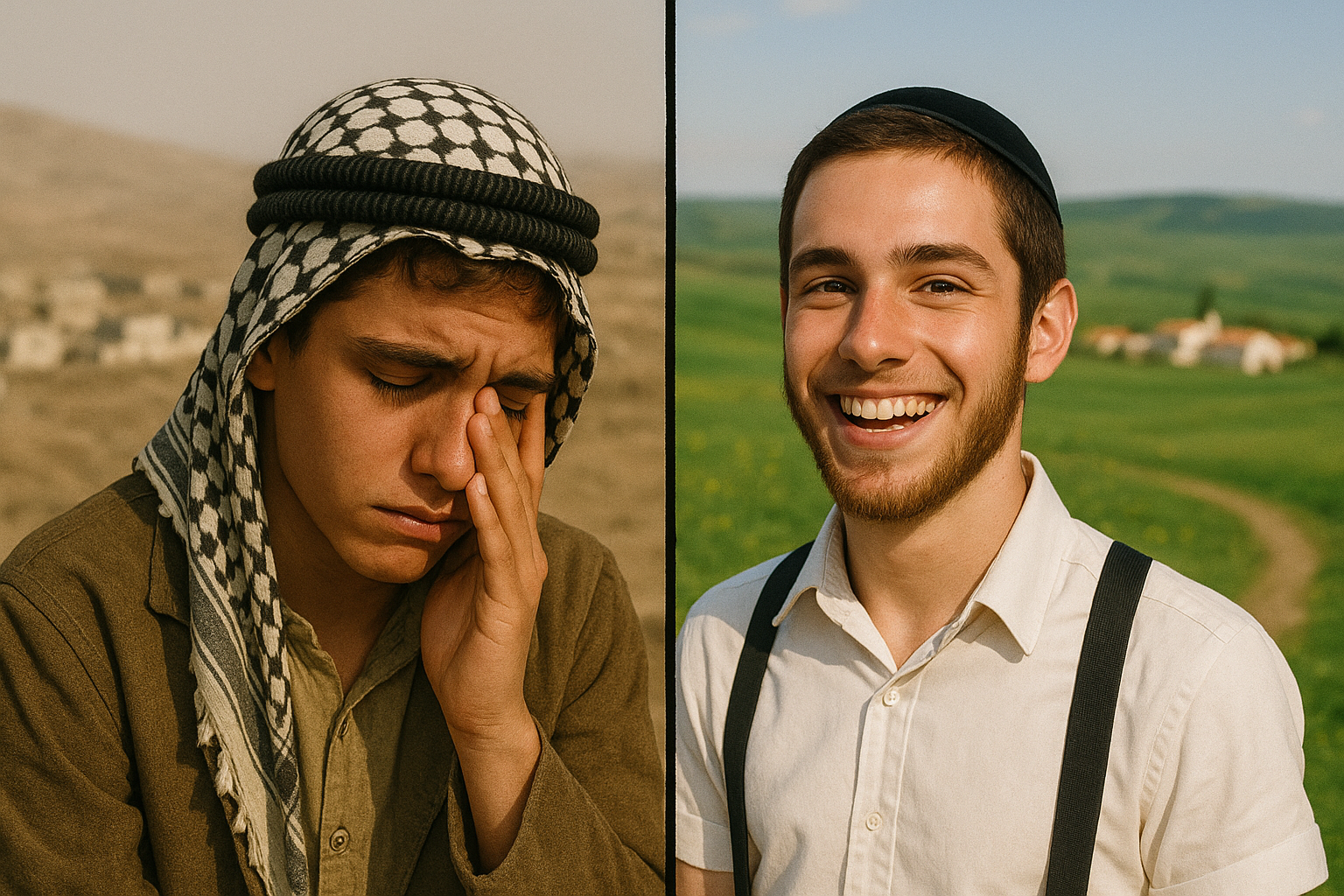
Two faces of 1948 – one smiles at a homeland gained, the other weeps for a homeland lost. (AI-generated)
In 1948, the State of Israel was established, marking the end of Jewish exile and centuries of persecution, including the Holocaust. For Palestinians, the same year became al-Nakba – “the catastrophe” – when over 700,000 people were displaced, hundreds of villages destroyed, and an entire nation scattered in exile. One birth, one loss – two truths intertwined.
I. Ibrahim – the Palestinian
I am Ibrahim, son of olive trees older than empires, born in a house with a jasmine gate in Al-Lydd.
The year was 1948 – عام النكبة (‘Am al-Nakba, “the year of the catastrophe”). The year the sky broke open and names were erased like chalk in the rain.
They came at dawn.
We heard the bullets before we saw the faces – men shouting words we did not understand, words like “Eretz” and “Tzva.” My mother screamed “يا رب!” (Ya Rab! – Oh my Lord!) while my father held the Qur’an against his chest as if verses could stop fire.
We buried our dead in haste, in silence.
We left the key in the lock, thinking we would return in a week.
We never did.
Now I walk, barefoot, over stones that once knew my name.
They say the land is theirs.
But tell me – can you own the dust that holds your grandfather’s bones?
Can you name God differently and claim He changed His address?
They call us “refugees.”
I call myself ظلّ الوطن (Zill al-Watan – the shadow of a homeland).
In the camp, under torn canvas, we whisper to our children about the smell of fig trees and خبز الطابون (khobz al-taboon – oven-baked bread).
We tell them: there was once a Palestine, and her heart beat under our feet.
I am angry, والله (Wallah – by God), but my anger is not hate – it is memory.
Because every time the muezzin’s call rises at dawn, I remember the hills of Jaffa and the wind that once carried my childhood laughter.
We were not soldiers.
We were simply people who loved the land too much to believe it could love another.
And yet, the world turned its back – والله, even the sky felt foreign that year.
II. Avraham – the Israeli
I am Avraham, grandson of exiles, son of longing.
For two thousand years my people wandered deserts, kingdoms, and ghettos – whispering “לשנה הבאה בירושלים” (L’shana haba’ah b’Yerushalayim – Next year in Jerusalem).
It took us two thousand years to arrive.
Europe burned us.
Six million turned to ash, and the smoke rose to heaven unanswered.
When I stepped on this soil, my knees trembled.
The dust of Eretz Yisrael stuck to my palms, and I kissed it – “ברוך אתה ה׳” (Baruch Atah Adonai – Blessed are You, Lord), the promise is alive.
We came not to conquer but to return.
We planted orange groves on fields that had forgotten laughter.
We built kibbutzim from stone and sweat, believing we were healing a wound older than time.
Yes, I saw the Arab families leaving – silent, eyes wide with fear.
Some of us wept. Others said it was war.
But I tell you truthfully: every victory felt like a funeral.
Because to build our home, someone else lost theirs.
Still, I could not turn away.
The Torah said, “לך לך” (Lech Lecha – Go forth), to the land I will show you.
And after centuries of exile, how could we not obey?
I hear their cries even now – the sound of “يا رب!” (Ya Rab! – Oh my Lord!) echoing against the sound of “שְׁמַע יִשְׂרָאֵל!” (Sh’ma Yisrael! – Hear, O Israel!).
Two prayers rising to one sky, each begging the same God for justice, each convinced the other stole His ear.
We are here now.
But some nights, when the wind carries the scent of burnt thyme and olive, I wonder – does this land remember us both?
Does it dream of the day when it won’t have to choose?
Related Topics
Related Posts