
Israel as a global geostrategic axis
Israel’s Elections: the world needs men like Netanyahu
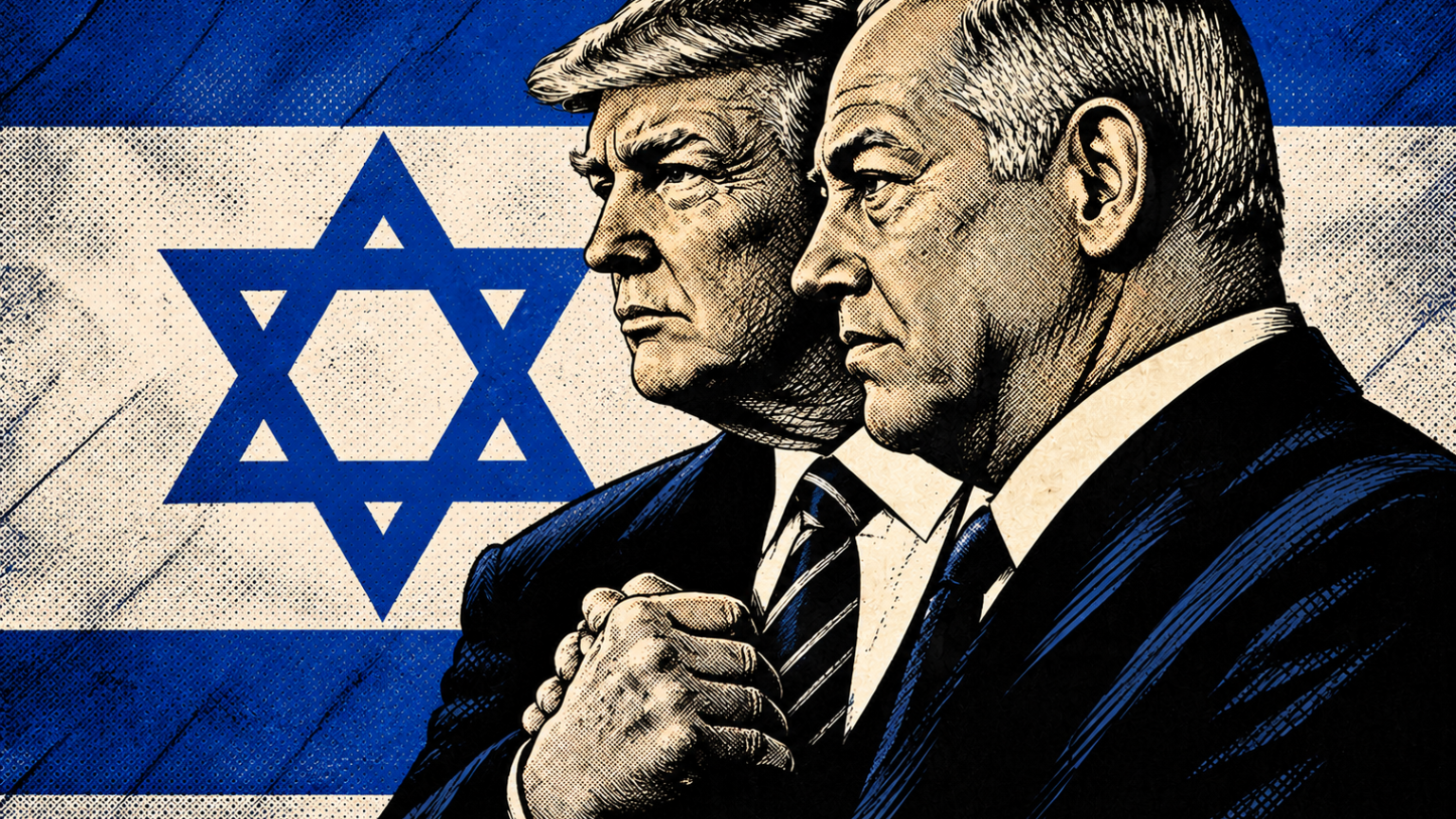
Trump's support for Netanyahu (AI-generated image)
The contemporary West suffers from a chronic anomaly, an institutional decay in which the raison d’État has been supplanted by the anxious management of approval ratings. Leaders who apologize for their own sovereignty. Governments that flinch at their own shadows. Amid this twilight of courage, where moral disarmament precedes military disarmament, the State of Israel is not merely a regional actor; it is the open-air laboratory where the fate of the Judeo-Christian heritage is being decided. Israel’s elections transcend the borders of the Levant. They materialize an ontological clash between two visions of civilization.
On one side of the spectrum lies the conviction that a nation must survive by force, defending its borders, its history, and its faith. On the other lies the cosmopolitan fantasy—echoed in the corridors of Brussels and the plenary halls of the UN—that peace emanates from unilateral concessions and agreements devoid of coercion.
Ronald Reagan, the architect of the doctrine that brought the Soviet empire to its knees through structural pressure, understood this asymmetry with surgical clarity. In his worldview, peace was not a byproduct of weakness, but the direct result of deterrent supremacy. “Peace through strength” was not merely a slogan; it was the practical application of game theory in a zero-sum environment against an expansionist adversary. Weakness, invariably, invites aggression.
Benjamin Netanyahu internalized this lesson decades before it became palatable in Washington. He shattered the Oslo fantasy, dismantling the illusion that terrorism could be domesticated through territorial concessions and diplomatic rhetoric. He stood up to the international press, pushed back against hegemonic pressures from Washington when necessary, and placed Israel’s security above the ephemeral applause of the so-called “international community.” This is the essence of a statesman: the willingness to be vilified in the present in exchange for the nation’s survival in the future.
The historical recognition of this posture found its clearest expression in the alliance between Jerusalem and the presidency of Donald Trump. By breaking with the multilateralist dogma that had paralyzed American foreign policy for decades, Trump acted as the direct heir to Reagan’s transactional realism.
The transfer of the US Embassy to Jerusalem, the recognition of Israeli sovereignty over the Golan Heights, and the withdrawal from the disastrous Iran nuclear deal were not mere acts of diplomatic provocation. The Abraham Accords—the greatest peace achievement in the Middle East in a quarter of a century—were born precisely from the application of this doctrine: bilateral peace, rooted in mutual interests and shared strength.
In the recent electoral cycles of 2024 and 2025, Trump’s support for Netanyahu transcended mere protocol. It was a civilizational endorsement. The alliance between the two reaffirmed a premise long forgotten by the Western establishment: when strong leaders unite under the aegis of deterrence, evil retreats. One does not negotiate with those who have sworn your extinction. In such cases, diplomacy is merely the continuation of war by other means, and war demands victory, not empathy.
A man of Netanyahu’s stripe does not govern to be loved in European capitals. He governs to ensure that Jerusalem remains the indivisible capital of the Jewish people, and that the Israel Defense Forces continue to be the most moral and lethal military in the region.
The difference between a politician and a statesman lies in their perception of time and threat. The politician believes peace is a signed document. The statesman knows that peace is merely the interval between wars, guaranteed by the superiority of the sword. The contemporary world is replete with Neville Chamberlains—leaders who return from international summits waving “peace for our time,” while surrendering the sovereignty of entire nations to their executioners.
Israel’s lesson for the West is brutal in its simplicity. Weakness is an invitation; strength is the guarantee. The world needs men like Netanyahu because the world, in its tragic and inescapable essence, still obeys the law of the jungle, thinly disguised by paper treaties. And against the barbarism that threatens the roots of our civilization, the only universal language is that of unquestionable force.
We are short on Reagans. Short on Trumps. Short on Netanyahus.
Therefore, I hope for Netanyahu’s continuity at the helm of the government and his victory at the polls, because beyond the borders of Israel, the world needs men of such stripe.
Shema Yisrael שְׁמַע יִשְׂרָאֵל
Related Topics
Related Posts