
Urban sociologist and geopolitical commentator
20 Watts: The Energy Price of Thought
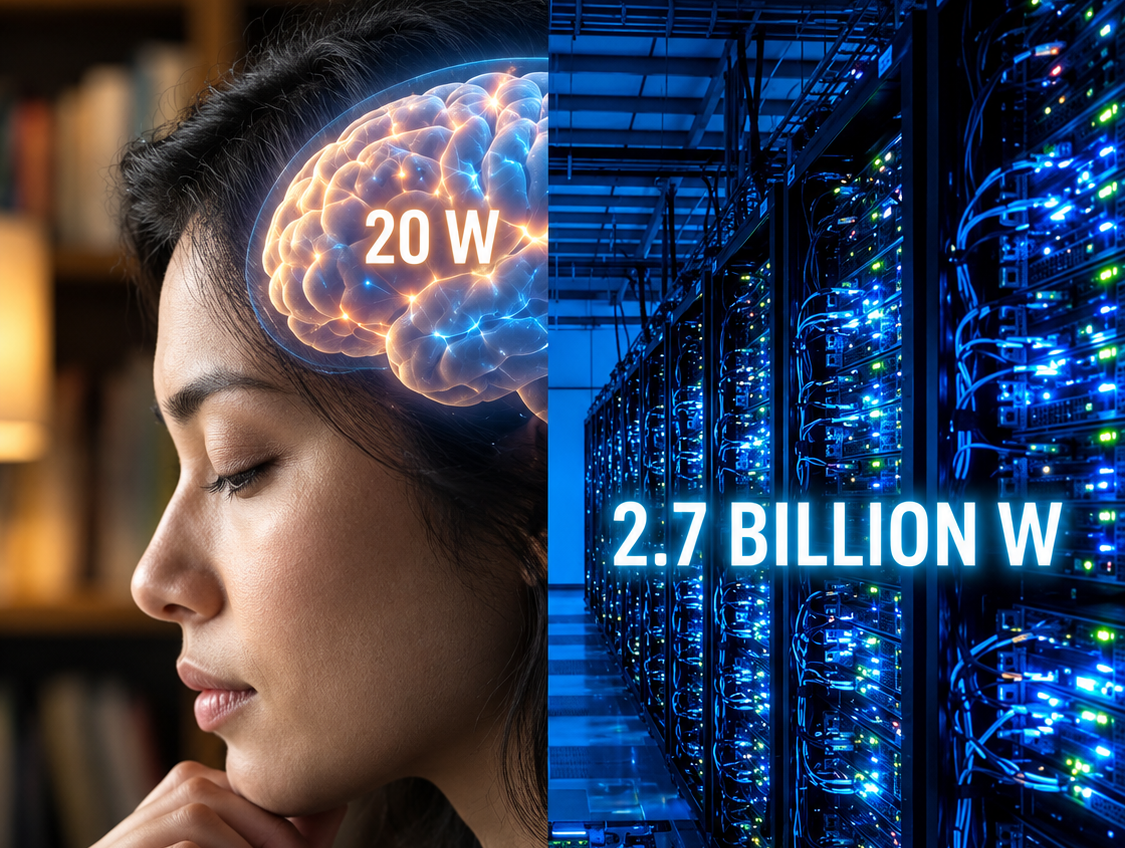
Twenty Watts - The Energy Price of Thought. An AI Illustration.
As artificial intelligence (AI) consume ever more power, we must ask what intelligence is worth and what we intend to think about.
The human brain runs on about 20 watts, roughly a dim bulb. It composes symphonies, proves theorems, and recognises a friend’s face across a crowded station, and it does all of this on a sandwich and a cup of tea. Over twenty years, from birth to the end of university, the whole project of building a mind consumes something like 3.5 megawatt-hours. The widely cited estimate for training a single large language model of the GPT-3 generation was several hundred times that, and the models have grown since.
That comparison is usually made to scold the machines. I think it is better used as a clue, because it points to something we tend to forget: intelligence has always been an energy problem, and the story of thought is largely a story of who could afford it.
Consider what the brain costs. It is about 2% of body mass and burns about a fifth of the body’s resting energy. That is an extravagant tax, and for most of evolutionary history almost no lineage was willing to pay it. One influential hypothesis, the “expensive tissue” argument, holds that our ancestors could afford larger brains only after they found cheaper ways to feed them: first by eating calorie-dense food, later by cooking, which lets the body extract more energy for less digestive work. The details are debated, but the shape of the argument is hard to dismiss. Fire, agriculture, fossil fuels and electrification each widened the energy surplus, and each time a society’s capacity to support thinkers, scribes, engineers and scientists widened with it. Cognition is not free. It is financed.
Artificial intelligence is the first form of thought whose bill is itemised in public. We can read it in megawatts (MW), in transmission queues and in the water drawn for cooling. This visibility is uncomfortable, but I suspect it is useful. For most of history the energy cost of a human thought was hidden in agricultural surpluses and domestic labour, so nobody asked whether a given thought was worth its calories. Now the question is unavoidable: what is a unit of machine cognition worth?
There are two lazy answers. The first, from the enthusiast, is that it is worth whatever the market will pay, and that efficiency will take care of the rest. The second, from the sceptic, is that most of it is waste, a vast furnace burned to autocomplete emails. Both miss the structure of the problem.
Take efficiency first. The physics leaves enormous headroom. Landauer’s principle sets a floor on the energy needed to erase one bit of information, on the order of a few zeptojoules at room temperature, and today’s chips operate many orders of magnitude above it. The brain, whatever else it is, demonstrates that vastly cheaper computation is physically possible. Engineers will keep closing the gap, as they have for decades. But here the economist’s warning arrives: when William Stanley Jevons observed in 1865 that more efficient steam engines increased Britain’s coal consumption, he identified a rule that has held for nearly every general-purpose technology since. Cheaper computation does not sit idle. It is spent on more computation. Efficiency lowers the cost of a thought, and a lower price summons more thoughts. Anyone who expects efficiency alone to cap AI’s appetite is betting against the best-documented regularity in energy economics.
The sceptic is wrong in a subtler way. Waste is real, but the interesting question is not whether some computation is frivolous. It is whether we have any mechanism for telling the valuable from the frivolous before the electricity is spent. Today we largely do not. A query that helps a clinician catch a missed diagnosis and a query that generates the ten-thousandth variation of an advertising slogan draw on the same grid, at prices that bear no relation to their worth. The market prices the kilowatt-hour; it does not price the thought.
This is where the matter ceases to be technical and becomes political, and where countries will diverge. A society that treats intelligence as an energy-intensive good must decide how to allocate it, and there are only a few ways to do so. It can leave allocation to price, which favours the wealthy and the commercially lucrative. It can ration by decree, which is clumsy and invites capture. Or it can make the cost legible, by publishing the energy and water footprint of computation, tying large loads to clean supply, and funding the uses whose social return is high but whose commercial return is low. Legibility is the modest option, and it is the one that keeps the others available.
The deeper lesson from the 20-watt brain is that the frontier is not simply scale. Evolution did not produce human intelligence by adding power indefinitely. It produced it under a hard energy constraint, and the constraint was the teacher: sparse activation, aggressive compression, learning from small amounts of experience, hardware and software shaped together. The next real advance in machine intelligence may come less from larger clusters than from taking that constraint seriously, from architectures that treat joules as a design parameter rather than an externality. Countries and firms that must economise, because power is scarce, expensive or politically contested, may find themselves ahead in that race. Scarcity has a long record of being a better engineer than abundance.
There is, finally, a quieter point about what we choose to value. Every civilisation spends its surplus on something it considers worth thinking about. Ours has just built machines that convert electricity into fluent language, and has begun, mostly without deliberation, to decide how much of the world’s power to give them. It would be a strange outcome if the first society able to measure the energy price of cognition declined to ask what cognition is for.
Twenty watts built the minds that built the machines. The machines will soon draw more power than some nations. Whether that exchange is remembered as an investment or a squandering will depend on a question no data centre can answer for us: what, precisely, do we intend to think about?
Related Topics
Related Posts