
3 Days in ‘Judea and Samaria’
A couple of weeks ago, I joined a seven-day J Street trip to Israel and the West Bank, hoping to better understand the political landscape and the obstacles standing in the way of a peaceful resolution to the Israeli-Palestinian conflict. Having visited Israel twice before as a tourist, I had never included a politically focused trip to the West Bank on my itinerary. And judging by conversations I’ve had since returning, it’s not a destination most people expect to be part of a tour of Israel.
One of the more striking themes of the trip was how deeply Israeli control of the West Bank has become normalized. Under Netanyahu’s government, the term “Judea and Samaria” has become increasingly commonplace in Israeli political discourse. While the name reflects the Jewish people’s historical and biblical ties to the land, its growing use also reflects a broader political effort to treat the West Bank as an inseparable part of Israel.
Throughout the trip, one central dilemma, introduced by one of our tour leaders, helped put much of what we encountered into perspective: Israel can only ever have two of three things.
- A democracy
- A Jewish majority
- Control over all the land between the Jordan River and the Mediterranean Sea
Captured by Israel during the Six-Day War in 1967, the West Bank has remained under Israeli occupation for nearly 60 years and is widely viewed as the territorial foundation of a future Palestinian state. Today, nearly 3 million Palestinians and hundreds of thousands of Israeli settlers live in the West Bank, with the settlements widely considered illegal under international law.
Yet despite the Green Line marking the boundary between Israel and the West Bank, the distinction is often blurred in everyday Israeli life. Israelis living on either side generally drive vehicles with the same yellow license plates, allowing them relatively unrestricted movement between Israel and much of the West Bank. Israeli settlers also retain full voting rights in national elections. Even among my fellow travelers, many of whom grew up in secular households and attended Reform Hebrew schools, most recalled seeing classroom maps depicting Israel and the West Bank as one continuous territory, with no boundary indicating that the West Bank was, at the very least, disputed.
The distinction becomes much more apparent when examining the rights of Palestinians. Across Israel, the West Bank, and Gaza, approximately 15 million people live between the Jordan River and the Mediterranean Sea, with roughly equal Jewish and Palestinian populations. Yet while Jewish Israelis generally enjoy the same citizenship and voting rights regardless of which side of the Green Line they live on, Palestinians live under vastly different legal systems depending on their location. Palestinian citizens of Israel can vote in national elections, while most Palestinians in East Jerusalem hold permanent residency without national voting rights. Palestinians in the West Bank have neither Israeli citizenship nor permanent residency and face significant restrictions on their freedom of movement. In Gaza, Palestinians have lived under nearly two decades of authoritarian Hamas rule, compounded by Israeli military control and restrictions.
If Israel is to control all of the land, it cannot remain a democracy without extending voting rights to everyone living there. Yet doing so would mean giving up its Jewish majority. The alternative, supported by many who advocate for a peaceful resolution, is for Israel to remain both a Jewish-majority state and a democracy, but without controlling all of the land. In other words, a two-state solution.
These political questions took on a much more tangible meaning during our days in the West Bank, beginning with our first destination: Hebron, less than an hour’s drive south of our hotel in Jerusalem.
Under the Oslo peace process of the 1990s, the West Bank was divided into three administrative areas. Area A, consisting primarily of major Palestinian population centers, was placed under Palestinian Authority control for civil affairs and internal security. Area B came under Palestinian civil administration while Israel retained overriding security authority. Area C, covering more than 60% of the West Bank, remained under full Israeli civil and security control, and is where the vast majority of Israeli settlements are located.
Unlike other major Palestinian cities in the West Bank, Hebron is divided into two administrative areas under the 1997 Hebron Protocol: H1 and H2. H1, comprising roughly 80% of the city, is administered by the Palestinian Authority, while H2, covering the remaining 20%, including the historic Old City and parts of downtown, remains under Israeli military control, with the Palestinian Authority retaining certain civil responsibilities. Hebron is also the only major Palestinian city in the West Bank, outside East Jerusalem, with Israeli settlements located directly within its urban center. The presence of these settlements has resulted in an unusually large Israeli military deployment to protect a relatively small settler population, with hundreds of soldiers stationed in the area.
Our guide for the day was Nadav Weiman, executive director of Breaking the Silence, an Israeli nonprofit that collects and shares testimonies from former IDF soldiers about their experiences serving in the occupied Palestinian territories, aiming to shed light on the realities of the occupation. Weiman had led a similar tour for U.S. Congressman Ro Khanna in July, during which the group was detained by armed settlers.
Our first stop was near the outskirts of downtown Hebron, at the gravesite of Baruch Goldstein, a Jewish extremist who murdered 29 Palestinian worshippers at the Tomb of the Patriarchs in 1994. The gravesite, located in the nearby settlement of Kiryat Arba, has become a place of pilgrimage for some far-right settlers, something we soon witnessed firsthand. Almost immediately after stepping off our bus, we were confronted by two settlers, one of whom began shouting and cursing at Nadav, making it nearly impossible for him to speak. As we approached the grave, the screaming settler leaned over and kissed the stone in a striking display of reverence for a man he clearly regarded as a hero.
Our next stop was a couple of kilometers away in downtown Hebron, where Israeli flags now lined Shuhada Street, once a vibrant Palestinian commercial hub. Formerly bustling with shops and businesses, the street has become a ghost town as a result of Israeli military restrictions on Palestinian movement and commerce, imposed in the name of security following years of violence and tensions between Israeli settlers and Palestinians. As we walked through the streets, we encountered the same settler once again, this time speeding around a corner in his car with a different companion. Our tour was cut short yet again as the settlers began yelling at and shoving Nadav, forcing us to return to our bus earlier than planned.
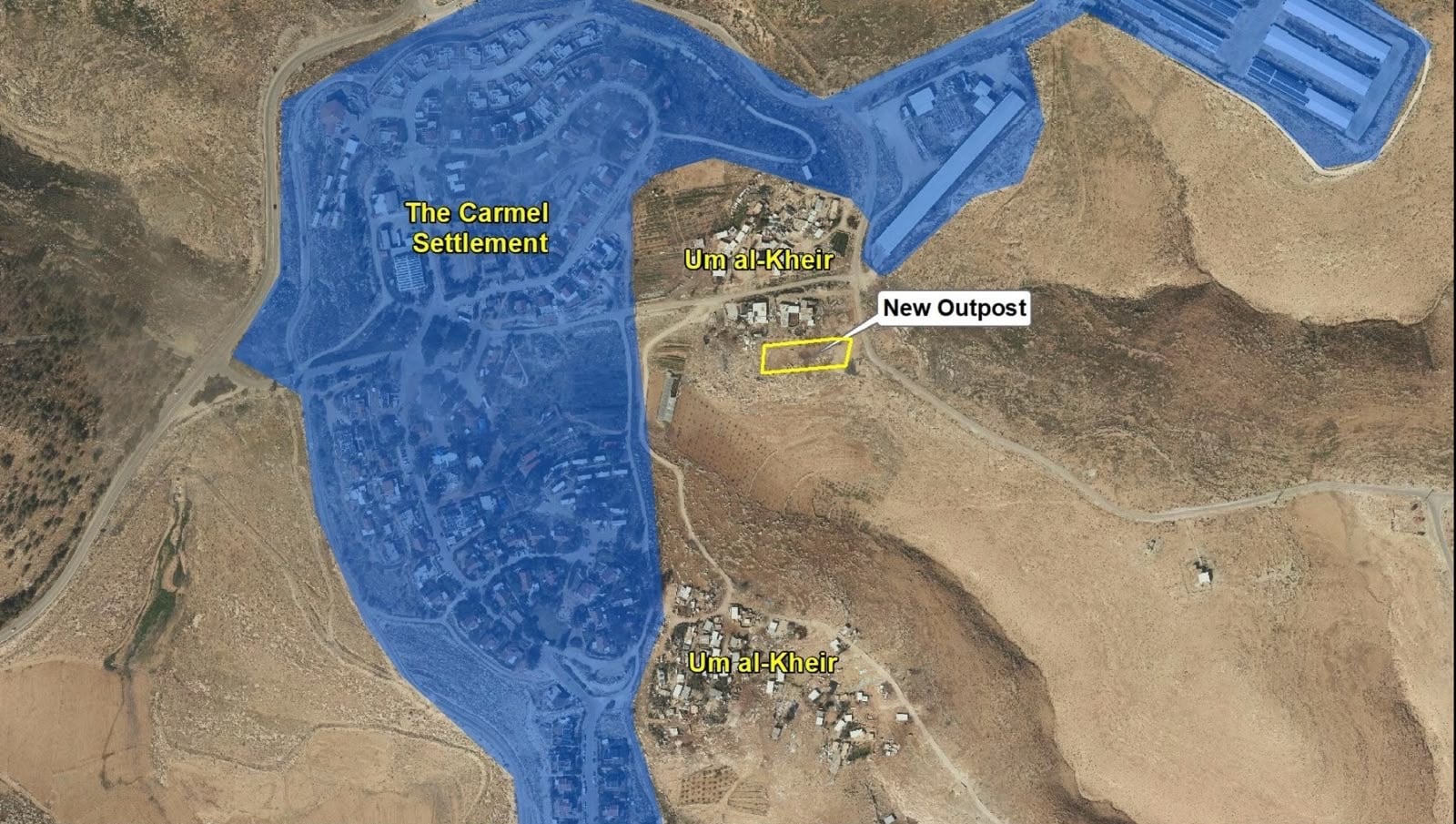
The final stop of the day took us to Umm al-Kheir, a small Bedouin Palestinian village of approximately 200 residents in the South Hebron Hills. The contrast with the neighboring Israeli settlement of Carmel was stark. While Umm al-Kheir residents face severe restrictions on construction and unreliable access to basic utilities, their Israeli neighbors enjoy modern infrastructure, including paved roads, running water, and electricity. The establishment and expansion of a nearby Israeli outpost since 2025 has further restricted residents’ movement, leaving the community increasingly enclosed. At one of the homes closest to the new outpost, settlers have encroached upon the family’s backyard, marking it with an Israeli flag and stickers depicting far-right Israeli minister Itamar Ben-Gvir, seemingly as a warning to the residents not to enter their own land.
As we spoke with community leaders in Umm al-Kheir about the challenges they faced, several settlers approached our group, filming us, arguing with residents, and calling us “anarchists.” When it came time to leave, armed settlers from the nearby outpost blocked the village’s only remaining accessible exit road with their car, forcing us to call the authorities for assistance. Police and IDF vehicles arrived fairly quickly, but nearly 30 minutes of back-and-forth followed as authorities attempted to persuade the settlers to clear the road. Nadav eventually stepped outside to intervene, later telling us that he had challenged the authorities with a simple question: “Who gives orders to whom?”
Eventually, one of the soldiers boarded our bus, his face entirely concealed by a mask and sunglasses. He announced that the area surrounding the village had been designated a closed military zone and ordered our group to leave and never return.
————
Our second day in the West Bank took on a different focus as we visited Ramallah, the administrative capital of the Palestinian Authority. Although Ramallah lies just 10 miles north of Jerusalem, it is largely surrounded by Israeli-controlled territory, with military checkpoints restricting access to the city. As we approached the Beit El/DCO checkpoint, Israeli flags lined both sides of the road, leading up to a sign marking our entry into Area A, under Palestinian Authority administration. Remarkably, this was the first time throughout our travels in both Israel and the West Bank that I had encountered any signage explicitly referencing Palestine.
Though noticeably different from Tel Aviv or Jerusalem, Ramallah offered a more encouraging picture of Palestinian life than what we had witnessed the day before, with Palestinian self-rule reflected in the presence of foreign diplomatic missions, Palestinian flags flying throughout the city, and a general sense of normalcy and civic life. After a briefing by the Carter Center on the current state of Palestinian politics, we met with Dr. Omar Awadallah, the Palestinian Authority’s Deputy Minister of Foreign Affairs for Political Affairs. This was one of the most hopeful meetings of the entire trip. Awadallah emphasized his belief that a two-state solution was the only viable path forward, describing a future that included recognition of Israel and a demilitarized Palestinian state. While highly critical of Israel’s far-right government, he stressed the importance of having willing partners on both sides and preventing those opposed to peace from derailing a potential agreement. Hearing such a position from a senior Palestinian official was particularly encouraging, given the longstanding argument within Israeli politics that there is no willing partner for peace on the Palestinian side.
————
Throughout the trip, we had the opportunity to hear from a wide range of voices offering different perspectives on the conflict. We met with Israeli and Palestinian peace activists, election analysts, policy experts, politicians, IDF spokespeople, security personnel, and even settlers from the Binyamin Regional Council. We also spent a powerful day in the communities surrounding Gaza, visiting the site of the Nova music festival and hearing heartbreaking stories of young concertgoers murdered by Hamas terrorists on October 7 in acts of indiscriminate violence. The trauma experienced by these communities extends far beyond the border towns, deeply affecting Israeli society as a whole.
As our trip wound down with a final day in Jerusalem, our group had plenty of opportunities to reflect on what we had witnessed, consider the challenges ahead, and find reasons for hope amid what can only be described as a nightmarish conflict. My time in Israel, however, was not yet over. I was set to spend the next few days with my cousin Rachel, who had made aliyah to Israel just five months earlier. Taking advantage of my visit to explore more of the country beyond her new home in Tel Aviv, we decided on a getaway to a glamping site near the Dead Sea. It was only later that I found out our destination was located directly east of Jerusalem, in Area C of the West Bank. And so, this time from a very different perspective, I would find myself spending a third day in the territory known to Israelis as Judea and Samaria.
————
Our time as tourists in this part of the Dead Sea led me to several observations. Even though we were in occupied territory, all the cars we encountered had yellow Israeli license plates, and the only Palestinians we interacted with were employees of the glamping site. The following day, we stopped for lunch at a trendy spot farther south along Route 90, which runs parallel to the Dead Sea. The atmosphere and clientele were indistinguishable from what you might find in Eilat, within Israel proper. The experience stood in stark contrast to what we had witnessed in Hebron, as Rachel and I blended in with the other tourists, with little to remind us that we were still in the West Bank.
The rest of my time in Israel was filled with discussions about the upcoming Israeli election, a topic Rachel and I had plenty of time to explore during an 18-mile hike around Masada and south into the Judean Desert. Back in Tel Aviv, on the evening before my departure, we attended a pre-election rally hosted by the center-left Democrats party, specifically geared toward olim, the Hebrew term for Jewish immigrants who have moved to Israel through aliyah. With the election approaching, I felt a sense of uncertainty about what lay ahead and wished I could stay longer to engage with the political energy and conversations surrounding such a consequential moment in Israel’s history. But before returning home, I had one final stop that would bring the larger significance of the trip into focus.
————
I had intentionally booked my flight home with a 22-hour layover in Warsaw, Poland, a city deeply connected to the history of European Jewry and the events that shaped the eventual establishment of the State of Israel. After everything I had learned over the previous 10 days, I wanted to explore that history through a different lens. At the top of my list was the POLIN Museum of the History of Polish Jews, which chronicles 1,000 years of Jewish life in Poland, from the Middle Ages through the Holocaust and into the present day.
After spending much of the trip examining the consequences of Israeli military occupation and the unequal rights afforded to Israelis and Palestinians living on the same land, I found it particularly striking that my visit to Warsaw reinforced the importance of having a Jewish state. Throughout centuries of Jewish life as a minority in Poland, there were periods of relative prosperity and tolerance, but also recurring persecution, discrimination, and ultimately the devastation of the Holocaust.
The contrast was difficult to reconcile, but it strengthened my conviction in the importance of preserving Israel as both a Jewish state and a democracy, while ensuring that Palestinians enjoy the same rights, freedoms, and opportunity for self-determination that Jews have sought for centuries.