
From Kibbutz to the global stage
3I/ATLAS Is Shaping the New World Order — And the Next UN/IAWN Planetary Defense
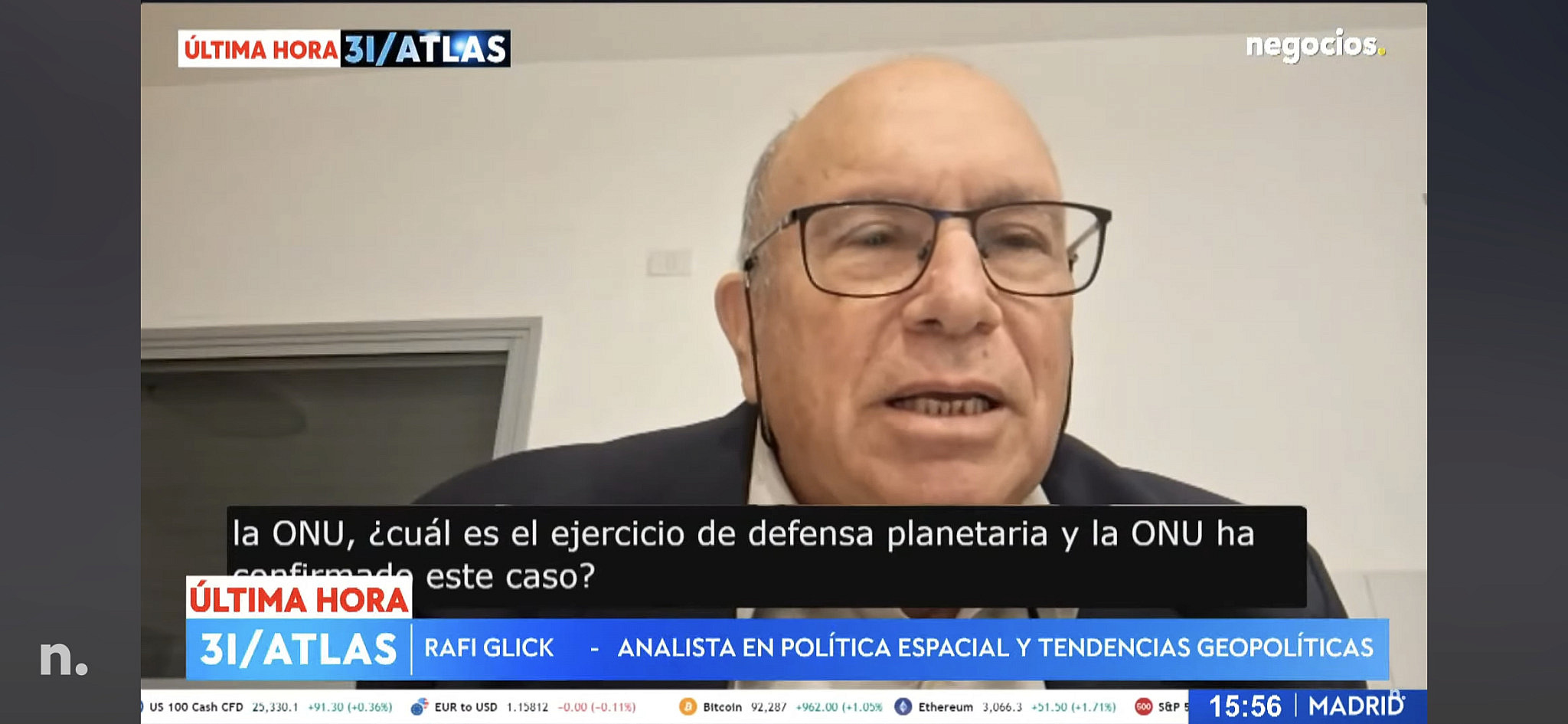
Image: Rafi Glick during a two-hour live broadcast on Spain’s NegociosTV, discussing the UN planetary-defense exercise — whose full document he publicly revealed for the first time through The Times of Israel.
3I/ATLAS Is Shaping the New World Order — And the Future of UN/IAWN Planetary Defense
The presence of 3I/ATLAS now shadows every discussion about our shifting world order — and every debate about the future of planetary defense.
The ducks that once guarded Rome are making strange noises.
Rome can be Washington, and the ducks can wear stripes and stars.
Something is happening in the United States — in its media ecosystem and in its geopolitical posture — and it is happening precisely during a week in which the world is changing at a speed that is almost impossible to process.
Below are the major events of the last week. Each one is significant on its own — but together, they form a troubling picture of a world at a turning point.
1. The UN’s Largest Planetary-Defense Exercise Ever — Focused on 3I/ATLAS:
The United Nations is conducting the most extensive asteroid-tracking and planetary-defense exercise in its history — and in practice, the entire effort revolves around 3I/ATLAS.
This “mysterious neighbor” has shaken the world’s sense of security and is now influencing global, scientific, political, and public processes.
3I/ATLAS will approach Earth on 19 December and is expected to begin departing afterward. Yet precisely now, it exhibits unusual uncertainties, including possible developments toward March, when it passes near Jupiter.
Its very presence moves spotlights, shifts attention, and reshapes priorities.
2. Trump’s Proposal to Zelensky — A Strategic Shockwave:
Trump’s offer to President Zelensky — a unilateral withdrawal from two Ukrainian regions, including areas never occupied by Russia, and without any mechanism to protect Ukraine from future aggression — represents a dramatic shift in American strategic thinking.
Meanwhile, ongoing strikes on Ukrainian cities receive faint responses.
A clear sign of weakening American willingness to confront geopolitical crises.
3. Taiwan and China on the Brink — and the Venezuela Signal:
China has intensified its patrols over Taiwan, escalated friction with Japan, and is trying to shape an economic framework that protects its long-term strategic interests vis-à-vis the United States.
Beijing senses a window of opportunity, created by perceived American hesitation, and it is advancing across every front.
At the same time, Trump closed Venezuela’s airspace under a “drug war” declaration — a move that could soon be mirrored by China and Russia in their own regions.
This ties directly to a deeper strategic reality:
The democratic world’s key advantage is open information flow.
Artificial intelligence depends on fresh, unrestricted, high-velocity data.
Without it, the free world will lose not only the information war — but the AI war as well.
4. Saudi Deals Stand Still — India Redraws the Map:
The massive agreements with Saudi Arabia remain one-sided for now and do not form a stable route from India westward.
India is quietly building a new India–Europe strategic and economic corridor, bypassing the United States.
New Delhi is not bound to agreements of previous administrations. Its rising global weight — combined with American pressure on Indian markets — pushes it simultaneously eastward and westward.
Next month, Israel’s Prime Minister will visit India, attempting to advance this path.
His request for a pardon — handled discreetly through Donald Trump — certainly will not hurt.
5. Europe Changes Direction — and Officially Enters Planetary Defense:
At the EU Council of Science and Space Ministers, ESA received the largest budget in its history.
For the first time, Europe is officially entering planetary defense and active-deflection systems.
The plan:
Increase this budget every year.
Meanwhile, NASA faces:
- Budget cuts
- Layoffs
- Hundreds of threatened projects
- Thousands of displaced scientists
Diplomatically, Europe expands cooperation with countries losing faith in American consistency:
- Canada increases its ESA contribution by 400%
- Australia and South Korea become privileged partners
- India advances through bilateral space agreements
India is determined to become a developed global power within 20 years — and space is a central pillar of that roadmap.
6. A Strange Silence in US Media:
Just as all this unfolds — what is the tone of much of the American media?
Silence.
Thanksgiving brought comfort and denial.
For three days, the world changed dramatically — yet most Americans heard nothing in real time.
By the time the reports appeared, they documented events after they happened — not as they were unfolding.
7. Meanwhile in Europe: A Two-Hour Broadcast on NegociosTV:
At the very same time, I participated in a two-hour live special on the Spanish network NegociosTV — at one of the strongest Friday-evening time slots.
In the interview, I discussed the UN planetary-defense drill — whose detailed document I publicly revealed for the first time on The Times of Israel (25 November 2025).
Most of the broadcast focused on 3I/ATLAS, and on the debate between Prof. Avi Loeb and NASA experts over the non-gravitational forces influencing its trajectory toward its Jupiter near-pass on 16 March, roughly 53 million km from its heliocentric curve.
Europe is talking.
India is talking.
Israel is talking.
Spain is talking.
And in the United States — calm, quiet, silence.
8. Why Is Part of the US Media Silent?
During the live broadcast I said:
“The whole world is reporting on the UN planetary-defense exercise and the ESA conference — but much of the American media is silent.
And I ask: why?”
This is not a technical question.
It is a strategic one.
When the press responds days late to critical events, it loses the ability to shape the narrative.
And that is exactly what happened to NASA — partly because of its budget crisis — and partly because the story escaped its control.
9. When Institutions Go Silent — the Public Takes Over:
In five months, 3I/ATLAS moved from academic corridors to TikTok.
Kim Kardashian speculates.
Elon Musk issues warnings.
A small Israeli city appears in Google News with a planetary-defense article.
A Spanish football club posts alerts to its fans.
Once this happens, no institution can manage the story without acknowledging the global public that has already taken ownership.
Public engagement is growing exponentially — while the scientific uncertainties remain unresolved.
Conclusion: A New World, A New Public, A New Reality
The world is shifting.
Power centers are realigning.
The media must keep pace — or fall behind.
When official institutions fall silent, the public fills the vacuum.
And in an era defined by space, communication, and rapidly changing geopolitical forces — this is no longer just a matter of policy.
It is a matter of global consciousness.
Related Topics