From Kibbutz to the global stage
3I/ATLAS: Syndrome or Breakthrough? The Future of NASA Goddard Space Center.
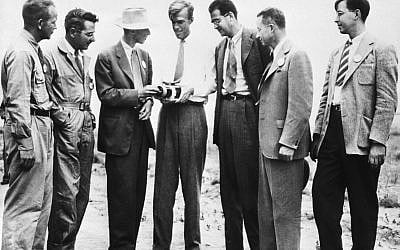
From left to right: Dr. Kenneth T. Bainbridge (Harvard University), Dr. Joseph G. Hoffmann (University of Buffalo), Dr. J. Robert Oppenheimer (University of California), Dr. Louis H. Hempelmann (Washington University), Dr. Victor Weisskopf, Dr. Robert F. Bacher (Cornell University), and Dr. Richard W. Dodson (University of California).Photo:AP
Will 3I/ATLAS Lead to an Atlas Syndrome — or to a Breakthrough in Space Science? The future of NASA Goddard Space Center.
The strange neighbor that entered our solar system some six months ago has injected significant tension and uncertainty into governmental, political, and academic systems across capitals worldwide. At the same time, it has polarized social media and the global press around a single question: is this object natural — or does it represent a form of technology unfamiliar to us?
What began as scientific papers submitted for review by academic institutions and space agencies quickly spilled over into TikTok, rumor mills and coded hints on social platforms, and even fabricated videos on YouTube.
Instead of a professional, measured, and scientific clarification of the issues raised, a systemic weakness was exposed. Academia and space agencies are not adequately prepared to confront such a phenomenon using conventional tools and methodologies. The discussion slid into polarization, mutual accusations, and prestige-driven disputes.
When scientists rush to publish papers and peer reviews on a complex, unfamiliar, and multidisciplinary subject simply to be “first,” there is little time left for deep analysis, consultation with experts from adjacent fields, or careful critical evaluation. The result is partial findings, premature conclusions, and growing divisions within the scientific community itself. In an era in which AI tools can generate accurate reviews in a very short time, the value and role of many traditional publications inevitably take on a different meaning.
Comet 3I/ATLAS is estimated to be between 7 and 13 billion years old — a type of object never before observed in our solar system. Determining its nature requires highly complex and synchronized systems of ground-based telescopes and space research missions. Astrophysicists alone are not enough. Experts in materials science, chemistry, biology, aeronautics, rocket engineering — and even behavioral sciences — are needed, particularly to manage responsible public communication and explanation here on Earth.
In the near future, interstellar objects are expected to appear at a frequency of once every few months, following the full operation of the powerful new survey telescope, the Vera Rubin Observatory in Chile. If we do not prepare differently and more intelligently than we do today, such phenomena may become a vortex of fear, rumors, and mistrust — an “Atlas Syndrome” — rather than a catalyst for scientific breakthroughs.
The way to confront the “Atlases” yet to come is through deep, coordinated global collaboration among leading experts from top universities worldwide. What is needed is an international scientific corps — a permanent core of specialists supplemented by “scientists in reserve” — operating in a structure similar to the US National Guard, but with multinational participation. Not hurried papers, not races for priority, and not endless peer-review bottlenecks, but multidisciplinary teams that share data, think collectively, and make informed decisions.
The The New York Times recently wrote:
“Trump wants the Moon, but the place where NASA’s future missions are born is withering under his direction.”
The paper noted that the planned closure of the main library at NASA’s Goddard Space Flight Center at the end of 2025 is one of the saddest examples of the impact of budget cuts: libraries shuttered, laboratories closed, thousands of experts and engineers laid off, missions canceled, and space telescopes — already developed at a cost of billions of dollars — frozen.
Instead of shutting down research centers like Goddard, they should be transformed into infrastructure and operational bases for a global scientific corps — facilities that communicate, function continuously, and convene rapidly when needed, much like the gathering of scientists at Los Alamos during the Manhattan Project in World War II.
This is how humanity should confront the new era of interstellar objects expected to be discovered in the coming decade — not through fear and chaos, but through meaningful breakthroughs in science and space exploration.
Related Topics
Related Posts