
From Kibbutz to the global stage
3I/ATLAS: The Interstellar Visitor and Humanity’s Next Frontier
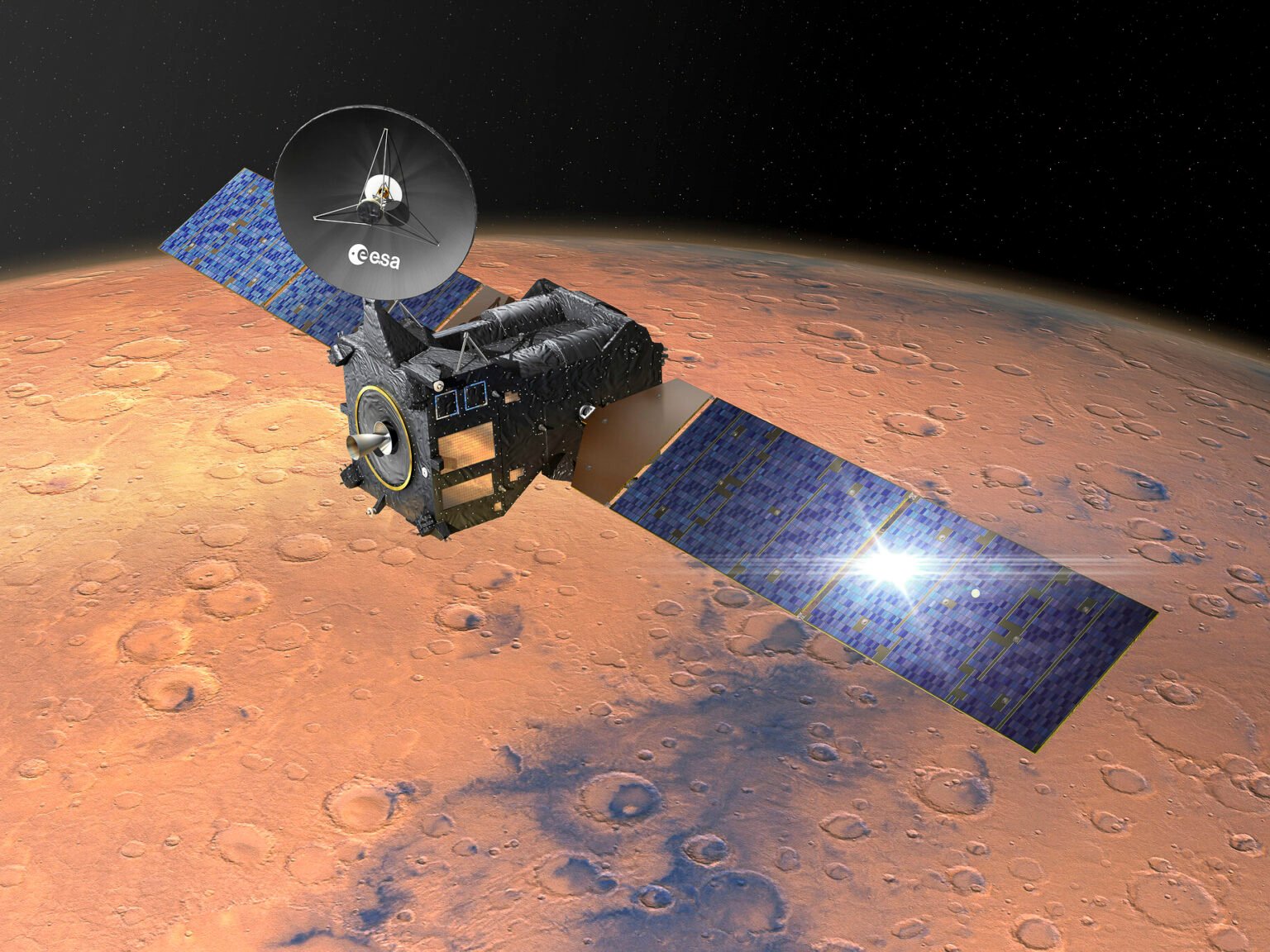
Image: The European Space Agency’s ExoMars Trace Gas Orbiter observed the interstellar comet 3I/ATLAS as it passed near Mars in early October 2025, capturing the closest view of the comet by any ESA mission — from about 29 million miles away. Credit: D. Durcros / ESA — Public Domain
3I/ATLAS: The Interstellar Visitor and Humanity’s Next Frontier.
A foreign body the size of Manhattan — and possibly larger — weighing around 33 million tons, has been wandering through our Solar System for at least four months since its discovery on July 3, 2025.
Nicknamed “the strange neighbor,” the object 3I/ATLAS reached its closest point to the Sun this week — about 200 million kilometers away — but for now, it remains hidden behind the Sun from Earth’s telescopes.
Astronomers still don’t know whether it will continue on a parabolic trajectory out of the Solar System, or change course and head — at 58 kilometers per second — toward another destination, perhaps even Earth.
And if that uncertainty weren’t enough, NASA has not yet released the HiRISE telescope data that captured this enigmatic traveler.
A Rare Encounter near Mars
On October 3, 3I/ATLAS passed within 29 million kilometers of Mars, where it was photographed by the HiRISE camera aboard NASA’s Mars Reconnaissance Orbiter — a rare observation of an interstellar object by a planetary spacecraft.
NASA’s official explanation for withholding the images — “staff shortages due to the US budget crisis” — sounds implausible when dealing with something of potential scientific and even strategic importance.
Meanwhile, NASA quietly added 3I/ATLAS to its asteroid hazard watchlist, and since early October, the International Asteroid Warning Network (IAWN) has launched a global observation campaign led by NASA.
Dozens of ground and space-based telescopes — including JWST, Hubble, SOHO, ExoMars, Mars Express, and TGO — are participating, alongside amateur astronomers invited to help track this visitor from beyond our Solar System.
Awaiting the Next Encounter
The next milestone will come in a few weeks, when 3I/ATLAS exits the Sun’s glare.
Later, on March 16, 2026, it will pass within 59 million kilometers of Jupiter, where NASA’s Juno spacecraft will be able to observe it directly.
Harvard astrophysicist Prof. Avi Loeb has even proposed redirecting Juno to collide with 3I/ATLAS for closer inspection. NASA has not publicly responded, likely preferring to wait and see whether the object shows any unusual signatures as it emerges from behind the Sun.
Should We Be Afraid?
It sounds frightening — and perhaps it is.
Am I afraid? No. Because fear changes nothing.
And because our planet is already overwhelmed with its own crises — wars, disasters, and the endless noise of human conflict.
NASA’s silence, I believe, stems from uncertainty rather than conspiracy: inconclusive HiRISE data, confusion in the Mars observation network, and a desire to avoid public panic.
By March, when Juno and other instruments gather new data near Jupiter, we may know whether this traveler is a natural comet, a frozen mass of interstellar ice, or… something else.
From Threat to Opportunity
One day, an interstellar body — perhaps not a natural one — will enter our Solar System and confront humanity with a question:
Did we prepare for peace, or only for fear?
Instead of panic, we could see opportunity.
Why not use such interstellar visitors — natural or artificial — as platforms to extend Earth’s presence across the Milky Way?
We could land micro-cameras and sensors on them, turning each into a cosmic messenger that carries humanity’s greetings, knowledge, and symbols of peace far into the galaxy.
If objects like 3I/ATLAS already travel at 60 kilometers per second, beyond our propulsion limits and at no extra cost, why not harness them?
Earth’s nations should cooperate to deploy ready-made satellites and probes stationed around the Solar System — waiting for the next interstellar visitor to pass by.
That would mark the beginning of humanity’s expansion beyond the Sun, a step that could preserve our civilization for tens of thousands of light-years to come.
The Final Thought
Do we have any defense systems ready if our “strange neighbor” becomes a “hostile one”?
Probably not.
Let’s hope that even if 3I/ATLAS turns out not to be a natural comet, its intentions — or those of its creators — are peaceful.
Perhaps they share the same cosmic values we aspire to: curiosity, cooperation, and a sense that the universe itself is built on unity rather than conflict.
Autour: Rafi Glick ( רפי גליק)
Credit: D. Durcros / ESA — Public Domain
Related Topics
Related Posts