
Area Codes: The Evolution of Our Digital Front Porch
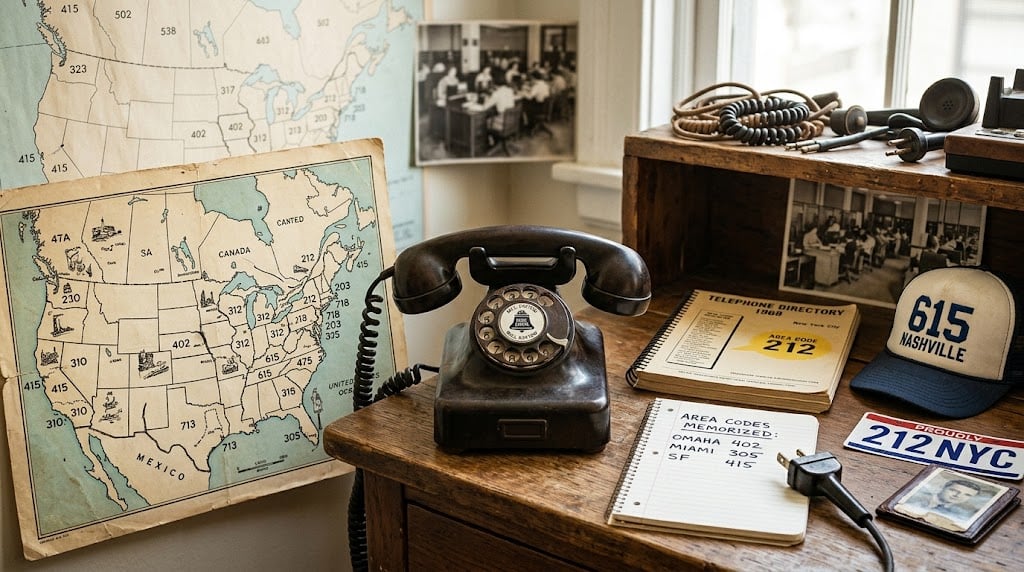
Have you heard? New York City is getting yet another area code for its residents!
Yes, it’s true: 465 has just become the eighth area code assigned to people requesting new numbers in the five boroughs, joining the ranks of 212, 718, 917, 646, 347, 929, and 332. Fortunately, I live in Fairfield County, Connecticut, where we are thankfully still holding the line with just two: our trusty, original 203 and the newer 475.
But seeing that news made me pause. It got me thinking about the history of those three digits—when they started, how they evolved, and how a technical engineering solution managed to weave itself so deeply into our personal identities.
If you trace the story back to the early decades of the 20th century, long-distance calling wasn’t something you did on a whim; it was a scheduled event. In 1930, if you wanted to call from New York to Los Angeles, you didn’t press buttons. You picked up the receiver and spoke to a human operator, who then literally plugged your call into a switchboard, passed your call to another operator down the line, and another, until you finally reached your destination minutes later.
When telephone ownership exploded after World War II, that manual system simply couldn’t keep up. So, in 1947, AT&T and the Bell System introduced the North American Numbering Plan. The goal was revolutionary: let customers dial long-distance calls all by themselves.
To make it work, they created a strict system designed to play nice with the electromechanical switches of the era. The first digit had to be 1–9, the middle digit always had to be a 0 or a 1 (which signaled to the heavy machinery that a long-distance call was happening), and the third digit was 0–9.
There was a wonderful, tactile logic to how they assigned those original 86 area codes. In the days of the heavy, spring-loaded rotary dial, big numbers took longer to return to center. To save time and wear-and-tear, the largest cities with the highest call volumes got the fastest, shortest numbers to dial. That’s why New York City got 212, Los Angeles got 213, and Chicago got 312. If you lived in a rural area, your fingers had to do a lot more spinning.
Though the blueprint was laid in 1947, the magic didn’t happen overnight. The very first direct-dialed long-distance call didn’t take place until 1951, when the mayor of Englewood, New Jersey, dialed his counterpart in Alameda, California, without an operator’s help. At the time, it was treated like a technological marvel.
In the 1960s and 1970s, when I was growing up, the concept of an area code was something you only thought about when calling grandma out of state. Locally, everyone shared the same three digits, so you only had to dial seven numbers. You could hear the rhythm of your neighborhood in those seven clicks of the wheel.
Back then, and later in my professional career, I prided myself on being a bit of a human directory. Dealing with vendors across the country, I knew them by heart: 402 was Omaha, 305 was Miami, 713 was Houston, and 415 was San Francisco.
Then came the 1990s, the explosion of cell phones, second lines, and fax machines. The old system was running out of breath. By 1995, the rule requiring a 0 or 1 in the middle was abandoned, opening up the center position to any digit from 0 through 8. It saved us from running out of numbers, but it shattered the old geography. To this day, I still have a hard time believing 646 or 475 are “real” area codes!
Today, because of cell phone mobility, looking at Caller ID tells you almost nothing about where a person is physically standing. Yet, unexpectedly, those numbers became badges of honor. What started as an engineering shortcut evolved into cultural shorthand. The 212 area code became synonymous with Manhattan prestige; 310 came to define the glitz of Beverly Hills; 615 belongs to the soul of Nashville’s music industry. People wear their area codes on hats, t-shirts, and bumper stickers like hometown jerseys.
For those of us who remember the heavy clunk of a rotary phone, area codes evoke a very specific kind of nostalgia. They recall an era when every phone was tethered to a wall by a tangled cord, when long-distance calls were saved for Sunday evenings because they were expensive, and when memorizing dozens of family phone numbers was second nature.
Few engineers in 1947 could have imagined that their humble routing codes would become symbols of a lifestyle—but then, that’s the beauty of how we humanize the technology we love.