
Try | Make Mistakes | Learn | Succeed
5 Examples of Situations Where Israeli Cultural Habits Brought Me Positive Feelings

“Depending on what country we come from, and what culture(s) we identify with, each of us comes with a healthy dose of baggage of what we think are “right” and “wrong” topics to bring up with other people.” – I loved this introduction about culture differences made by Gregg Hoffman. It is known that Israel is composed of immigrants and that it is a new country (almost 71 years old). For me, Israel is the perfect definition of a Babel Tower.
Originally from Brazil, I have worked with people from all over Latin America, USA and some European countries (UK, France, Germany and Spain, for example). I immigrated to Israel almost 4 years ago and married an Israeli (and his “Polish” family – I’ll try to write about this subject later on). On top of that, I worked 2 years for a “kibbutz” style company that was acquired by an international investment fund and I’m now working for an Israeli management consulting firm providing professional services to small and mostly locals firms. In addition, I spent a one-year period looking for a qualified job and have been through several interviews steps during this period, so I studied and visited some of the most promising “start-ups” in Israel, such as Wix, Gett, Appsflyer, CommonSense Robotics, Riskified, Start-up Nation Central, CropX and others.
Having said that, I feel comfortable in stating I have remarkable multi-cultural skills. But I’m not an anthropologist. Everything that I’ll write in this post is my own observation of a generalized Israeli culture, more focused on the Israeli Business environment.
Before you start reading my first post on a series about Israeli culture (the way I see it), if you don’t know anything about the subject, I suggest you read basic guides that are available online, such as Intel’s guide to doing business with Israelis and the Expat Arrival’s guide on doing business in Israel.
Let’s start with my positive experiences:
People want to meet you on a personal level
During my first meeting with my current boss, she told me her marital status, how many kids she has, and showed me pictures of her family. Of course, I did the same. Some people see this as being nosy. I see it as being nice and caring about you. I felt so welcomed in this environment!
People are people and treat you as people
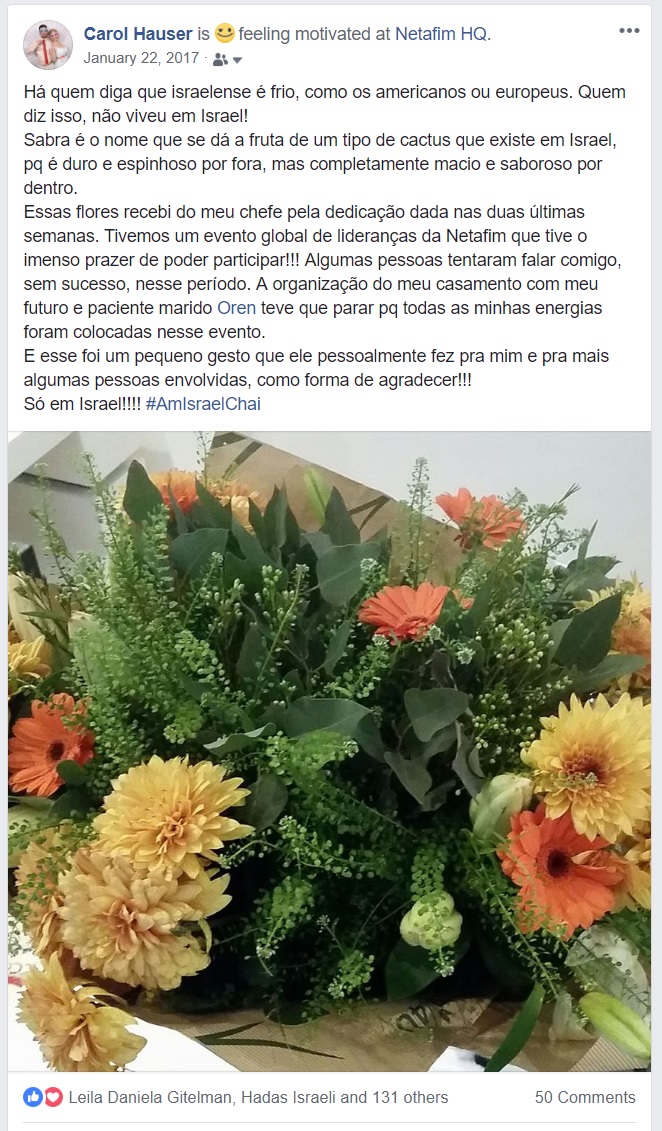
In my previous job, I had to attend an event and, at the same time, prepare some material to be presented with information collected during the event. I would attend every meeting, participate in discussions, go to happy hour events, but later at night, when I arrived at my room, I had to begin working on my presentation. I think that most people who must do business travel are familiar with this process. My boss’ different attitude here was that when I got home, there was a flower bouquet waiting for me. My boss was thanking me for my effort at that event. I know that, in some other countries, this could be considered harassment. But I very much appreciated that my boss recognized that I worked my ass off and that this was his way of thanking me. This kind of attitude is what gave the Israelis their nickname: sabra (supposedly tough on the outside, but delicate and sweet on the inside).
Hierarchy is almost non-existent in Israel
C-levels are usually very much reachable. Quoting Hillel Fuld in his last talk, “you can basically invite every CEO in the country for a coffee; decisions in Israel are made over coffee”. Of course, either you have a good idea/suggestion to offer the CEO or have a very strong connection in order to convince them to go grab a coffee with you (their time is still very expensive, like anywhere else in the world), but it’s doable!
Companies love to celebrate the holidays with the employees
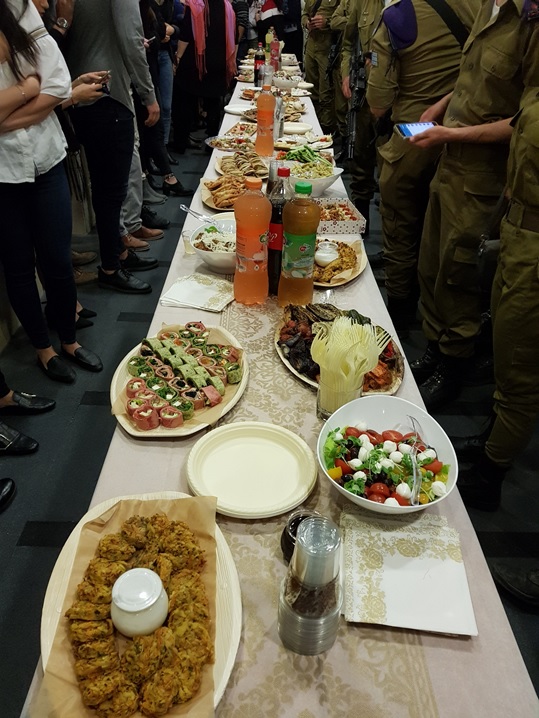
Now is time for Pesach (the Jewish Passover). Expect to receive a small bonus (usually as a gift card), and have what they call “Haramat cossit” (הרמת כוסית), which is the same as a toast. In this small event, all employees get together to toast with wine (vodka, whisky, sparkling wine…), the CEO speaks nice words in front of everybody and, usually, the company either hires a catering company or invites the employees to lunch together. Expect that to happen twice a year, on both Pessach and Rosh Hashana (Jewish New Year). I love it!
Everything will be OK “Hakol ieie besseder” (הכל היה בסדר)
You have deadlines, multiple priority tasks to deliver everything at the same time, difficulties to reach someone from your team that is overseas and doesn’t work on Sundays, and pressure from all over the matrix style structure – 9 hours of work isn’t enough to deliver all that! But don’t worry, everything will be OK, as the Israelis like to say when you look worried, or when you’re jaded or overthinking. And yes, “Everything will be okay in the end. If it’s not okay, it’s not the end” – the original source of that quote is a mystery, but as far as I know, it’s from a Brazilian writer, called Paulo Coelho – it amazes me how Israeli and Brazilian culture are similar!
********
If you want to read a very interesting and informative book, you should get a copy of Osnat Lautman’s Israeli Business Culture book, as fast as you can! She also gives lectures and when I attended one of her talks, offered by Tel Aviv Yafo Municipality, I thought: “this content is a must-read for anyone who has decided to make Aliyah, has previous work experience in their native country, and wants to continue their career in Israel.”. A lot of things that I had to learn and understand by making mistakes, she covered in her book!
********
And you? What do you think is particularly positive in Israeli culture when compared to your previous work experience?
Wait for my next posts, where I’ll write the negative and some neutral things I observe.
Related Topics
Related Posts