70 Faces of Torah: Wrestling with Toldot and Life
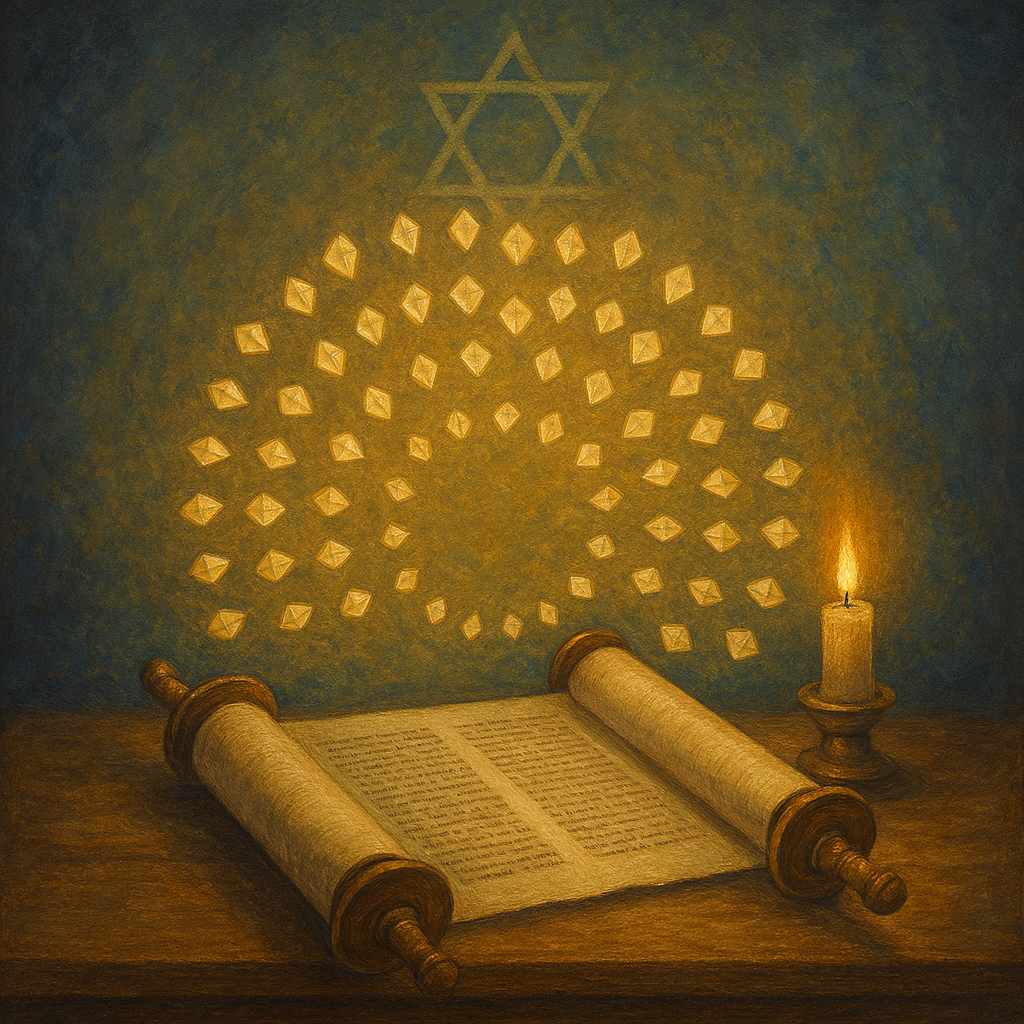
Jewish tradition teaches that the Torah has shiv’im panim – seventy faces. It is not a book of simple answers or one-dimensional truths. That is its beauty: always fresh, always authentic, inviting us into a world of layered meaning where multiple perspectives coexist.
To my fifteen-year-old self, who craved black-and-white answers, this would have seemed impossible. How can two different perspectives be true at once? Yet the Torah through its very design insists that truth is multi-layered – and nowhere is this clearer than in Parshat Toldot.
Toldot: A Story of Tension
Toldot tells of Yitzchak and Rivkah, their children, and choices that shaped our destiny. Yitzchak goes into exile during famine, echoing Avraham’s journey. Rivkah favors Yaakov, Yitzchak favors Esav – a dynamic that leads to deception and heartbreak. Yaakov secures the birthright and blessing through cunning, setting in motion the covenantal path to Sinai.
These acts are not simple moral tales. They are blessed by G‑d, yet to us they seem messy and human. The Torah does not hide this tension. It shows that the road to holiness runs through human struggle. If humans were inventing a religion, they would never write such an honest account of their founders. It wouldn’t pass the first draft.
Living the Duality
This duality mirrors our own lives. As someone living with a terminal illness and deep faith, I wrestle daily with the paradox that what feels like a painful battle is, on a divine level, part of a purposeful plan. I hold both emotions – faith and fear, hope and grief – at once. We live in two worlds: the finite and the infinite.
Rabbi Jonathan Sacks captured this beautifully in The Great Partnership:
“Science takes things apart to see how they work. Religion puts things together to see what they mean.”
Science explains; religion gives meaning. Likewise, the Torah does not force us to choose between angelic perfection and human frailty. It calls us to integrate both truths. Some choose to see these two distinct paths to understanding Torah – I choose to revel in the synthesis.
Commentators on Complexity
Rav Dessler, in Michtav Me’Eliyahu, insists that the Avot were so spiritually refined that what the Torah calls “sins” are infinitesimal lapses measured only against their towering greatness.
Ramban, however, does not shy away from critique. On Avraham’s descent to Egypt, he writes:
“Abraham our father unintentionally committed a great sin… His leaving the Land… on account of the famine, was also a sin he committed.”
Even the greatest can falter – and the Torah does not conceal this.
Rav Samson Raphael Hirsch offers a bridge. Commenting on Toldot, he notes that Chazal never hesitated to highlight weaknesses in our forefathers, making them more instructive for us. He critiques Yitzchak and Rivkah for failing to tailor their parenting to Yaakov and Esav’s distinct personalities. For Hirsch, the Torah’s honesty is not a flaw but a feature: greatness lies in sanctifying real life, not escaping it.
The Beauty of Torah
The Torah does not sanitize its heroes nor strip them of transcendence. It teaches humility – we cannot fully grasp those who stood at the threshold of revelation. It teaches empathy – their struggles make them relatable. And it teaches aspiration – their greatness calls us upward, even as their flaws assure us that imperfection is not disqualifying.
The seventy faces of Torah invite us to hold both truths: the Avot and Imahot were extraordinary and deeply human. To reduce them to one dimension – angelic or flawed – is to impoverish the text. To embrace their complexity is to discover the beauty of a book like no other, where divine holiness and human reality meet – and where our own struggles can become the path to covenantal greatness.
Lighting Shabbat candles or saying a blessing are simple physical acts, yet we believe they carry spiritual weight in a world we cannot see. Two realities coexist: the tangible and the transcendent. So too with the Avot and Imahot. They were human, with fears and flaws, and yet they lived in G‑d’s presence in a way we cannot imagine. To embrace both truths is not a contradiction – it is the essence of Torah. It is the essence of life. And perhaps, as I wrestle with my own journey, holding faith and fear together, I am learning that this tension is not something to resolve but something to live.