
Jewish photographer and author. Also, indigenous Ryukyuan.
A ‘3,000 Year’ View on Comment Sections
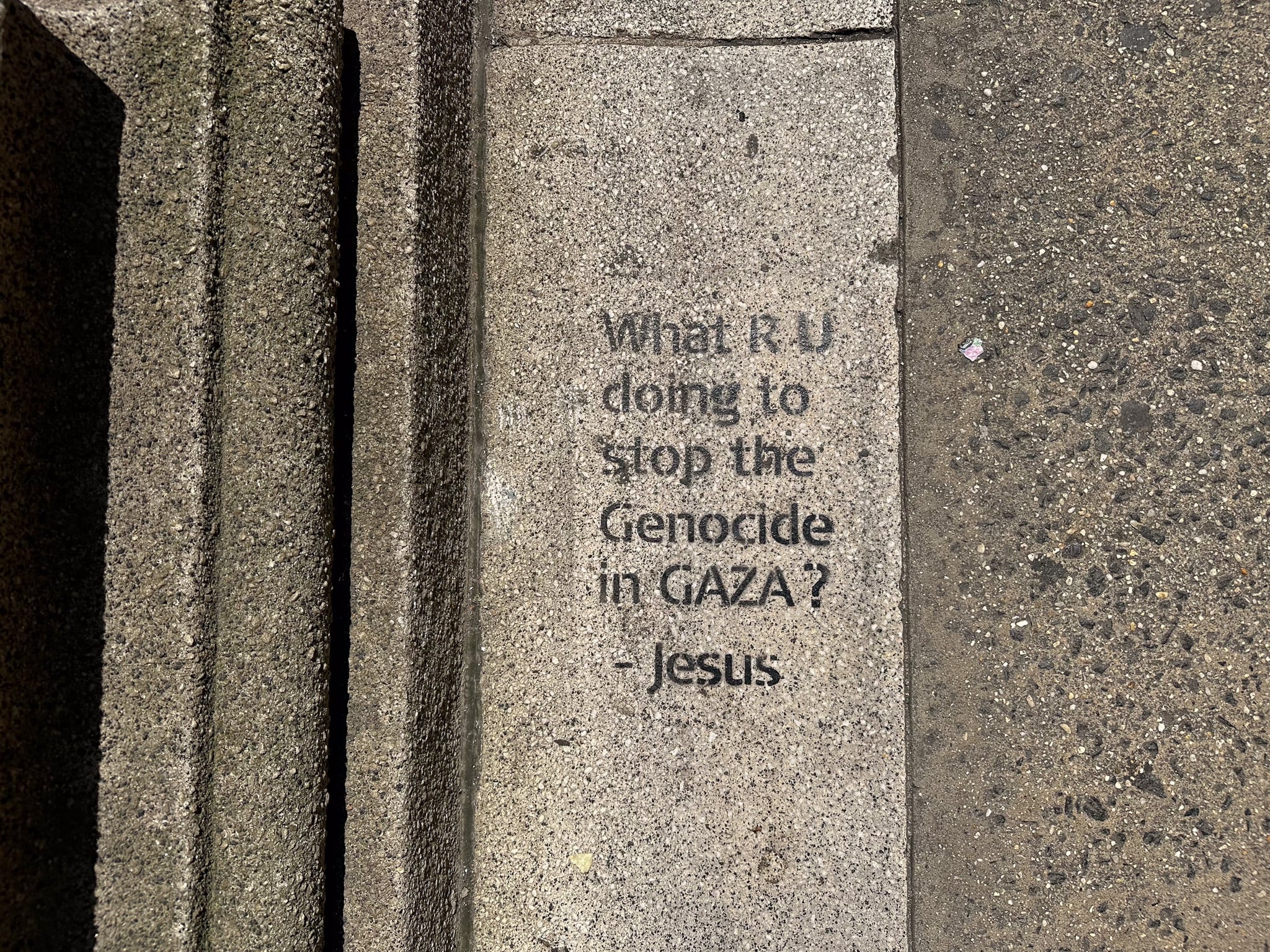
Graffiti spotted in New York City, connecting theology, messianism, and antizionism. Photo by Levi Meir Clancy.
On March 5, 2026, I was crossing the street in San Francisco wearing my kippah when a car drove into the crosswalk and yelled “Free Palestine” at me. That was the physical threat.
When I posted about it online, the incident opened into something else: a flood of antisemitic and antizionist responses, multiplied by the scalability of digital reach. One ugly moment became dozens of notifications, then more, then arguments and personal attacks that reached into my personal life. It was tempting to read every comment as a fresh revelation of how much Jew-hatred is out there.
Jewish organizations face this problem, too. When a synagogue, school, museum, federation, or nonprofit makes an ordinary post, there is always the possibility of a dogpile. This happens so often that many of us have a clear mental picture of it: one comment invokes libels; another asks a question that is asked of no other community in the world; a few comments insist Jews are fine, but not Zionists; flags and copy-pastes spread like spam.
Jewish institutions should pair moderation tools and security protocols with historical framing. Online Jew-hatred collapses into a few recurring scripts that non-Jewish parents and leaders have renewed for centuries. These scripts are not infinite or original, only repetitive and scalable.
In practice, hundreds of hate comments are never hundreds of original thoughts. They are just a few old scripts, carried forward from papal decrees, scriptural hadiths, and family discussions directly to the comment sections of today.
One script treats the Jew as a totemic obstacle. Antisemitism or antizionism becomes a global cause. The Catholic Catechism states that Jewish faith is the only thing preventing messianic return. The Quran states that all Jews will be killed as part of messianic arrival. The Hamas Charter repeats these views. The issue is not what Jews have actually done, but the fact that Jews do not disappear into a universal claim about a messiah, messenger, or freedom. When I see this frame, I remind myself that the commenter is reacting to their own worldview, not to me as a human being.
A second script treats the Jew as a trophy. Consider the trophies: Jewish defeat carved into the Arch of Titus in Rome; Jewish blood depicted in the Vatican; Safiyya, a Jewish hostage, elevated to the status of Mohamed’s bride; and Jewish graves turned into paving for a palace built atop the Mount of Olives. The commenter who says, “I love Jews but hate Zionists,” is consistent within their own logic. It is a butcher’s pride in what they want to carve from us. Once you recognize this script, a whole category of online discourse becomes easier to classify and refuse to internalize.
A third script treats the Jew as a contaminant. This is an enduring paranoia. Islamic scholars debated whether a Jew killed Mohamed. Christian scholars debated whether Jews brought the Black Death. These issues were treated as serious questions among non-Jews. Online, this appears in recycled claims about Jewish control, child murder, genocide, poisoning, and all-around evil. If a communications staffer can recognize that script quickly, it stops feeling like a thousand distinct accusations. It is one stale pattern passed by non-Jews to their children and students.
A fourth script treats the Jew as subordinate. Jewish equality is read as oppression, Jewish sovereignty is read as supremacy, and Jewish history is read as a threat. Echoing the Pact of Omar when the Caliphate conquered Jerusalem, or the Catholic Catechism of just a few decades ago, this is where the “this was promised to them 3,000 years ago” meme is rooted. Fundamentally, it is the idea that Jews may exist, but not as equals, and certainly not with a history or future on their own terms.
Why does this historical reframing help?
First, it reduces reactivity. If every hateful comment is read at face value, the nervous system gets scraped raw. However, the temperature drops whenever we recognize how repetitive these scripts are.
Second, it protects mental health. People managing Jewish social media accounts should not have to process every comment as a unique emergency. Historical framing creates strategic distance.
Third, it improves decision-making. Once you see the underlying pattern, you can develop and implement moderation strategies more consistently. Not every comment deserves the same response. Some comments should be ignored, some should be deleted, and some should receive a plain institutional answer. Historical awareness makes moderation smarter.
Jewish nonprofits should train the staff who run public platforms to identify these recurring scripts before engaging online hate. The volume of Jew-hatred on the internet can feel overwhelming. Our ancestors must have felt similarly stunned when facing Jew-hatred amplified by entire empires, kingdoms, caliphates, and regimes. We outlasted them. That is our advantage.
Related Topics
Related Posts