
Writer covering Israel–Africa, Jewish affairs, and Israel worldwide
A Beginner’s Guide to Middle East Translation (Warning: Reality Inside)
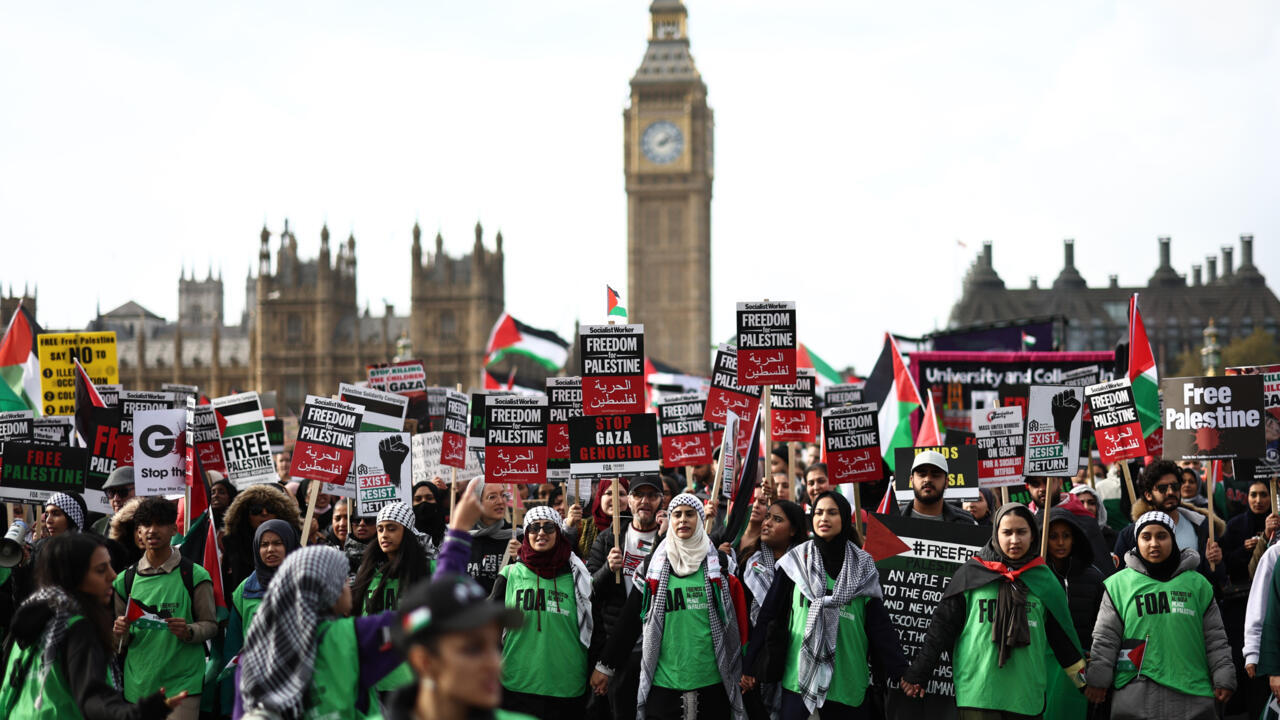
Many demonstrators waved Palestinian flags © HENRY NICHOLLS / AFP
If you only read the English, the slogans sound noble. If you understand the history—or the language—they sound very different. This is the small-print version of the chants, the part that doesn’t make it onto placards, social media captions, or headlines.
“Free Palestine”
On its face, “Free Palestine” sounds noble, like a rallying cry for national liberation—a people’s struggle against injustice, a head-on protest against “occupation” and “apartheid.” Indeed, activists at rallies deploy it under that banner: liberation, justice, and self-determination for a dispossessed people.
But even the context-aware admit it’s fuzzy: to some it simply means a call for independence alongside Israel; to others, it’s interlinked with the more charged phrase “from the river to the sea.” And crucially, Hamas—whose charter explicitly rejects any two-state framework—frames “free Palestine” as liberation through violent struggle and overthrow of Israeli control, not diplomatic settlement.
In short, on the surface, “Free Palestine” is dressed up as egalitarian emancipation—but even its proponents can’t agree on whether that’s peaceful coexistence or armed conquest.
“From the River to the Sea”
Next comes the slogan that practically invites misunderstanding by design: “From the river to the sea, Palestine will be free.” To many Western ears, it evokes a poetic dream of freedom for all people between the Jordan River and the Mediterranean Sea—a historical territory long contested and laden with sorrow. Advocates insist it’s about liberation and dignity for all living in that land regardless of background—framed as a peaceful call for equality and self-determination.
But notice how clean and pretty the English sounds compared with reality: the phrase rambles around multiple interpretations even before you get to its political baggage. Some defenders explicitly deny that it calls for violence; others claim the critics “misinterpret” its meaning. On its surface, then, this chant is a solidarity slogan, a catch-cry for liberation that sounds inclusive and anti-colonial—a picture perfect protest line for placards and Instagram grids.
“End the Occupation”
This phrase is tailor-made for the mainstream media and diplomatic press releases: “End the occupation” is simple, legalistic, righteous-sounding. Organizations use it to demand that “Israel must end its occupation of Palestine to stop fuelling apartheid and systematic human rights violations.”
On the surface, this sounds like a human-rights plea straight out of the UN playbook: unlawful control, pushing people around, international law this — human rights that. It’s a phrase that paints Israel as the bad guy, and implicitly positions the other side as the morally pure oppressed. There’s no mention here of how occupation is defined, what borders are implied, or what the end state would look like—just the call itself. It’s perfectly media-friendly, bureaucratic, and superficially attractive to audiences halfway around the world who just read the headline.
“Long Live the Intifada”
Then we hit the most volatile of the lot: “Long live the Intifada.” In Arabic, intifada literally means “shaking off,” often interpreted as resistance or uprising. At protests—campuses and international demonstrations—it’s chanted like a pep talk: resistance! uprising! energy! A youthful, almost rebellious catch-phrase for a new generation itching to be on the “right side of history.”
On the surface, intifada could be sold as symbolic resistance against oppression—think civil disobedience, public grievances, street autonomy. Broadcasters treat it like an archaeological token from a people’s revolt. But notice the slippery softness: that interpretation—nonviolent resistance—is rarely how it’s politicized. The surface language is uplifting and timeless: shaking off, rising up, throwing off chains. The slogan itself doesn’t spell out how that uprising happens.
The Surface Language
Seen from thirty thousand feet, all four slogans share something in common: they are designed to sound universal, righteous, and morally compelling. They are short, catchy, and look good in headlines and chants.
“Free Palestine” justice and liberation.
“From the river to the sea” freedom for all.
“End the occupation” human rights and law.
“Long live the Intifada” resistance and uprising.
On paper, these slogans are morally flawless. In reality? They’re like kale smoothies: look healthy, taste bitter once you swallow the history.
What They Mean vs. What They Really Mean
At this point, a pattern should be impossible to ignore. None of these slogans are accidental. None are merely sloppy translations or unfortunate misunderstandings. They are deliberately engineered to operate on two frequencies at once: one for Western consumption, the other for those fluent in the political and cultural language of the Middle East.
This is not a bug. It’s the feature.
Take “Free Palestine.”
What they say it means: freedom, dignity, self-determination, justice.
What it really means: freedom from Jewish sovereignty — and in its more radical usage, freedom without Jews altogether. The slogan survives precisely because it allows the chanter to deny that meaning while benefiting from those who embrace it.
Or consider “From the river to the sea.”
What they say it means: equality and liberation for all people in historic Palestine.
What it really means: a map with no Israel on it. Geography doesn’t lie, even when slogans do. There is only one state that disappears between the river and the sea — and it isn’t imaginary.
Then comes “End the occupation,” the most bureaucratic of the bunch.
What they say it means: roll back military control, uphold international law, restore human rights.
What it really means: redefine Israel itself as an occupying force — not just in the West Bank, but anywhere Jews exercise sovereignty. Once existence becomes occupation, elimination becomes justice.
And finally, the most honest slogan of all: “Long live the Intifada.”
What they say it means: resistance, uprising, shaking off oppression.
What it really means: a celebration of a violent legacy that included suicide bombings, stabbings, and the deliberate targeting of civilians — now repackaged for global export. The word may be abstracted in English, but its history is written in blood.
What makes this linguistic shell game so effective is that plausible deniability is baked in. Each slogan can be defended in polite company, disowned when challenged, and re-embraced when shouted among true believers. It is activism with an escape hatch.
This is why defenders rush to say, “That’s not what we mean.”
And critics respond as they should rightfully do, “Then why do those who chant it alongside you clearly mean exactly that?”
Language shapes reality. In conflicts like this, it also conceals it. These slogans are not misunderstood — they are strategically ambiguous, designed to radicalize without accountability, to threaten without confessing, and to mobilize without ever having to own the endgame out loud.
It’s the linguistic equivalent of ordering vanilla ice cream and getting ghost pepper. Pleasantly sweet until it hits your tongue.
In the next section, I’ll show why this double language persists, who benefits from it, and why the West keeps falling for the same rhetorical trap — again and again, with devastating consequences.
Why This Language Works (Especially on the West)
If these slogans are so loaded, so historically saturated, so transparently duplicitous—why do they keep working?
Because they are perfectly calibrated for a Western audience that prefers morality plays over messy realities. The slogans are short, emotive, and morally pre-sorted. They arrive already labeled: good versus evil, oppressed versus oppressor, liberation versus colonialism. No footnotes required. No historical literacy expected.
In English, the language is clean. In Arabic, it is combustible.
This linguistic laundering allows activists to outsource moral responsibility. Western students chant phrases they would never dare say plainly if translated honestly. Media outlets repeat slogans they would never print if stripped of their euphemisms. Institutions endorse “calls for justice” while remaining willfully blind to the ideological freight being smuggled in the baggage.
It is activism by implication: say just enough to sound righteous, never enough to be accountable.
And when those of the right mind object, the response is always the same: You’re overreacting. You’re misinterpreting. You’re weaponizing antisemitism.
Translation, apparently, is now a hate crime.
Turns out the West loves its slogans like it loves microwavable meals: short, easy to digest, and conveniently calorie-free when it comes to context.
When Language Stops Being Symbolic
There is a comforting myth—especially popular in academic and activist circles—that words are merely symbolic. That chants are catharsis. That slogans don’t matter.
History disagrees.
In the Middle East, language has never been ornamental. It has always been operational. Slogans precede violence. They normalize it. They prepare the moral terrain so that when violence arrives, it feels justified—inevitable, even righteous.
This is why “Intifada” isn’t a metaphor to Israelis.
This is why “From the river to the sea” isn’t poetry.
This is why “Free Palestine” shouted outside synagogues doesn’t feel abstract.
Words don’t just describe intentions; they reveal them. And when slogans consistently erase Jewish sovereignty, Jewish history, and Jewish safety, pretending otherwise is not neutrality—it is complicity. The tragedy is not that these phrases are misunderstood.
The tragedy is that they are understood perfectly by those who need them most—and ignored by those who should know better.
Words are not just words. They’re the blueprint for chaos—like IKEA instructions, but with rockets instead of shelves.
Translation Is a Moral Act
Every conflict has propaganda. But few rely so heavily on linguistic sleight of hand as the modern anti-Israel movement.
The genius—if one dares call it that—lies in the dual script:
One language for the cameras.
Another for the faithful.
Say liberation in English.
Mean elimination in Arabic.
Deny it when confronted.
Repeat it louder when unchallenged.
This is not a misunderstanding problem. It is a refusal-to-translate problem.
So the next time a chant echoes through a campus quad or floods a social-media feed, don’t ask what it sounds like. Ask what it has meant historically. Ask who first used it. Ask why Jews keep hearing threats where others hear slogans. Because in this conflict, translation isn’t academic, it’s ethical. And pretending not to understand a language doesn’t make its meaning disappear—it just makes the listener responsible for what comes next.
Translation isn’t just about language. It’s a morality test disguised as a chant. Pass it, fail it, or pretend you didn’t see the fine print.
Decode the slogans however you like—just don’t be surprised by what they actually reveal.
Related Topics
Related Posts