A blessing of love: Recalled
On the morning of October 8, the day after the atrocious and tragic events of October 7, I attended morning services on Simchat Torah, at Congregation Beth Israel, where I serve as the community’s rabbi. I was in a complete haze. The day before, we had learned of the devastating events unfolding in Israel. Our family had also received its own tragic news: my nephew, Yoav Malayev, died heroically, fighting at the gate of his base.
During the morning services, I remember breaking down in tears during the Shema and its blessings. I struggled even to stand during the Amidah.
In the Diaspora, it is customary on the morning of Simchat Torah to recite the Priestly Blessing during Shacharit, the morning service, rather than during Musaf, when it is customarily recited on the rest of the year’s holidays. Kohanim are forbidden to recite this blessing while intoxicated, and given the custom of drinking on Simchat Torah, it is preferable to recite the blessing before anyone has had the chance to drink. None of us were drinking that day. In retrospect, though, we probably should have recited the Priestly Blessing later, during Musaf.
Looking back, it seems I myself should not have recited the Priestly Blessing that morning at all, as several authorities forbid reciting it in a state of sadness. I was not sad. I was utterly broken.
I remember that shortly before the time for the blessing came, two dear members of the shul helped me to my feet, and in my memory, essentially carried me to wash my hands. I somehow made it back to the bimah in time.
Rabbi Josh Ladon led services that morning. He recited the first word: Yevarechecha. Be blessed. I tried to repeat it, but my voice cracked, and the letters came out shattered. Josh attempted the second word — Hashem, God — and now his voice cracked too. The letters came out shattered as well. And so, too, my own attempt to recite God’s name came out broken.
Somehow, we made it through the entire blessing — broken, shattered, feeling unblessed.
That week, I traveled to Israel to attend the shiva services at my sister’s family’s home, where the Priestly Blessing was omitted, as is customary during a shiva. This practice resonated with me deeply. I could understand, intuitively, why a mourner cannot feel God’s blessing — and even more than that, God’s love — during such troubled times. Not reciting it was a tremendous relief. Even a comfort, of sorts.
On Shabbat morning, we attended services at the local synagogue. During the Priestly Blessing, I felt incapable of joining in. I remained outside the sanctuary, grateful that I remembered the halakha that permits doing so, according to some authorities.
When shiva ended, I found myself in a state that in Hebrew I would call hatraf shel asiyah — a frenzied state of action. Every night, my friend Gavriel Porten and I filled the refrigerators of a local shelter housing evacuees from the Gaza envelope, funded by donations from our community. One evening, the siren went off while I was filling shopping carts at a supermarket with no proper shelter, and we were herded into its storage freezer. Another evening, it went off on the highway, and we lay face down on the dirt by the side of the road and prayed for our lives.
By day, I crisscrossed Israel — visiting CBI families now living in Jerusalem, most of their men already enlisted; meeting evacuees from Kfar Aza; making a three-hour drive from Tel-Aviv to see Jon and Rachel Goldberg-Polin in Jerusalem. Most of the roads were closed that day, as President Biden was visiting Jerusalem.
Looking back on that week, I think I threw myself into action for many reasons. But most of all, it was out of grief and desperation, out of a profound need to assert some sense of control and order, and also, to model a sense of purpose and hope. Not because I possessed any of those things, but precisely because I lacked them completely.
It took time before I could return to those moments and examine them. Did I act correctly? Did I really have a choice in the choices I was making? Part of me suspects I will always return to those days, in an effort to explain to myself things that can likely never be fully understood.
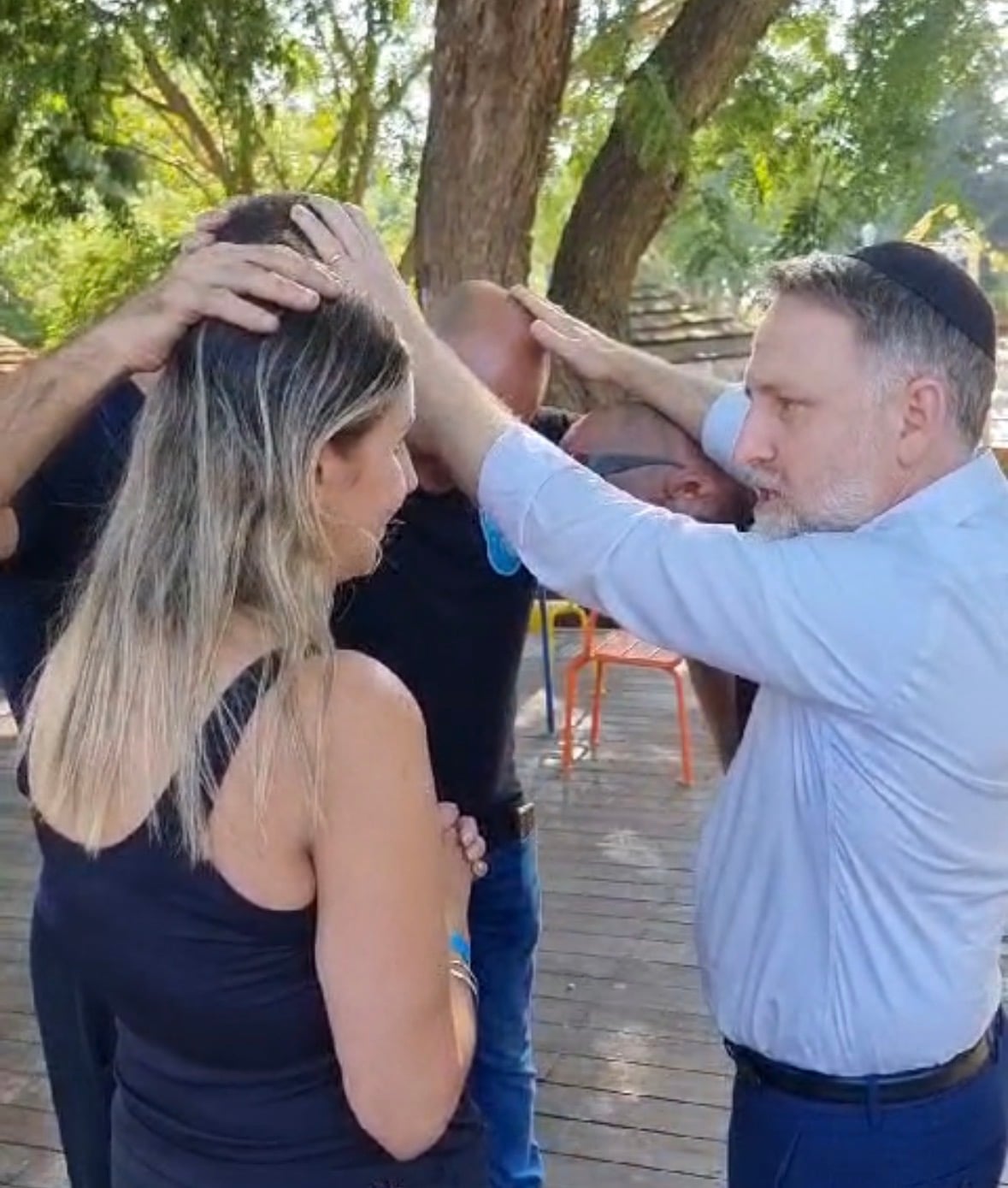
One of the most surprising parts of those frenzied visits was that at each encounter, I offered to bless the people I was visiting with the Priestly Blessing. And each time, they eagerly accepted the words of prayer.
A family whose father was now serving in Gaza gathered under my hands for the blessing. Jon and Rachel cried as I recited the words in their presence. A group of Kfar Aza evacuees gathered eagerly, in a group hug, for the Priestly Blessing.
My memory, as it kept trying to make sense of that period, returned again and again to those encounters. I felt increasingly ashamed of my own audacity — of the sheer naivety of imagining that a blessing could restore all that had been lost, or offer real comfort rather than a hollow faith in the face of such tragedy and devastation.
It felt like too much, and too soon.
For several years, not a month passed without my questioning that decision to offer that blessing. I felt out of tune and out of touch — spiritually, emotionally, pastorally. At my lowest moments, I felt like a false prophet.
Where did I get the sheer chutzpah — the audacious authority — to offer words of blessing when I could not feel blessed at all?
This past summer, I received a surprising answer to that question.
In early June, our family celebrated 20 years at Congregation Beth Israel. We were blessed to be joined by the rabbinic families who, together with ours, had served as part of the clergy team over these past two decades. At the gala, each of these families and individuals offered reflections about their time at our shul. One of these honored speakers was my dear friend, Elishav Rabinovich, who, together with Rabbanit Maayan Rabinovich, served as our shul’s youth and community directors from 2011 to 2014. When Elishav rose to speak, he shared these words:
“I remember the summer of 2014. We had just returned to Israel after our years here, at Congregation Beth Israel, during Operation Protective Edge. Rabbi Yonatan arrived in Israel soon after, called me, and said: ‘Come to Tel Hashomer Hospital — we are going to visit wounded soldiers.’ When I offered to coordinate, he replied: ‘No need. We’ll just go.’
“We went room to room. Rabbi Cohen asked gently if we could enter, introducing himself as a rabbi from the US and a kohen who wanted to offer a blessing. We stayed in some rooms for a long time. There were tears and hugs. It was life-changing. In Berkeley, Rabbi Yonatan is in his kingdom — the cultural codes are familiar. But in Israel, with the local cynicism and roughness, I wondered: would the magic work? And it worked. Wow, did it work.
“Inspired by this, I formed a small musical ensemble with friends. For over five years, we played in a rehab center before every holiday — Hanukkah, Tu B’Shvat, Purim.”
As Elishav shared those words, a rush of memories overwhelmed me. Moments I had forgotten returned to me all at once. Those words of blessing, offered to complete strangers in 2014 — wounded soldiers in a time of great need — had once meant something to me. And more than that, they had meant something profound to them: to those soldiers, horribly wounded and disfigured, who received those blessings.
And then one more memory returned to me — at that very moment — a lost key that had been in my pocket all along.
During the week of shiva, in the days following October 7, Elishav came to visit me. He was wearing his reserve army uniform. He was on his way to Gaza for the very first time. That morning, he had bid farewell to his wife, Maayan, and his five daughters, not knowing if or how he would return.
At the end of his visit, with Gaza as his next destination, Elishav asked me to bless him with the Priestly Blessing — the same blessing he had once seen me offer to soldiers at Tel Hashomer Hospital. The blessing he now wanted for himself.
For three years, I had forgotten that moment. How I laid my hands on his head, as a loving parent would. How I recited those words, fully aware of the severity of the hour. The desperate need for God’s blessing of love, grace, and protection.
What gave me permission for the audacious blessings I continued to offer all that week? Elishav did. And what gave Elishav the audacious nerve to ask for that blessing? I did — when I had offered that same blessing to other soldiers years earlier.
I had forgotten how to bless. But Elishav reminded me.
I had forgotten who I was. But my friend remembered me.
I had forgotten the sacred duty bestowed upon my ancestor Aaron the high priest, generations before me: to bless the people of Israel with love. But Elishav reminded me of that duty too — Elishav, whose name means God has returned to me. Indeed, I too have returned to God’s love.
When I think back on these past three years — years of profound loss and trauma — I first think of all the loved ones we lost. Too many relatives and friends. And I think, too, of all that we lost within ourselves. All that we had forgotten about who we once were, and even who we are now.
Blessings that were lost and needed to be restored. And so too, love, faith, and hope.
I needed Elishav to remind me of all that. In truth, we all need each other — people we love and people we trust — to remind us, to help restore us, to call us to feel blessed once again, to permit us to bless once again.
This past summer, we hosted the Froman family from Israel for Shabbat. Netaya, the father of the family, in his 40s, is the son of Rav Menachem Froman, of blessed memory — the eccentric, mystical, neo-Hasidic rabbi who was both a settler and a peace activist. Netaya shared with me that his father could never understand how a kohen could live in the Diaspora. “How could a kohen give up the opportunity to recite that blessing every day? To be a vessel of God’s love?”
The Froman family was now on their way back to Israel, after a year abroad. Their time away had been restorative, following three years of war and trauma. As they left our home, heading to LA from Berkeley for their flight back, they asked me for the Priestly Blessing.
I offered it eagerly. After all, how could a kohen resist the opportunity to be a vessel for God’s love?
They all gathered under my outstretched hands. With Israel as their next destination, and home in their hearts, I uttered these words: May God bless you and protect you. May God shine God’s countenance upon you and grant you grace. May God turn toward you with favor and grant you peace.
And so too, we pray for God’s continued blessing for Israel:
יְבָרֶכְךָ ה’ וְיִשְׁמְרֶךָ
יָאֵר ה’ פָּנָיו אֵלֶיךָ וִיחֻנֶּךָּ
יִשָּׂא ה’ פָּנָיו אֵלֶיךָ וְיָשֵׂם לְךָ שָׁלוֹם