
A Book for Society
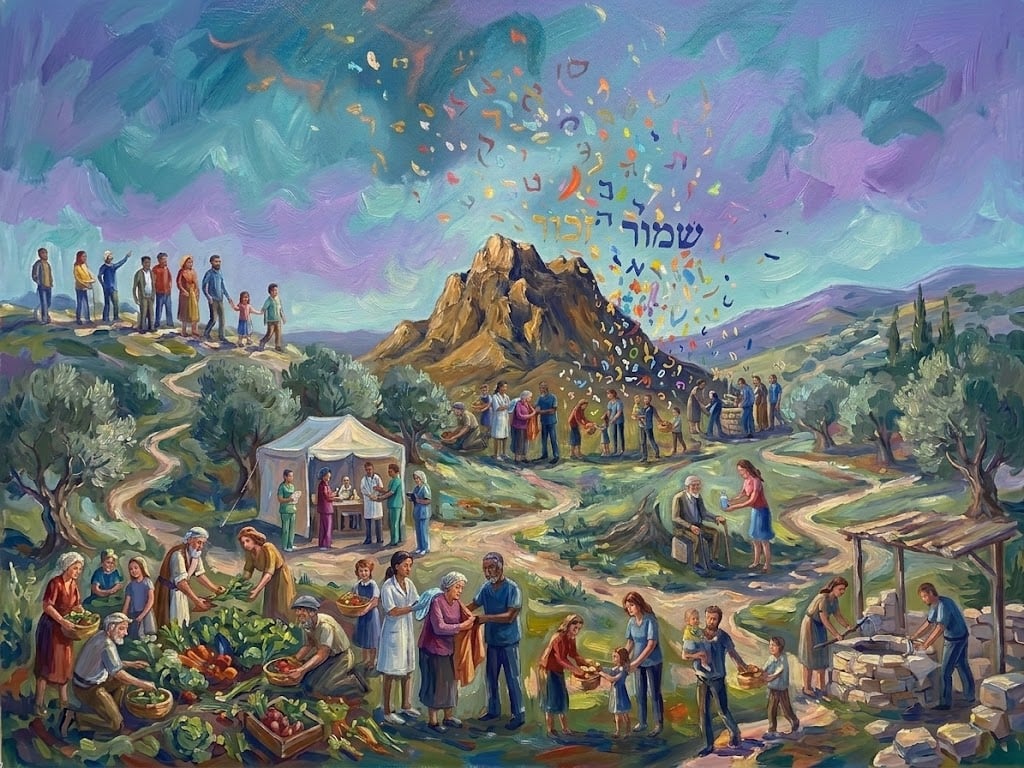
Hidden behind one of the oldest nicknames in Judaism lies a profound lesson for society. Sefer Devarim is also known as משנֵה תורה (Mishneih Torah). Perhaps self-given[1], this title was adopted by Jewish tradition[2] and has remained the book’s enduring moniker.
But what does משנֵה (Mishneih) mean? At least three answers are possible[3]: It could mean that it is a repeat, a summary of what has originally been mentioned in the Torah[4]. The Hebrew word for second is שני (sheni). Indeed, many of the laws in Devarim have been taught before. In fact, all of its stories – with the notable exception of Moshe’s heart-wrenching plea to enter the Land of Israel[5] – have already been told. A second explanation[6], could be related to the word שנון (shinun), literally “sharpen” – in the context of education – to impress and foster diligence upon students. Indeed, many of the rousing parts of Moshe’s speech and the memorable ceremonies that he directs, talk to the soul of the listener. A third alternative[7], is to relate it to the word משנֶה (Mishneh) which means secondary. This sees Sefer Devarim as a secondary layer to the primary text of the Torah. Rather than merely repeating what came before, it refracts the Torah through a new lens, adding an new dimension to what proceeded it.
These three explanations are not mutually exclusive. In Sefer Devarim we find many repetitions that are taught in a way that leaves a lasting imprint upon the reader and/or reveal a newfound perspective on an established idea.
The foremost example of this appears in our parashah. The story of the Ten Commandments first appears in Parashat Yitro. It is repeated, with notable differences in Parashat Vaetchanan. The most significant deviation appears between the two versions of the command to keep Shabbat. The first and most commonly known difference is the two different words used to introduce the mitzva of Shabbat. However, even more blatant are the completely different reasons the Torah gives for the observance of Shabbat in both accounts. Have a look here, first at the Ten Commandments as spoken in Parashat Yitro and then at them as listed this week in Sefer Devarim:
“זכור-Remember” the Shabbat day and keep it holy. Six days you shall labour and do all your work, but the seventh day is Shabbat of Hashem your God: you shall not do any work – you, your son or daughter, your male or female slave, and your cattle, and the stranger who is within your towns. For in six days God made heaven and earth and the sea and all that is in them; and then rested on the seventh day; therefore God blessed the Shabbat day and made it holy. (Shemot 20:8-11)
“שמור-Observe” the Shabbat day and keep it holy, as Hashem your God has commanded you. Six days you shall labour and do all your work, but the seventh day is Shabbat of Hashem your God; you shall not do any work: you, your son or your daughter, your male or female slave, your ox or your ass, or any of your cattle, or the stranger in your towns; so that your male and female slave may rest as you do. Remember that you were a slave in the land of Egypt and Hashem your God freed you from there with a mighty hand and an outstretched arm; therefore Hashem your God has commanded you to observe the Shabbat day. (Devarim 5:12-15)
The reason for Shabbat in the earlier command is to remember that God created the world in six days and rested on the seventh; we rest in imitation of God, to remember just that. In the second set of commands, we rest to remember that we were slaves, bereft of the freedom to rest. There is even an added explanation that your slaves should “rest as you do”. Being gifted freedom should make you extra sensitive to the freedom of others. Sefer Devarim repeats the mitzvah from the previous books but adds a new dimension: the human dimension.
This pattern continues. Sefer Devarim repeats the mitzvah of not holding slaves beyond, and freeing them after, six years. The reason for this mitzvah was clearly stated earlier in the Torah:
For they are my (God’s) servants, whom I brought forth out of the land of Egypt; they shall not be sold as servants. (Vayikra 25:42)
People are supposed to be the servants of God alone, ultimately that is the only service hierarchy that the Torah promotes. When this mitzvah returns in Sefer Devarim, it comes with a new purpose:
If a fellow Hebrew man or woman is sold to you, he shall serve you six years, and in the seventh year you shall set him free from you. When you set him free, do not send him away empty-handed: Furnish him from your the flock, threshing floor, and vat, with which Hashem your God has blessed you. And you shall remember that you were slaves in the land of Egypt and Hashem your God redeemed you; therefore I command this matter of you today. (Devarim 15:12-15)
The prior reason has not lost its relevance or potency, but another – human – dimension has been added to it. We know the bitterness of slavery from our own national experience. Therefore, we must break cycles of perpetual slavery. The slave is not merely freed. People cannot pull themselves up by their bootstraps if they have no boots. You must give a slave a starter package to propel him into his new life.
The commandments of Shmitta and Yovel were detailed at length in Sefer Vayikra. The land must lay fallow for one year of every seven. After seven sets of seven years land would return to its original owners. The reason was clearly stated:
But the land must not be sold for perpetuity, for the land is Mine (God’s); you are but outsiders-and-residents with Me. (Vayikra 23:23)
Shmitta returns in Sefer Devarim this time, with a new legal and philosophical dimension:
At the end of (a cycle of) seven years you shall do Shmitta (a release). This is what is required for the Shmitta, every creditor shall release the loan he extended to his fellow and to his brother for a Shmitta has been declared for God…. In order[8] that there will be no destitute among you, for Hashem will bless you, in the land that Hashem your God is giving to you as an inheritance to possess it. (Sefer Devarim 15:1-2,4)
Shmitta will now apply to capital alongside land. Alongside its theological message, a testament to God’s ownership of all property, there is now a social component: the neediest are given the opportunity to be freed of the burden of debt.
This theme continues throughout the whole of Sefer Devarim, whether through explicitly detailing new reasons for aforementioned mitzvot or adding new halachot or nuance to them, the theme is one and the same: A new human dimension is added to the Torah.
Consider the חגים-festivals. They are mentioned frequently in the Torah. They are repeated in Sefer Devarim with a new, crucial element to them:
And you shall rejoice in your festival: You, your son, your daughter, your servant, your maidservant, and the Levite, and the convert, and the orphan, and the widow who are in your gates. (Devarim 16:14)
You cannot rejoice and leave the most vulnerable alone. Celebrate together.
The reason for this new dimension is clear. Sefer Devarim is the closing book of the Torah, Moshe’s final opportunity to guide his people in the life they will live after he has passed. They will no longer be in a divine encampment in the desert. They will have to build a godly society. A place where they care for the other, as the other is created in the image of God. Sefer Devarim introduces a new human dimension to the Torah, telling the Jews the society they must form: one in which each cares for all and all care for each. If they do so they will become a beacon of the Torah’s values, shining out to the world.
–
[1] See Devarim 17:18, Yehoshua 8:32
[2] See Avodah Zara 25a, Hulin 62b. There are many examples of this.
[3] See Netziv, Introduction of Ha’amek Davar to Devarim
[4] See Rashi Devarim Ibid
[5] Devarim 3:23-28
[6] Rashi Ibid
[7] See Ibin Ezra ibid,
[8] Translation following Bechor Shor and Chizkuni (ibid), other commentaries translate differently, which gives that verse in particular a different meaning, but the overwhelming theme of these two mitzvot as introduced in Devarim, is to care for the vulnerable.