
Sports, Politics, Broadcast and Media Specialist
A Brief History – The beginning of Jews and Sport
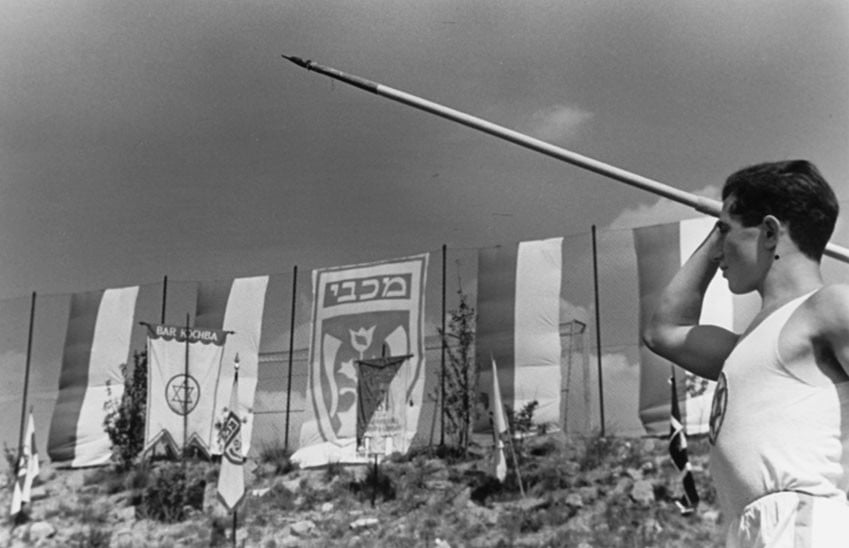
Source: https://www.maccabi.org/who-we-are/our-story
‘speerwerfer herbert sonnenfeld galleryimage’
The beginnings of Jews relationship with sport
Sport is often regarded as a kind of modern religion, serving as a bridge between cultures, nations, religions and ethnicities. Yet for centuries there has persisted a stereotype that Jews are not athletic. This idea can be traced to ancient Jewish thinkers who were wary of sport, largely because athletics in Greek and Roman times were intertwined with idol worship, notions of bodily sanctity and public nudity. Given this context, it is unsurprising that Jews were historically distanced from sport.
The end of the eighteenth century, however, marked the birth of modern athletics and the beginning of a flourishing relationship between Jews and sport. Jews participated in a wide range of disciplines, but one of the most unexpected was boxing. If one were asked to list the “most Jewish sports,” boxing would rarely appear—yet Jews have a remarkable history in the ring. Among Britain’s early boxing greats, Samuel Elias, Barney Aaron, the Belasco brothers and Isaac Bitton all proudly identified as Jewish. The standout boxer of that era was Daniel Mendoza, a Portuguese Jew known as “Mendoza the Jew,” who held the English boxing crown from 1792 to 1795 and became a favourite of the English public. Mendoza is widely considered the father of “Scientific Boxing,” elevating the sport from mere brute force to a disciplined art of strategy, concentration and skill.
As the nineteenth century progressed, Jewish athletes continued to excel. Lon Myers dominated the world of running, Lipman Pike became America’s first professional baseball player in 1866, and Louis Rubinstein of Canada captured the first world title in figure skating in 1890. Myers was regarded as the fastest man alive in the 1880s, while Pike helped launch the now-famous connection between Jews and baseball.
The seeds of organised Jewish sport were planted in 1898 when Hungarian physician and Zionist leader Max Nordau called for “Muscular Judaism” at the Second World Zionist Congress. His message inspired the creation of Jewish gymnastics clubs across Europe. These movements can be traced to 1895 in Constantinople, where German Jews excluded from local clubs founded their own, followed by the establishment of Gibor (later Samson) in Bulgaria in 1897. Similar organisations, such as the Bar Kochba club in Berlin, soon captured the imagination of Jewish youth in German-speaking communities. Their growing popularity led to the creation of an umbrella organisation in 1903: the Jüdische Turnerschaft. Nordau’s vision reached a symbolic zenith in Basel, Switzerland, when member clubs proudly demonstrated their athletic excellence before the Seventh Zionist Congress.
Although early Jewish clubs focused mainly on gymnastics, by 1909 Jews were founding organisations across a broader range of sports. Hungarian Jews established the Vívó és Athletikai Club (VAC) in Budapest and later the famed Hakoah Club of Vienna. Around the same period, fencing in the Soviet Union became known as “the Jewish sport” as Jewish athletes such as Mark Midler, Mark Rakita and Grigory Kriss won multiple gold medals and attained national prominence. Jews also excelled in table tennis: Hungary’s Viktor Barna won an astonishing 23 world titles in the 1920s and 30s, and between 1927 and 1935 the Hungarian national team captured eight world championships—losing only to an Austrian team, but both teams were almost entirely Jewish.
By the time World War I erupted, Jewish sporting movements across Europe were already thriving. The war reshaped Jewish athletic life, particularly as Russian Jews—barred from their clubs—migrated westward to Poland and Germany, where they established new organisations. In 1915, these efforts culminated in the creation of the unified Maccabi Club, which became the largest Jewish sporting institution between the wars. The momentum continued, and in 1921 the Maccabi World Union (MWU) was founded with the mission of achieving “the physical and moral rejuvenation of the Jews for the sake of the restoration and existence of the Jewish land and its people.” Throughout the interwar years, Maccabi clubs spread across the globe, reaching as far as Australia, South Africa and South America. Yet European clubs remained central, particularly the Hakoah Club of Vienna and the Hagibor Club of Prague. Hakoah Vienna, which won the Austrian national championship in 1925, achieved worldwide fame and became a potent symbol of Jewish pride wherever it played.
During this period, Maccabi and Hakoah clubs evolved beyond athletic organisations. They founded community centres that became social and cultural hubs, strengthening Jewish communal life and deepening the bond between Jews and sport. Parallel movements flourished as well: Hapoel expanded into Lithuania, Latvia and Poland, Betar established clubs in China and Manchuria, and Bund created athletic programs in Poland, the United States and Canada.
As the modern era unfolded during and after World War II, Jewish athletes continued to excel on the world stage. Among the most celebrated is the Hungarian gymnast Ágnes Keleti. Forced to delay her Olympic career due to war and injury, Keleti did not compete until the age of 31—remarkably late for a gymnast—yet she defied all expectations. At the 1952 Helsinki Olympics, she won one gold, two silver and one bronze medal. Four years later, at 35, she claimed four golds and two silvers at the Melbourne Olympics, finishing her career with ten Olympic medals. Her exceptional achievements and extraordinary life story make her one of the greatest Jewish athletes—and one of the greatest female Olympians—of all time.
During this same period, one of the greatest athletes in Jewish history emerged: Sandy Koufax. Born in Brooklyn, Koufax is widely regarded as one of the best pitchers ever to play baseball. A three-time Cy Young Award winner, league MVP, four-time World Series champion (and two-time World Series MVP), seven-time All-Star, and the youngest inductee into the Baseball Hall of Fame (36), his legacy is legendary. Yet the story most often associated with him—recounted by rabbis around the world on the High Holidays—is his decision not to pitch in Game 1 of the 1965 World Series because it fell on Yom Kippur. His absence made national headlines and won admiration throughout the Jewish world. In fact, his replacement Don Drysdale struggled in the game, and he famously joked to manager Walter Alston, “I bet right now you wish I were Jewish too.” The Dodgers went on to win the series, and Koufax’s choice became an iconic moment in Jewish sports history.
Since the late twentieth century, Jewish involvement in sport has expanded dramatically. Jewish athletes now compete—and thrive—in nearly every recognised sport worldwide. From Mark Spitz, Dick Savitt and Max Baer to Aly Raisman, Dara Torres, Jason Lezak, Sue Bird and Shawn Green, and today Jessica Fox, Domantas Sabonis, Max Fried and many more, the list of Jewish athletic achievements is vast. The old stereotype that “Jews can’t play sport” has been relegated to a myth.
The Jewish people have long been known for their hard work, determination, perseverance and intellect—qualities that translate seamlessly to the sporting arena. Jewish athletes also possess one unique source of strength: Am Yisrael. Wherever they compete, whichever nation or team they represent, Jews around the world cheer for them. Because when one member of our global community succeeds, we all succeed.
Related Topics
Related Posts