Retired NYC Teacher. Proud Jewish Voice
A Brooklyn Classroom, October 7, and Everything Between
A New York City Teacher’s Testimony
I never imagined that one day I would be writing about antisemitism.
For thirty-one years, I taught in the New York City public school system. Like many American Jews of my generation, I believed antisemitism was becoming a relic of the past. I believed in public education, diversity, dialogue, and the promise that people from every background could learn to live together with mutual respect. I believed America had largely solved the problem.
I retired in 2019 proud of my career.
Then came October 7, 2023.
The following day, while Israelis were still counting their dead and families around the world were desperately searching for missing loved ones, crowds filled the streets of New York City, celebrating Hamas. Posters of kidnapped Israelis were torn down almost as quickly as they were hung. Chants of “Resistance is justified” echoed through neighborhoods I knew well.
Like millions of Jews around the world, I watched in disbelief.
How had we arrived here?
For me, the answer did not begin on October 7.
It began decades earlier, in 1993, in a Brooklyn public school classroom.
Today, I am stunned by how quickly history has been rewritten, how easily otherwise compassionate people have accepted narratives that erase Jewish history and question the legitimacy of the world’s only Jewish state, and how eagerly many young Jews have embraced those same narratives.
Looking back now, I see a pattern that I completely missed while I was living through it.
I grew up as a thoroughly assimilated American Jew. Israel mattered to me, but I believed its struggles were largely separate from Jewish life in America. I married an Israeli, traveled there often, and loved the country, yet I never imagined that antisemitism would again become a defining part of Jewish life in America.
I believed that if we embraced diversity, celebrated one another’s cultures, and worked toward equality, everyone—including Jews—would benefit.
I was wrong.
Before I tell that story, let me be clear about what this essay is—and what it is not.
This is not a scholarly paper or an investigative report. It is the testimony of one New York City public school teacher who spent thirty-one years inside the system.
I know I cannot speak for every school or every district. I can only describe what I witnessed firsthand. But I suspect many educators across America will recognize parts of this story.
This essay is for anyone who has ever found themselves asking questions like these:
What exactly are our children learning? More importantly, what assumptions are they absorbing about history, democracy, Israel, and the Jewish people?
You don’t have to be Jewish to care about those questions. You can be Black, White, Hispanic, Asian, Indian, Christian, Muslim, secular, or anything else. You simply have to possess enough intellectual curiosity to wonder how so many thoughtful, compassionate people have come to embrace some of today’s most extreme voices in the name of social justice.
This is simply one teacher’s story.
The memories I had long dismissed as isolated incidents began fitting together into a much larger picture.
It is also the story of my own awakening.
I had recently left private education for what I believed was my dream job as a special education teacher in a middle school in Brooklyn. I was newly married, thrilled to have the security of a union position, and excited to begin building my career. Those early years were filled with teaching, traveling back and forth to Israel, and raising my young daughter, who had been born in 1991.
Black History Month had become an important part of our school’s programming, and I embraced it wholeheartedly. Like many young teachers, I was eager to learn and wanted my students to experience perspectives different from my own.
That year several new teachers joined the staff, fresh out of Brooklyn College. One in particular—I’ll call him Mr. B—immediately stood out.
He was charismatic, talented, and exceptionally gifted as an artist. As a Black educator in East New York, he was viewed as an important role model for our students. I understood that completely. In fact, I agreed with it. More Black men in education meant more children could see themselves reflected in positions of leadership and success. As a young white teacher from Long Island, I knew there were experiences I could never fully understand, and I welcomed the opportunity to learn from colleagues whose backgrounds differed from my own.
But gradually, I began noticing something else.
Mr. B’s artwork wasn’t simply educational. Increasingly, it framed history through the language of oppression and resistance.
One Thanksgiving, he covered an entire hallway wall with a mural depicting Native Americans being slaughtered by European settlers beneath a headline that read something very close to: Americans Give Thanks by Killing Native Americans.
Then came his response to the 1992 Los Angeles riots following the Rodney King verdict.
Like many Americans, I hoped his display would encourage healing after one of the country’s most painful episodes. Instead, another enormous mural appeared, filled with scenes of fires and destruction beneath a bold headline proclaiming that Black people were rising up against their oppressors.
I no longer remember the exact wording.
I do remember the repeated emphasis on “rising up” and “oppressors.”
At the time, none of this struck me as especially significant.
I was still completely unaware of where these ideas might eventually lead.
Then came Black History Month in February 1993.
Mr. B was chosen to create the school’s Black History Museum, and no one questioned that decision. His artistic talent was undeniable.
The entrance featured beautifully drawn portraits of prominent Black leaders. I remember Martin Luther King Jr., Malcolm X—and one face I did not recognize: Louis Farrakhan.
“What an incredible artist,” I remember thinking.
I had no idea who Louis Farrakhan was.
Someone else did.
Mrs. K, our school psychologist, quietly pulled me aside.
“Gwen,” she asked, “did you really look at what was in that museum?”
I admitted I hadn’t.
She then asked if I knew who Louis Farrakhan was.
I shook my head.
Mrs. K gently explained why his inclusion troubled her. Then she directed my attention to a large map of the Middle East displayed inside the exhibit.
“Look carefully,” she said.
I did.
Israel wasn’t there.
In its place was “Palestine.”
At that point, I had spent enough time in Israel to know the country certainly existed. I knew Israelis lived with terrorism and repeated wars. I wasn’t completely uninformed.
But I was confused.
Mrs. K wasn’t.
She was the daughter of Holocaust survivors.
At that point, Mrs. K gathered the few Jewish teachers in the school and explained why this wasn’t simply an oversight. She explained why it mattered.
We rallied around her, and together we encouraged her to speak with the principal.
It quickly became clear that the principal wanted no part of it. Rather than address the issue herself, she told Mrs. K she would have to speak directly with Mr. B.
She did.
It did not go well.
Mrs. K came out of that meeting visibly shaken. She told us she had begun by explaining that she was the daughter of Holocaust survivors and that was why she found both the map and some of the imagery so deeply offensive.
Before she could finish, he interrupted her.
His words have stayed with me for more than thirty years.
“Mrs. K, I really don’t give a damn what your people went through.”
I remember feeling terrible for her.
But only for a moment.
Then life went on.
If I’m being completely honest, I still didn’t understand what I had witnessed. I certainly didn’t imagine that one day I would look back on that conversation as one of the earliest warning signs of something much bigger.
What seemed like an isolated act of hostility in one Brooklyn school would, over the next three decades, spread through classrooms, college campuses, social media, and public institutions in ways I never could have imagined.
When Mrs. K told me what had happened, I was upset for her—for a second.
Then life went on.
I had absolutely no idea that this tiny seed of radical anger would, over the next three decades, spread quietly through parts of our educational system and eventually surface in ways I never could have imagined.
The bulletin boards stayed up. Louis Farrakhan remained part of the exhibit. The map without Israel remained on display. There was no pushback.
Mr. B continued to be celebrated as one of the school’s brightest young teachers, praised by the principal—a white Jewish woman from Park Slope who was nearing retirement. Looking back, I often wonder what she was thinking. I honestly don’t know.
By 1994, both Mrs. K and I had left the school. I guess we each instinctively knew it was time to move on.
For the next ten years, I rarely thought about any of it.
I transferred into another program working with very young children with autism. My days became consumed with helping students learn to communicate, build independence, and navigate the world around them. Politics and world affairs took a back seat. Around the same time, my divorce also distanced me from the daily conversations about Israel and the constant security challenges that had once been part of my life.
Like so many American Jews, it was easy to think, This just doesn’t apply to us.
Meanwhile, history kept moving.
Israel signed the Oslo Accords. Peace with Jordan followed. There was genuine hope that perhaps the conflict could finally begin to wind down.
Then Prime Minister Yitzhak Rabin was assassinated by Yigal Amir, a Jewish extremist. To this day, Amir remains in prison. Israelis did not elevate him to martyrdom or celebrate his actions. They mourned the loss of a leader and watched their country become even more divided.
At the same time, Israelis were enduring wave after wave of suicide bombings during the First and Second Intifadas. For many outside Israel, “intifada” sounds like a political slogan. For Israelis, it evokes memories of buses, cafés, restaurants, and shopping centers blown apart by terrorists targeting ordinary civilians.
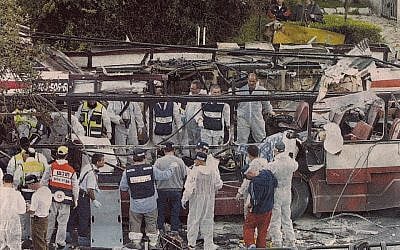
The security barriers and checkpoints that much of the world now criticizes did not emerge in a vacuum. They were built in response to a relentless campaign of attacks against civilians.
I had never seen a people so hopeful for peace with their neighbors—and then so repeatedly devastated when that hope was met with more violence.
I still didn’t fully appreciate what all of this meant for Jews living safely in America.
Not yet.
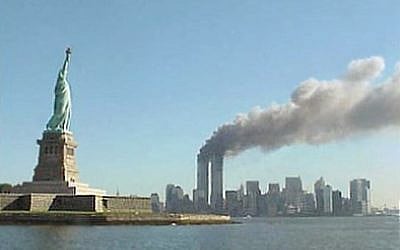
Back in America, we experienced our own terrorist attack on 9/11. I will never forget that day. Nor will I forget watching on television as Palestinians in Gaza and the West Bank celebrated, handing out candy, burning American flags, and shouting, “Death to America.” There were also widespread reports—largely ignored by the local media—of similar celebrations in parts of Brooklyn and New Jersey.
But enough history…
Enter 2005. After 10 years of working with very young, severely disabled children with autism, I was offered a position in a middle school inclusion program. Inclusion was a new initiative in District 75. For those outside New York City, District 75 is the special education district specifically designed to meet the needs of the city’s most disabled students. The new inclusion program was designed to help integrate children with autism and other disabilities into general education classes. It was sorely needed. These were kids who could truly benefit from the general education curriculum with the right support.
I couldn’t wait.
I loved middle school. I loved history. I loved collaborating with classroom teachers and adapting lessons so my students could fully participate. It felt like coming home professionally.
One of my very first memories was ignited while supporting a 6th grade class. I suggested a book on 9/11 to the teacher.
Remember, this was only a few years after the attacks. In New York City, almost everyone knew someone who had been directly affected. In many ways, it reminds me of how Israelis speak about October 7 today. Everyone knew someone.
I found a thoughtful, age-appropriate book explaining what had happened. It included real photographs—not graphic ones—and described the attacks honestly. It identified the perpetrators as terrorists motivated by an extremist interpretation of Islam.
To me, it seemed entirely appropriate.
The history teacher looked at me like a deer caught in headlights.
She became visibly uncomfortable.
Within seconds, I understood.
There was no way she was going to teach that lesson.
I let it go.
Looking back, I have often wondered why.
During those years, New York City’s schools were welcoming families from Bangladesh, Pakistan, Egypt, Yemen, the Palestinian territories, and many other parts of the world.
Schools understandably became deeply concerned about unfairly stereotyping Muslim students after September 11. Conversations about Islamist extremism were often avoided for fear they would be perceived as promoting Islamophobia.
Whether intentionally or not, that silence left many students without the opportunity to discuss the ideology that motivated the attacks, distinguish extremist movements from Muslims who embrace coexistence, or explore how democratic societies confront religious extremism while protecting religious freedom.
That omission has stayed with me.
At the same time I noticed less schools having their students stand for the pledge of allegiance. I remember one teacher telling me how the high school students talked over it while it came out over the loud speakers. Many schools stopped saying it at all.
Years later, I also began paying closer attention to reports about foreign funding flowing into educational and cultural programs, including initiatives supported by organizations such as Qatar Foundation International. In one widely discussed case, an educational program associated with P.S. 261 in Brooklyn came under scrutiny after educational materials reportedly displayed maps identifying all of Israel as “Palestine.”
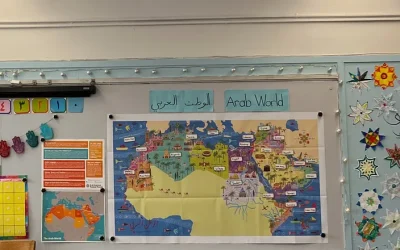
When I read those reports, I felt an uncomfortable sense of déjà vu.
I was back in 1993.
The map had changed classrooms.
The message hadn’t.
Then came October 7, 2023.
We all know what happened.
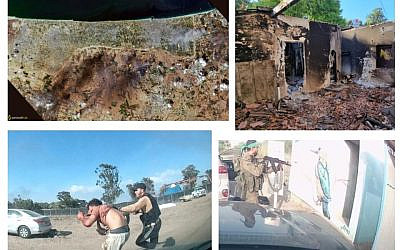
The next day, before Israel had even begun its military response, demonstrations celebrating what had happened appeared on the streets of New York and on college campuses across the country.
Posters of kidnapped Israelis were ripped down.
Calls for “intifada” echoed through neighborhoods I knew well.
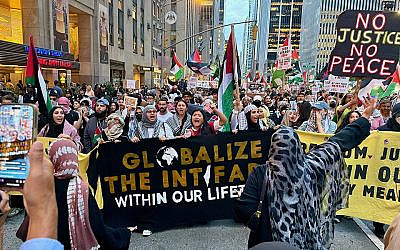
I watched, I couldn’t stop thinking about that classroom thirty years earlier.
Maybe that day hadn’t been an isolated incident after all.
Maybe it had been an early glimpse of an ideological shift that had quietly taken root over decades.
I don’t pretend that one classroom explains everything we are witnessing today.
It doesn’t.
But I also no longer believe that what I saw in 1993 was insignificant.
I believe ideas matter.
Curriculum matters.
The stories we tell children matter.
If we teach young people to divide the world into permanent oppressors and permanent oppressed, if we erase complexity, and if we present only one narrative of a deeply complicated conflict, we should not be surprised when slogans replace critical thinking.
That is why I am telling this story.
Not because I believe every teacher shares these views.
Not because I believe every school does this.
But because I witnessed enough over three decades to convince me that silence is no longer an option.
Young people deserve to learn how to recognize extremist ideologies, challenge them, distinguish them from mainstream religious belief, and understand the democratic values that make a free society worth protecting
Looking back after 31 years in New York City public schools, I don’t believe our greatest mistake was asking difficult questions. I believe it was avoiding them.
If we fail to teach those lessons, someone else will.
Related Topics