A Christian Filmmaker’s Striking Defense of Israel and the Jewish People
Todd Morehead, who’s made three feature films about Israel including a deep-dive into the nightmare of October 7, challenges claims in new NAZA documentary that IDF intended mass killings of civilians in Gaza.
By Allan Ripp
“I don’t buy it,” says Todd Morehead. A Christian minister from Southern California, Morehead is referring to the new film NAZA, which claims Israel Defense Forces purposefully engineered large civilian casualties in its war in Gaza. The 80-minute documentary won the Special Jury Prize at the Venice International Film Festival, prompting a record 24.5-minute standing ovation at its September 10 premiere. It’s now a top contender for an Oscar.
Drawing on anonymous IDF and intelligence sources, NAZA asserts Israel used artificial intelligence to execute remote nighttime strikes against Hamas combatants, enabling a “calculated mass killing of Palestinian civilians.”
According to one source, an airstrike targeting a single Hamas operative was greenlit with knowledge it could kill 500 civilians nearby, though no evidence followed that such a trade-off occurred. That lopsided calculus of lethality explains the film’s title, an acronym of two Hebrew words translated as “collateral damage.”
NAZA has prompted fierce denials by the IDF, while Israeli Prime Minister Netanyahu has backed legislation that could strip its co-directors, both Israelis, of their citizenship for defaming the country’s soldiers. But to those who’ve long swallowed the narrative that Israel’s response to the October 7 nightmare was disproportionate, NAZA is a neon-flashing guilty verdict.
Morehead has more standing than most to challenge NAZA’s thesis. He’s co-produced three feature films about Israel, including an examination of the long-boiling backstory to the war in Gaza called October 7 – Bearing Witness to the Massacre (available to stream on Prime Video and Apple TV). Difficult to watch, with graphic video pulled from encrypted Hamas channels, it shows the before, during and aftermath of the attacks and hostage-taking that day – all conspicuously absent from the new festival fan favorite.
“By what logic or benefit would the IDF intentionally target civilians, knowing that global opinion is stacked against it?” says Morehead, 48, who’s traveled to Israel 30 times and interviewed numerous active and retired IDF soldiers and senior officers. He notes the number of IDF members who’ve suffered grievous injuries from clearing suspected Hamas holdouts to check for civilians.
“Why repeatedly send soldiers into hostile areas at high human cost to save Palestinians when you could level entire neighborhoods without a scratch?” he asks. “Soldiers we’ve met say there’s strict adherence to the purity code on using weapons for the mission only and not against innocents. That ethos seems ingrained in the IDF, never mind that Israel regularly gives civilians advance public warnings about pending strikes.”
Regarding collateral damage, “It’s what Hamas wants – it’s their primary objective, there’s nothing collateral about it,” Morehead states, noting how much of the group’s weapons, explosive ordinance and fighters were well entrenched in homes, schools, hospitals and mosques throughout Gaza. “Neither the military nor political wing of the party care how many Palestinians die, since a higher toll fuels their message that Israel is committing genocide and feeds a global media storyline. And if they don’t get high death counts from an Israeli strike, they manufacture them.”
Morehead recounts how he and his co-producer Justin Kron pored over fake kill videos made by Hamas. “You can watch scenes of one Palestinian sprawled out as a fatality and see the same dude show up in another scene, and there he is again moving under a body bag.”
If Hamas was truly concerned about safeguarding civilians, there was a surefire option. “They had 400 miles of fortified tunnels equipped for habitation,” he explains. “Yet those passages were off limits to civilians except for squirreling away hostages. Hamas would rather use its people as sacrifices for its cause, which is the annihilation of Israel.”
Telling Cogent Backstory of 10/7
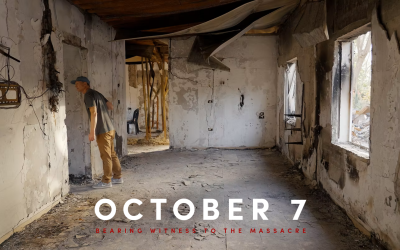
Made for $130,000 under a tight production timeline in 2024-25 to air in time for the second anniversary of the attacks, Bearing Witness to the Massacre is a well-researched and reported account of October 7. It includes interviews with Palestinian activists and Gazans as well as Jewish scholars, soldiers and politicians, including former Knesset member Einat Wilf.
The film traces the long arc of Islamic conquering expansionism and intolerance – against Christians and Jews. The very existence of Israel “is a theological affront to Muslims,” says popular biblical tour guide and author Joel Richardson, and any return by Jews is deemed “a permanent occupation.”
Also covered is Israel’s takeover of Gaza from Egypt after the 1967 Six-Day War and Anwar Sadat’s decline to reclaim the strip under the 1979 Camp David Accords. In a news clip from 2016, Bill Clinton recalls how in 2000 “I killed myself to make the Palestinians a state,” offering all of Gaza and 97% of the West Bank to create a sovereign state.” Yasir Arafat turned it down and in years following Gaza became a hotbed of militantism under the PLO, leading to the Second Intifada and some 1,400 Israeli deaths. Once Hamas gained control in 2005 following Israel’s withdrawal and with Iran’s full-on backing, Gaza devolved into what one Israeli Arab interviewed describes as an “urban war machine.”
Some of the film’s most disturbing portions depict indoctrination of Gazan schoolchildren. Not just the erasure of Israel from geography textbooks, or 4th grade math problems adding the sum of two sets of martyrs, but stoking violence in playful settings. In one Gaza TV kids’ show, a little girl prods her friend to pick up a stone “and when the Jews come throw it at them.” Another proudly says her uncle Ahmed is a policeman who catches thieves and shoots Jews, which is what she wants to do when she grows up – “all of them, Allah willing.” Little wonder Gazan teens are shown swarming Hamas recruitment centers.
Then there’s the raw footage of October 7, captured from the phones and GoPro cameras of Hamas fighters who burned and executed kibbutz residents or shot and mutilated those fleeing the Nova Festival. Included is the audio of the excited young attacker calling his parents from a victim’s cell phone to giddily report he killed 10 Jews “with my own hands,” while his folks wish him success. It’s horrific stuff and demands to be seen – and heard – to be remotely believed.
“To produce a film about the war and not discuss October 7 or probe Hamas’s murderous beliefs and what they teach their kids, or accuse Israel of genocide without mentioning the official genocidal intent of Hamas against Israel feels like documentary malpractice,” Morehead says. “NAZA actually makes our film more important than ever.”
A Surfer’s Path to Christian Zionist
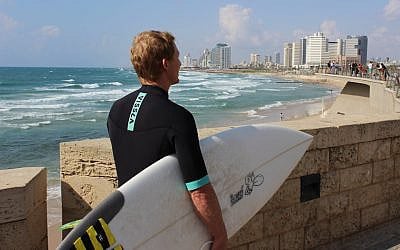
Morehead’s path to becoming a staunch defender of Israel was faith-based, combined with a love of the sea. The son of born-again Christians who “heard the Gospel,” Morehead says, “I realized I was a sinner at age 4 and needed a savior, so decided early to give my life to Jesus and seek forgiveness.”
As with many Evangelical Christians, “a love for the Jewish people came naturally, something that felt completely normal and compatible with my faith,” he continues. “I became fascinated by Israel not only as the birthplace of Christ but as ancestral home of the Jews.”
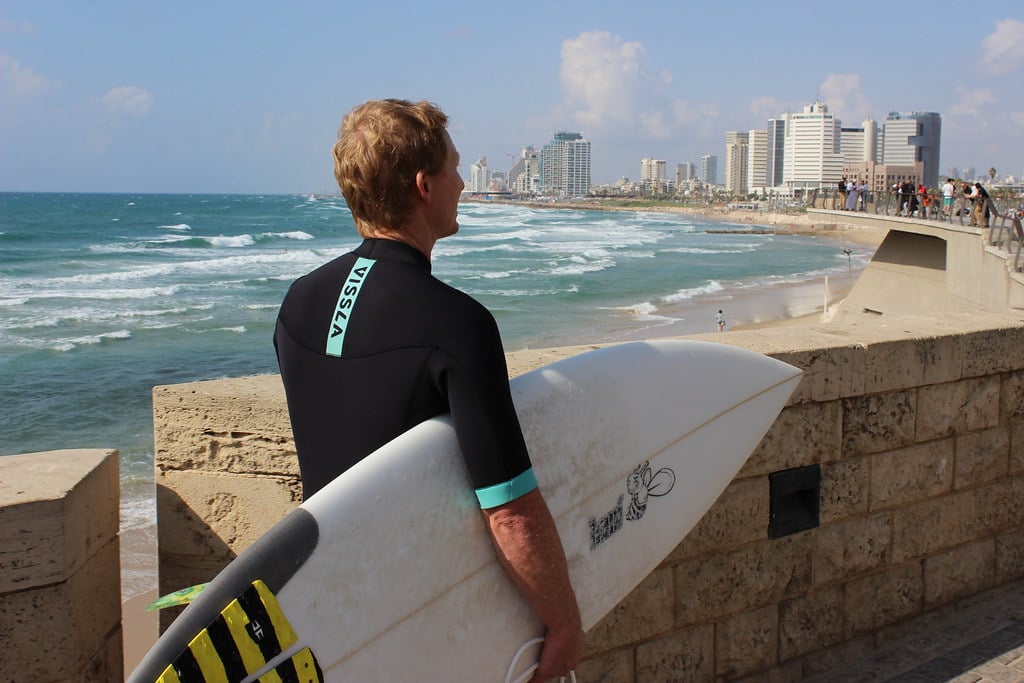
An avid water athlete, Morehead surfed competitively up and down the California coast from ages 12-19. Despite an intense love of the sport he felt he wasn’t cut out for the pro circuit and attended junior college, followed by a degree in organizational leadership at the Bible Institute of Los Angeles, where he later he added a Masters in theological studies.
At 22, he joined the Jesus Film Project, an outreach group affiliated with the Campus Crusade for Christ to spread scripture through films and videos. He also worked for Walking on Water, leading surfing camps and tours for Christian middle and high-schoolers, with trips as far away as Japan.
“Once I started taking surfers to Israel that was it!” he says. “It was a cool way to tell the story of the Holy Land through the lens of surfers there. Many had an Aliyah story about moving to Israel, or a Holocaust family history. And everyone spent two or three years in the army. It was a great bonding experience and there was the added closeness being with people surrounded by hostile neighbors who wanted to wipe them off the map.”
As part of his Israeli surfing education he befriended Dorian “Doc” Paskowitz, a Texas-born, physician credited with bringing surfing to the Jewish state around 1956. “Doc knew all the best spots from Maaravi Beach in Tel Aviv to Haifa and Jisr a-Zarqa,” the latter an Arab fishing village on the northern coast.
“Dorian had a big heart for Palestinians – he’d take surfboards to Gaza, where a whole generation of surfers came of age through him and the initiative he created, Surfing4Peace,” Morehead recalls. “Gaza actually has good waves – but unfortunately, Doc’s place shut down and became off limits after October 7.” (The devoutly Jewish Paskowitz, who was the subject of a 2007 documentary called Surfwise, died in 2014.)
That dual passion led to Morehead’s first feature doc entitled Promised Land, about two surfers worlds apart finding common spiritual ground – and water – in Israel. “Simply put,” Morehead wrote of the 2011 film, which he also directed, it “was made because historically the Church has not done a good job of loving the Jews.…Amidst this seemingly endless battle over land and religion, surfing has emerged as an escape from the controversy.”
Seven-Year Production for Hope in the Holy Land
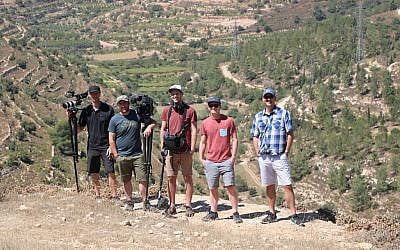
While promoting Promised Land Morehead was invited in 2012 to give a screening in Skokie, IL by Justin Kron, who headed a nonprofit called the Kesher Project to advance positive engagement between Christians and Jews (kesher being the Hebrew word for “connect”). Jewish on his mother’s side, Kron later showed Morehead several films made by Evangelicals that appeared to be fostering dialogue and harmony in the Middle East but placed ultimate blame on Israel for all that’s wrong in the region.
“Justin was infuriated by these treatments, which were full of historical half-truths and outright falsehoods,” Morehead recounts. “He was insistent we had to team up to make our own film to counter that anti-Zionist narrative.”
Over the next seven years they worked to co-produce a balanced, comprehensive film about the Israel-Palestinian conflict. The result was Hope in the Holy Land, creatively helmed by freelance director and editor Jesse Schluntz, with Morehead serving as an on-camera guide and interviewer of more than two dozen sources across the religious and ideological divide.
Released in 2021 and running just under two hours, Hope was well received, named Best Documentary by the San Diego Jewish Film Festival as well as earning a Gold Crown Award by International Christian Media and named an official selection by the Justice Film Festival.
“If there is one film you’re going to watch to understand the Israeli-Palestinian conflict, Hope in the Holy Land is it!” raved Col. Richard Kemp, former Chief of Command of British forces in Afghanistan. Yossi Klein Halevi, one of Israel’s most astute commentators, enthused: “This beautiful, politically nuanced and morally sensitive film models the approach to the Palestinian-Israeli conflict that I’d long hoped to see among Christians: an open heart to the two indigenous, traumatized peoples of the Holy Land.”
Morehead succinctly articulates his own position in making a film attempting to bridge an impossible chasm of religious mistrust: “If my theology doesn’t challenge me to love my enemy then I need a new theology.”
Side trip to Hebron, Where 97% of City Off Limits for Jews
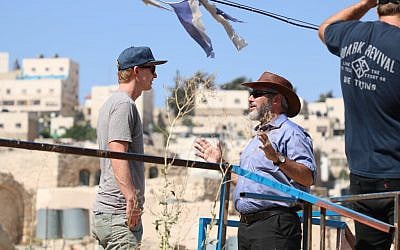
Morehead and Kron realized they had enough unused footage from Hope to create a series of mini-docs focusing on discrete aspects of their larger story. They outlined six separate episodes for streaming on YouTube, starting with a 26-minute take on historic tensions and violence in the West Bank city of Hebron called Liberation or Occupation?
In his laid-back Cali style, often peering out from a flat-brimmed baseball cap, the lanky Morehead calmly engages and listens to those he meets, asking them to estimate what percentage of Jews hate Palestinians and vice versa. Explaining the deep historic and biblical connections both sides have to the territory, the film looks back at an infamously brutal 1929 attack in Hebron that killed 67 Jews, an eerie foreshadow to more recent events.
Also featured is an extended conversation with Yishai Fleisher, a charismatic Haifa-born rabbi who serves as spiritual guardian of Hebron’s Jewish community, hemmed into a few narrow streets and compounds in ghetto fashion. Pointing to protective IDF outposts all around, Fleischer notes that Jews are prohibited from entering 80% of Hebron controlled by the Palestinian Authority, and effectively cut off from 97% of the city. “That to me, is the greatest apartheid in the region,” he says.
Pivoting to October 7, Preserving Record of Violence
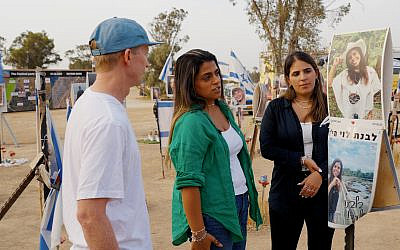
Barely a month after the Hebron segment debuted in September 2023, October 7 happened and the two filmmakers knew they had to pivot. “Within days of Hamas’s attack we saw the distortions spreading that Israel brought it on themselves after decades of illegal occupation and that inhumane conditions in Gaza justified the killings,” Morehead says. “We couldn’t let that stand uncontested.”
Using funding from Kron’s Kesher Project, the pair began sourcing video footage of the mass assaults and planning a trip to interview survivors and others. “One of the challenges of making this film was deciding how much of the onslaught to show, since it turned out there was so much video that Hamas captured, including a lot shared through Telegram and their own channels,” Morehead says.
In the end, the filmmakers went the more inclusive route, adding clips of savagery left out of other notable docu-accounts of October 7, such as Sheryl Sandberg’s Screams Before Silence and Wendy Sachs-Debra Messing’s October 8 – The Fight for the Soul of America.
The resonance from some of those scenes will not soon be forgotten, such as one attacker gleefully exclaiming how excited he was to be killing his first Jew. “We wanted to create a correct picture of a society completely joyful with that kind of violence against others simply because they are Jewish,” Morehead says. “They’re doing what they said they would do, what they were taught to do.”
Of course not all the victims were Jewish. Up to 79 foreign nationals were reportedly killed during October 7, including many agricultural workers from Southeast Asia and Africa, as well as Arabs, Bedouins and Israeli Druze.
In one especially telling point-counterpoint from Bearing Witness to the Massacre, a Black Lives Matter group in Los Angeles is shown cheering the attacks as an act of resistance and proclaiming the “close parallels between black and Palestinian people.” What the viewer sees next is footage of a young Tanzanian named Joshua Mollel, who was working as a dairy intern on Kibbutz Nahal Oz on October 7. Only 21 and on his first trip ever away from home, Mollel is shown being yanked around by a group of armed fighters and then executed at close range by AK-47 and knife. His lifeless body is then stomped on for good measure, followed by a graphic of the red-and-black Hamas fist. So much for solidarity with BLM.
Having set the table with extensive framing of the generational forces animating the attacks, Morehead says it didn’t make sense to hold back. “So many people still don’t believe any group could do such unspeakable things, or they associate shoot-ups with video games,” he says. “Unless you witness what happened you can’t imagine the level of depravity Hamas exhibited on October 7. We appreciate many viewers can’t watch because it’s so gruesome but the historical record demands that this terrible content be preserved.”
“So Not Like Us”
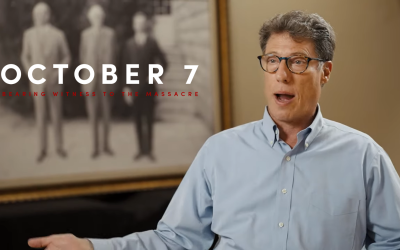
After making it through Bearing Witness to the Massacre, it’s worth a rewind back to the film’s opening, in which American-Israeli author Daniel Gordis talks about his son, a former member of an elite IDF unit as well as a medic who was sent to treat potential victims of October 7. None were forthcoming, since they had been left slaughtered in their homes and on roads or else grabbed as hostages, though returning soldiers shared vivid accounts and footage of the atrocities they encountered.
Noting his son was “not naive” about security issues, Gordis adds he was a “peace guy,” who formerly believed that Palestinians were “just like us: two states, peace –they just want a better life for their kids.” After all he saw and heard following the attacks, that outlook changed. “I think If he were sitting here now,” Gordis shares, “he would say, ‘They are so not like us.’” Which leads him to a natural follow-on question: “How do you convince Israelis to start working towards peace with a people who, given a chance, would do it again?”
Bearing Witness to the Massacre drew respectful response in the Christian press and won another top award by the International Christian Visual Media Association, the Christian equivalent of the Golden Globes. But it never cracked the mainstream festival circuit. “We didn’t even bother,” Morehead says, alluding to a likely cold shoulder from the same crowd that would honor NAZA a year later.
With limited marketing support, the film has not gotten the audience it deserves, though Morehead notes it lately has been beating similar titles in its small field on Prime. Others are noticing as well: at a rally in late September protesting a screening of NAZA at New York’s Lincoln Center, the Israeli-American Council mounted LED screens on small trucks running looped scenes from Bearing Witness to the Massacre.
Up Next – A Documentary Investigating Jihad Against the West
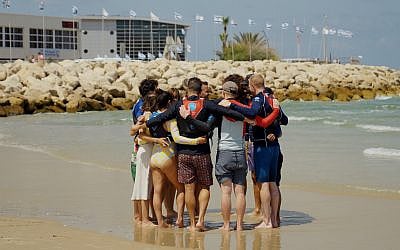
Back home in California, Morehead lives with his wife and four children and runs a nonprofit called Grafted Ministries, whose mission is to “awaken Christians and nurture love for the Jewish people.” Although ordained, he doesn’t preach and has no congregation – “I’m no pastor,” he says. Rather, he uses Grafted to lead pilgrimage tours to Israel (where he’s also surfed with October 7 survivors in Herzliya), produce philosemitic study guides and foster ties with Jewish groups.
“I hang out with all the Chabad rabbis,” he jokes, adding: “We’ve made real strides building friendships between our local Jewish and Christian communities up and down California. It’s the antithesis of what’s been happening nationally and feels important right now to keep those historic bonds close.”
And there are more film projects in works, in hopes of rallying greater support among Christians for Israel. Morehead feels an urgent need to awaken audiences to the looming threat of a larger social takeover, “curated by radical Islamists and Marxists.” He and Kron are planning a documentary investigation of jihadism in the West, focusing on Dearborn, Michigan, London and other cities inflamed with anti-Zionist extremism. They hope to raise a bigger production budget to support their director Schluntz once they get into the field.
“Americans should understand that the war Israel wages every day is also being waged in the U.S. and Europe,” Morehead says. “We need to educate people on why our Judeo-Christian heritage and our values are under threat. Without the full context of what happened on October 7, you miss the big picture.”
Allan Ripp runs a press relations firm in New York.