A Critique of Demis Hassabis on AI and Creativity in Visual Art
By Joe Nalven. Initial critique by ChatGPT; review and drafting by Claude.
Demis Hassabis runs Google DeepMind and shared a Nobel Prize for work on protein structure. Accepting the Royal Society of Arts’ Albert Medal on September 11, 2026, introduced by Hannah Fry, he turned an evening meant to honor his scientific work into an argument about creativity. His position has several parts. Creativity, not raw capability, is what separates good scientists from great ones. Technology only opens possibilities; it does not decide what we should do with them. Human creative work may keep a distinctive meaning because audiences care about what a story is based on. And education needs a radical change so that schools protect the human capabilities AI cannot supply.
I asked ChatGPT to critique these views. I then asked Claude to test the critique against the recording. This essay reports what held up, what needed correction once the actual source was checked, and where I come out, including from my own history as a working artist.
As you read this essay, and consider my art-making, the question of authenticity should be front and center; I, like many using AI, are exploring de-centering the human ‘I’ to include AI as a partner, more than just a tool. What that means is an unresolved issue, but it lurks beneath and within how much we are willing to be transparent about it.
Three claims presented as one
Hassabis makes three separate claims, though he is more careful than a composite picture suggests. The first is that AI will become very capable at producing creative work. He does not dispute this. The second is that this capability changes what artists do, since technology “enables the opportunities” without defining what we do with them. He states this directly. The third is that human work will keep a distinctive value because people care about knowing a story is based on something someone actually lived through.
That third claim he treats as an open question, unsettled. He says the question of “what is the difference between the craft and the soul of a creative piece going to be in a world where AI can create” needs an answer from the arts and the humanities, not from the technology itself. This is a more honest position than “AI will replace artists” versus “AI is just another tool.” He names a question and declines to answer it himself. That deserves credit.
Not a linear scale
The most useful thing he says is about how creative work gets judged at all. He rejects the comparison AI capability invites, saying that in creative fields there is no notion of “better” along a single scale, unlike chess, where a stronger move is simply stronger. Instead the relevant question becomes what is more meaningful to another human being, and he points to the emotional weight of knowing a story is based on something the author actually lived through.
This is a real distinction, and it matches research on how people evaluate creative work. Studies of AI-assisted visual art report that disclosure that AI was involved reduces how authentic and valuable viewers judge the work to be, especially when AI supplied the execution rather than only early ideas. A large study of over four million artworks found that adopting text-to-image tools increased artists’ output and the number of works rated favorably, but the average visual novelty of the work went down. People can enjoy a piece and still value it less once they learn how it was made.
So Hassabis’s claim about meaning depends on something he does not spell out: an audience actually knowing the history of a work. And here a real problem appears. People are not good at telling AI-generated images from human-made ones without being told. One recent study found accuracy close to chance. If viewers cannot detect provenance on their own, the “meaningful to another human being” standard he describes needs institutions that record and disclose how work was made. It will not survive on its own just because people prefer knowing.
Where the critique needed correction
ChatGPT’s original critique, working from different Hassabis remarks, made several claims that do not survive contact with what he actually said at the RSA.
It argued that art depends on the resistance of a medium, meaning the way marble refuses to cooperate or paint does something the painter did not intend, and that AI removes this resistance by simply delivering results on request. Hassabis does not make this claim, and it is not accurate as a description of working with image generators. The models misread prompts and default to familiar compositions. The resistance has changed in kind. It has not disappeared.
It also treated the third claim, that human work keeps value because of a human hand, as one Hassabis confidently asserts, then countered it with Duchamp’s Fountain, a factory urinal submitted for an art exhibition, to show that manual labor was never the actual source of artistic value. But Hassabis does not claim the value sits in manual labor. His own phrase is “craft, intuition, the soul of the piece,” and his stated criterion is what a story is based on, not whether a hand touched the object. The Duchamp point is fair against a cruder version of the claim than the one he made.
The earlier critique’s strongest and still valid point concerns economics rather than authenticity. It called “AI slop” not a quality problem but a cost problem: when a competent image costs almost nothing to produce, a market can be flooded with competent images, and buyers often prefer good enough, cheap, and immediate over excellent, expensive, and slow. This is happening now to illustrators and concept artists, and it is not something Hassabis addresses when he says technology lowers barriers to entry. Lower barriers for everyone mean more competition for the same attention and income.
A working artist’s trajectory through this same question
I did not arrive at this argument only as a reader. My own work has moved through collage, photography, mixed media, digital art, music-dance video, fused glass, and now AI-assisted visual art, in that order. Each medium changed what my hands did and what a viewer could see of my decisions in the finished piece. Fused glass required me to accept the kiln’s own behavior as part of the result. Digital art let me undo and layer in ways collage never did. None of these transitions was treated by anyone as a loss of authorship, because in each case what stayed constant was that I was choosing, arranging, and deciding what the piece would become.
AI-assisted work is a continuation of that same trajectory, not a break from it. My show Emergence at the Escondido Arts Partnership and my second-place piece Generalissimo in that venue’s HiRez exhibit both used AI as part of the process, and I say so explicitly rather than letting a viewer assume otherwise. This is the same practice I currently follow crediting ChatGPT, Gemini, and Claude by name in my writing, applied to images instead of text.
Generalissimo makes this argument formally rather than only in an artist’s statement. It is, in effect, a collage: built through successive iterations, each one shaped by my own decisions about what to keep, discard, or push toward next. The medium existed only as pixels through that entire process, generated in Stable Diffusion and reworked with Photoshop’s generative fill, and only became a physical object at the very end, when it was printed on paper. The fractured, overlapping surface of the jacket and trousers is the visible record of that iterative assembly, closer to a jigsaw of successive passes than to a single continuous gesture. The leg crossing out of the gilt frame onto the plain floor below breaks the fiction that this is a settled, single-take object; it says the image was built in stages and is still being handled. The two cards resting in the seated figure’s hand read as a small wink at the selection built into every iteration, the same role I played each time I chose one generated pass over another and carried it forward. None of this hides the process behind the illusion of a single traditional medium. It does the opposite: the fracture is left visible, so a viewer looking closely can see the work as a composite of my own successive choices, not something issued whole. That is the disclosure this essay argues for, done in pixels and print rather than in a caption.
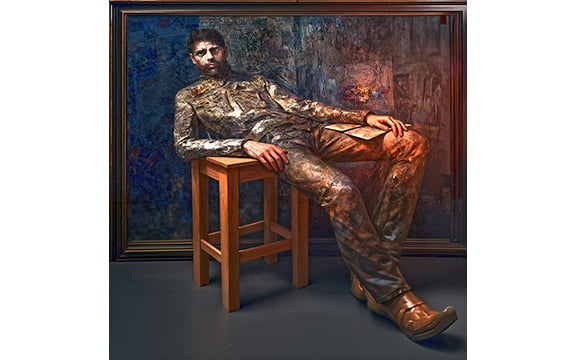 Generalissimo
This bears directly on the gap in Hassabis’s argument. He wants viewers to find meaning in knowing what a work is based on, but he does not say how a viewer is supposed to know that. My answer, from inside the practice rather than about it, is disclosure as a standing rule, not a caveat added when asked. A collage artist does not hide that scissors and glue were involved. An AI-assisted artist should not hide that a model was involved either. The medium changes. The obligation to let the viewer see the process does not. To be sure, viewers who are resistant to a medium, whether AI, digital art, photography, will simply walk away. This is not new in art.
Where I come out
The likely division is not between AI art and human art. It is between image production and the kind of authorship an audience can locate a person inside of. Hassabis is right that AI will make image production nearly unlimited and right that this does not by itself decide what art means. He is also right to treat the question as open rather than to assume, as a cruder optimism might, that people will keep preferring human work simply because they always have.
My own history across seven media suggests the condition under which his open question gets answered in part. It is not medium purity. It is transparency about process, consistently applied, regardless of which medium a body of work happens to be in. Other issues, such as the history of art curation, the monetary value placed on objects on auction or at galleries, and its perceived value by different audiences in different cultures are also at play. Time will tell.