A Day Trip to Auschwitz, 1989
Two Holocaust survivors. Their first grandchild. And a dandelion picked from the grounds of the largest killing center in human history.
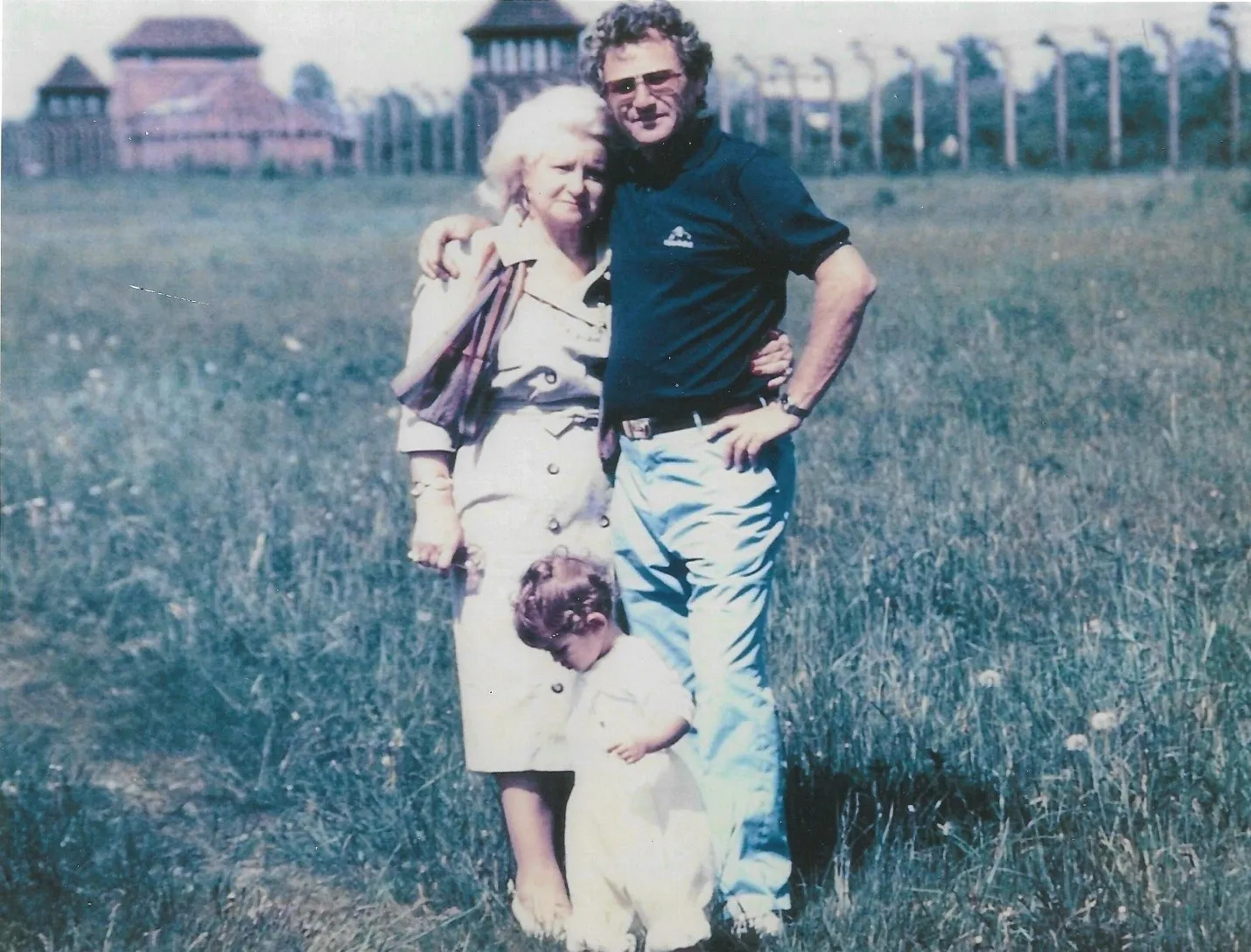
Look at this photograph.
A woman and a man stand in a field of tall grass. She has her arm around his waist. She leans slightly into him. Between them, pressed against her grandmother’s leg, a toddler clutches a dandelion — picked from the ground moments before, the way children pick dandelions everywhere, because they are bright and soft and close to the earth.
Behind them:
a watchtower.
a fence of concrete posts, still strung with wire.
the wooden barracks of Birkenau, fading into the summer haze.
This is not a meadow.
This is Auschwitz.
And the dandelion grew from soil mixed with ash.
The woman is my mother-in-law, Edna Brill.
The man is my father-in-law, Harry Brill.
The child is Rachel Alana, their first grandchild.
It is June 1989. The grass has grown tall. The sky is soft. And two Holocaust survivors have brought new life to the place that was built to end all of it.
What strikes me first is how ordinary they look.
A couple on vacation.
He wears a polo shirt, sunglasses pushed up.
She wears a belted coat, a scarf draped casually over her arm.
They could be tourists anywhere — Rome, Paris, the countryside of southern France.
But they are not anywhere.
They are standing on the grounds of the largest killing center in human history. More than one million people were murdered here. The earth beneath their feet holds ash.
And between them stands a child who knows none of this.
A child whose entire existence answers a question the Nazis never imagined would be asked:
What happens after you fail to destroy a people?
This happens.
A granddaughter happens.
Edna was born Edna Szurek at 18 Mila Street, Warsaw. She was not yet five when the bombs fell on September 1, 1939.
By seven, she was smuggling food through holes in the ghetto wall.
By nine, she was living on the Aryan side under a false Catholic identity, singing and dancing on the streets for coins.
She joined the Polish Home Army as its youngest soldier — nom de guerre Kajtek — running messages through sniper fire during the Warsaw Uprising. She was wounded by a grenade. On her tenth birthday, she received two military decorations.
No one knew she was Jewish.
After the uprising collapsed, she was sent to Oberlangen, the only all-female POW camp in Nazi Germany. After liberation, Pope Pius XII awarded her a papal medal for exemplary Catholic heroism.
She was a Jewish child.
Still hiding.
She remained hidden — as a devout Catholic student at St. Mary’s Convent in England — until her brother Yakov arrived and sang her a Yiddish lullaby their mother used to sing.
The walls collapsed.
The Jewish girl buried inside the Catholic woman broke through.
Harry’s war followed a different path.
He survived in the forests of occupied Poland, then boarded the Exodus 1947, the refugee ship carrying 4,500 Holocaust survivors toward Palestine. The British intercepted it, rammed it, and forced everyone back to displaced persons camps in Germany.
Eventually, Harry reached Israel.
Edna and Harry found each other at Kibbutz Lohamei HaGetaot — the Ghetto Fighters’ Kibbutz — founded by survivors of the Warsaw Ghetto Uprising, including Edna’s brother Yakov.
Two people who had lost everything.
Two people who refused to let that be the end of the story.
They married in Nahariya in 1953. On the ketubah, Edna kept the name she had lived under during the war:
Stefania Skólkowska.
A Jewish wedding.
Under a chuppah.
In the Jewish state.
Signed with a Catholic name she could not yet release.
By 1989, Edna and Harry had been in America nearly thirty years.
They had two sons. They had built a life — not a cautious life lived in the shadow of survival, but a big, unapologetic one.
Edna was radiant. Larger than life. The center of every room. She dressed magnificently. She danced. She went out every weekend. She adored her grandchildren.
She lived as if living itself were an act of defiance.
Which, for her, it was.
That June, Edna and Harry brought their first grandchild back to Poland.
They stood at the Mila 18 memorial in Warsaw — the mound built from the stones of Edna’s childhood home, now a mass grave covering the bunker where Mordechai Anielewicz and the fighters of the Warsaw Ghetto Uprising died.
And then they came here.
To Birkenau.
I have studied this photograph for years.
What I cannot move past is the grass.
It grows tall and wild when no one tends it — when nature reclaims ground soaked in human cruelty. It is June. The field is green. Dandelions bloom.
And a toddler stands in it the way toddlers stand in any field.
Rachel does not know that over a million people were murdered within sight of where she stands. She does not know what her grandparents survived. She does not know what the ground holds.
She is simply a child, pressing against her grandmother’s leg, holding a flower.
And Edna is smiling.
There is a tradition in Holocaust remembrance of bringing the next generation to the camps. Survivors bring their children. Their children bring theirs. It is an act of witness.
But Edna and Harry did something else.
They did not bring Rachel to Birkenau to teach her. She was too young to learn.
They brought her for the simple, defiant fact of her being there.
A granddaughter.
Standing in the grass.
At Auschwitz.
Holding a dandelion.
Alive.
Harry died in 2020.
Edna died on June 8, 2019, at eighty-four.
Rachel grew up. She is no longer the toddler burying her face in her grandmother’s coat. She is a woman now, carrying the memory of two survivors who refused to let the worst century in Jewish history determine what followed.
I married their son.
For thirty-seven years, I listened to Edna’s stories. I watched her fill every room. I watched her hold her grandchildren with a ferocity that only makes sense when you understand what she nearly lost — not only her life, but the future that depended on it.
This photograph is the evidence.
Two survivors.
A grandchild.
A dandelion.
A killing field turned green.
The Nazis built Birkenau to be the end of the Jewish story.
Edna and Harry stood there with a child and proved that history did not cooperate.
Janet Bond Brill, PhD, is the author of Little Edna’s War, based on her mother-in-law’s Holocaust testimony, published on January 27, 2026, on International Holocaust Remembrance Day.