A different look at Israel: Beyond the headlines
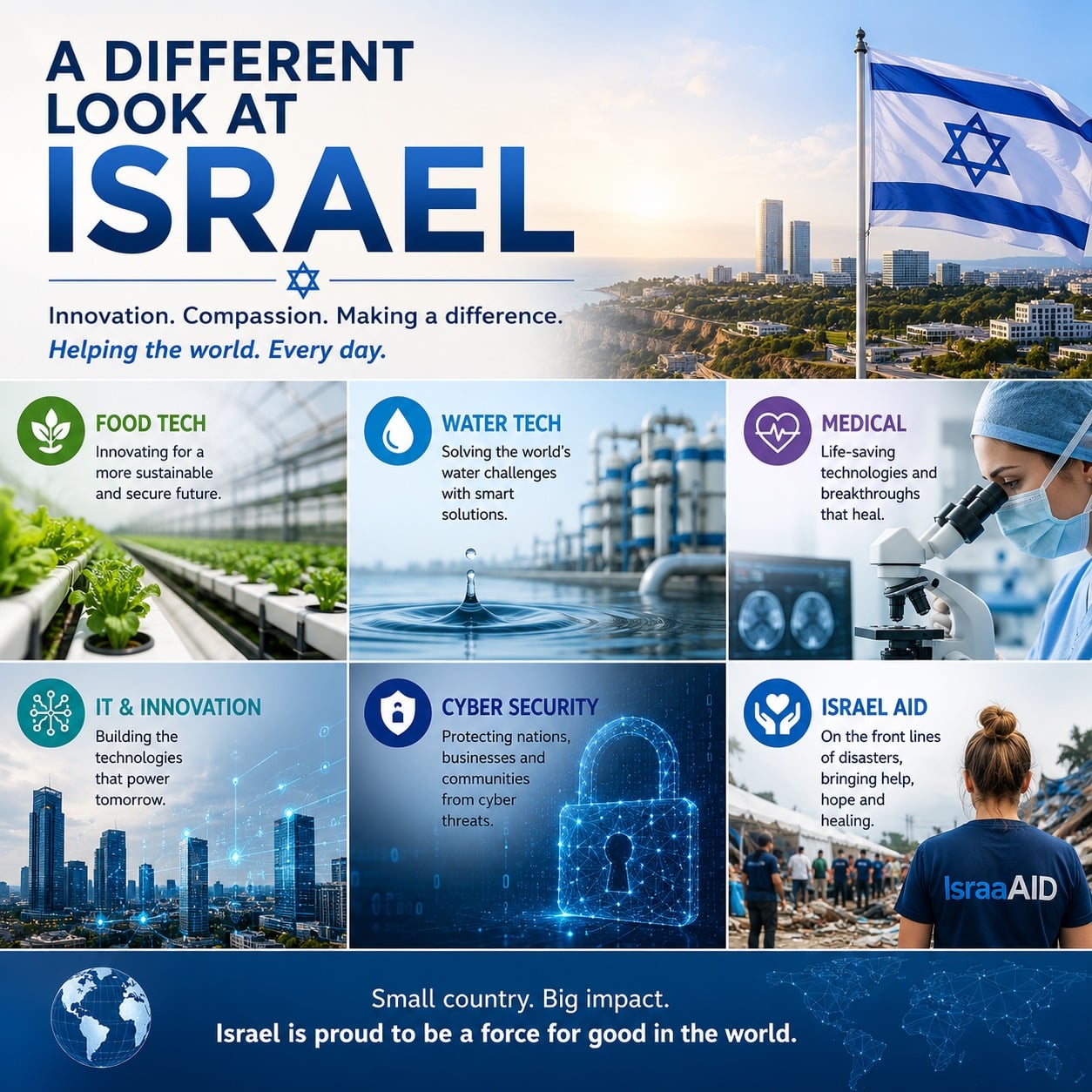
A Different Look at Israel: The World’s Capital of Innovation
Turn on the news, and Israel is often defined by war, politics, and division. But there is another Israel that rarely leads headlines: a country helping transform global healthcare, cybersecurity, agriculture, water sustainability, and disaster relief.
In May 2026, former US ambassador Tom Nides and ex-IDF intelligence chief Amos Yadlin unveiled in Washington, DC the US-Israel Technology Alliance — a “special relationship 2.0” in which both the United States and Israel will each contribute 1 billion dollars per year to joint AI, cyber, quantum, and energy projects, moving the relationship from aid to true partnership.
Just this year, Israeli tech has made global impact. Torq, a cybersecurity unicorn, uses AI for autonomous security operations — detecting, investigating, and remediating threats in seconds without human intervention. In early 2026, its no-code platform scaled for Fortune 500 firms facing AI-driven attacks, enabling security teams to handle incidents 10 times faster. Nvidia’s Rubin platform, unveiled in January 2026, integrates key components from Nvidia’s Israeli R&D teams, cutting AI training compute needs by four times and inference costs by up to 90 percent. Named after astronomer Vera Rubin, these systems are scheduled to ship in the second half of 2026 — underscoring Israel’s deep tech edge.
These advances build on decades of world-changing innovation:
When disaster strikes, Israel sends people. Israel’s impact extends beyond technology companies. After the Turkey/Syria earthquake in 2023, 150 IDF personnel rescued 19 people from the rubble — Israel’s 30th such mission since 1982. IsraAID has responded to more than 100 emergencies in over 65 countries, rebuilding Puerto Rico’s water systems after Hurricane Maria and aiding Los Angeles during the 2025 wildfires.
Israel feeds the world from scarcity. In pilot projects across Africa and other water‑stressed regions, farmers using Israeli precision irrigation and soil‑sensing platforms such as CropX have been able to cut water use while significantly increasing yields, turning previously marginal plots into reliable sources of income for their families. Drip irrigation, developed in 1965, delivers water directly to plant roots at 95–100 percent efficiency and is now used in 110 countries. Israel recycles 90 percent of its wastewater for agriculture, compared with about 4 percent in the United States, and desalinates roughly 75 percent of its drinking water. MASHAV has trained 270,000 professionals from 132 countries including in Africa where Israeli technology supports irrigation for over 3 million people. On April 27, 2026, Israeli water-tech company IDE Technologies formed a joint venture to build a 50-million-gallon-per-day desalination plant in southern Texas.
Food tech innovations. SodaStream, now part of PepsiCo, enables users to replace more than 1,000 plastic bottles per year. Hebrew University’s cherry tomato breeding program has generated billions of dollars in global seed sales. CropX’s AI platform optimizes irrigation worldwide, helping farmers use less water and increase yields.
Israel explores the cosmos with NASA. An Israeli-built cooling system on the Curiosity rover keeps scientific instruments safe from Mars’s extreme temperature swings. Israeli engineers contributed key components to the James Webb Space Telescope. SpaceIL’s Beresheet spacecraft made Israel only the seventh nation to orbit the moon. A 2025 NASA agreement covers cooperation on the Artemis program, the International Space Station, and ULTRASAT — Israel’s space telescope designed to detect supernovas and other transient events.
Medical breakthroughs save lives daily. In Rehabilitation centers in the VA system, in Maryland, Florida, Chicago, Europe and Israel falls for seniors have been reduced by 80% using GaitBetter’s treadmill technology. PillCam, a swallowable camera capsule, is used in more than 5,000 medical centers across 70 countries. Aidoc‘s AI flags strokes and other critical findings on CT scans in real time, saving lives by speeding treatment. Nervio is reducing spine injuries in surgery by providing an AI-driven assistant to the healthcare team. eHealth Ventures invests in health-tech companies that keep people out of hospitals and lower healthcare costs.
Israel hosts over 400 global R&D centers. Nvidia is building a “3,000-person AI” campus. Israel provides about 10 percent of the world’s cybersecurity technology via roughly 500 firms, including Check Point and Wiz. Germany signed a 2025 “cyber dome” agreement with Israel to strengthen its national cyber defense. These companies choose Israel to tap into its dense technology ecosystem, highly educated workforce, and ingrained drive for innovation.
Daily tech used around the world. Mobileye, acquired by Intel for 15 billion dollars, helps prevent car crashes globally. Waze, acquired by Google for 1 billion dollars, guides hundreds of millions of drivers through traffic every day.
Top universities partner with America. The Technion is the only non-American university awarding accredited graduate degrees on American soil, through its dual-degree campus with Cornell in “New York City”. Hebrew University, Tel Aviv University, and Ben-Gurion University collaborate with Harvard, MIT, and other leading institutions on AI, agriculture, and biotechnology.
Innovation thrives in diversity. Part of Israel’s creative energy comes from diversity – immigrants and minorities from dozens of backgrounds contributing to science, medicine, business, and public life. About 21 percent of Israel’s citizens are Arab — Muslim, Christian, and Druze — and they have served in the “Knesset since 1949”. Raleb Majadele became the first Muslim Arab cabinet minister in 2007. Jews of every background — Ethiopian, Yemenite, Indian, Moroccan, and more — are integrated into all aspects of society. Israel is the only country in the Middle East where LGBTQ+ rights are protected by law, including open military service and joint adoption; Tel Aviv’s Pride Parade draws more than 250,000 participants each year.
The world fixates on conflict. But there is another Israel: sending rescue teams, feeding billions, pioneering food tech, partnering with NASA, saving lives, securing cyberspace, and modeling diversity. This Israel is quietly solving some of humanity’s hardest problems.
Look beyond the headlines. See the Israel helping feed, heal, protect, and innovate for the world.