
A Digital Iron Dome: Fighting Antisemitism in the Age of AI
On Holocaust Remembrance Day, inside a room filled with technologists, founders, and community leaders, one message became unmistakably clear: the battlefield against antisemitism has shifted—and it is now digital.
At the “Hack the Hate” event in New York City, an initiative led by Generative AI for Good and the 8200 Alumni Association, the urgency of this moment was palpable. As artificial intelligence accelerates the spread of both truth and toxicity, the Jewish community—and its allies—are being forced to rethink how they respond.
“AI is transforming the way that we live,” I said during a conversation at the event, “but it’s also providing an opportunity for the antisemitic community to ramp up their efforts.”
I had the opportunity to meet Ofer Familier, Co-Founder and CEO of Dig, a company building tools to track and combat online narratives in real time. His response cut straight to the core of the challenge.
“We’re reinventing the social intelligence world,” Familier explained. “There’s so much going on across social media, and most of it has moved to video. There really aren’t tools today that help you understand what’s happening.”
That lack of visibility is not just a technical gap—it’s a strategic vulnerability.
A War of Narratives, Fought in Real Time
What makes today’s fight different is not just the scale of antisemitism online, but the speed at which it spreads—and mutates.
“When you really look deeply into what’s happening,” Familier said, “you realize that you just don’t really know what’s going on.”
And for the Jewish people, that uncertainty is compounded by a stark reality.
“In real life, we live in a very substantial numbers disadvantage,” he said. “There are 15 million Jews in the world. There are 1.5 billion Muslims in the world.”
In that imbalance, technology becomes not just a tool—but a necessity.
“The only way really to be able to combat this is through technology,” Familier emphasized.
His company, Dig, was born out of that realization in the days following October 7.
“It was very clear to me since probably October 10, 2023,” he said. “That’s really why we built DIG.”
The platform enables users to track “micro-narratives” in real time—identifying not just what content is spreading, but who is pushing it, how it’s evolving, and when it’s gaining traction.
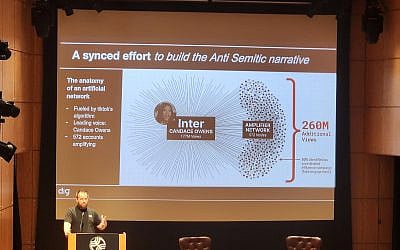
That timing, he stressed, is everything.
“In today’s world, it’s almost as important as the content itself—the timing of when you respond.”
A Generation Searching for Answers
But technology alone is not enough. The human element—the people on the front lines of this digital war—matters just as much.
In recent months, I’ve spent time speaking with high school students across the country. Their reality is stark.
“They feel alone, they’re afraid, and they don’t know what to say,” I shared.
“They’re getting bombarded on TikTok,” I added, referencing the wave of antisemitic and anti-Israel content circulating widely on social platforms.
So what do we tell them?
Familier didn’t hesitate.
“First of all, I take a lot of pride in the younger generation,” he said. “We always said Gen Z only cares about themselves—but it turns out they’re the most involved, the most contributing.”
His message to young Jews was simple—but powerful.
“Get involved. Care about it. Know that you’re part of a community that supports you.”
He continued: “In 20 years, you will be the leaders. It’s important that you learn how to live with this pain—and find your way to combat it.”
There is no one-size-fits-all response. Some will educate. Some will advocate. Some will build. But all have a role to play.
“Everyone can find their own thing,” he said. “But I encourage people to get involved—because it creates impact.”
From Darkness to Innovation
One of the most striking themes of the evening was how crisis fuels creativity—particularly in Israel.
When I asked Familier why Israelis are so innovative, his answer was deeply personal.
“When you feel that for your survival you need to do something—that’s where creativity comes from,” he said.
Dig itself is a product of that urgency.
“Before October 7, I was an entrepreneur,” he shared. “DIG was a pivot. It came from seeing what was happening… and feeling frightened for what it means for Jewish people.”
That fear became fuel.
“DIG is really the attempt to help fight this,” he said.
Transparency as the First Step
As part of its evolution, Dig is now launching a new product designed to bring these capabilities to a broader audience.
“What we’re trying to do with AskDIG,” Familier explained, “is bring the world to a place where everyone can know what’s really happening.”
The idea is simple but transformative: democratize access to information.
“You don’t need a TikTok account. You don’t need to understand how the algorithm works,” he said. “You can just know what’s going on.”
In a world where algorithms often obscure reality, that transparency could be a turning point.
“I think this is the first step in correcting where the world is heading,” Familier said.
A Call to Action
The message of Hack the Hate was not just about technology—it was about responsibility.
We are living in a moment where hatred can scale faster than ever before. But so can courage. So can truth. So can action.
The question is whether we are willing to meet the moment.
Because “Never Again” was never meant to be a slogan. It was meant to be a strategy.
And in the age of AI, that strategy must evolve.
The tools are being built. The networks are forming. The next generation is ready.
Now, it’s on all of us to act.