A First Crack in Islamic Antisemitism at Auschwitz
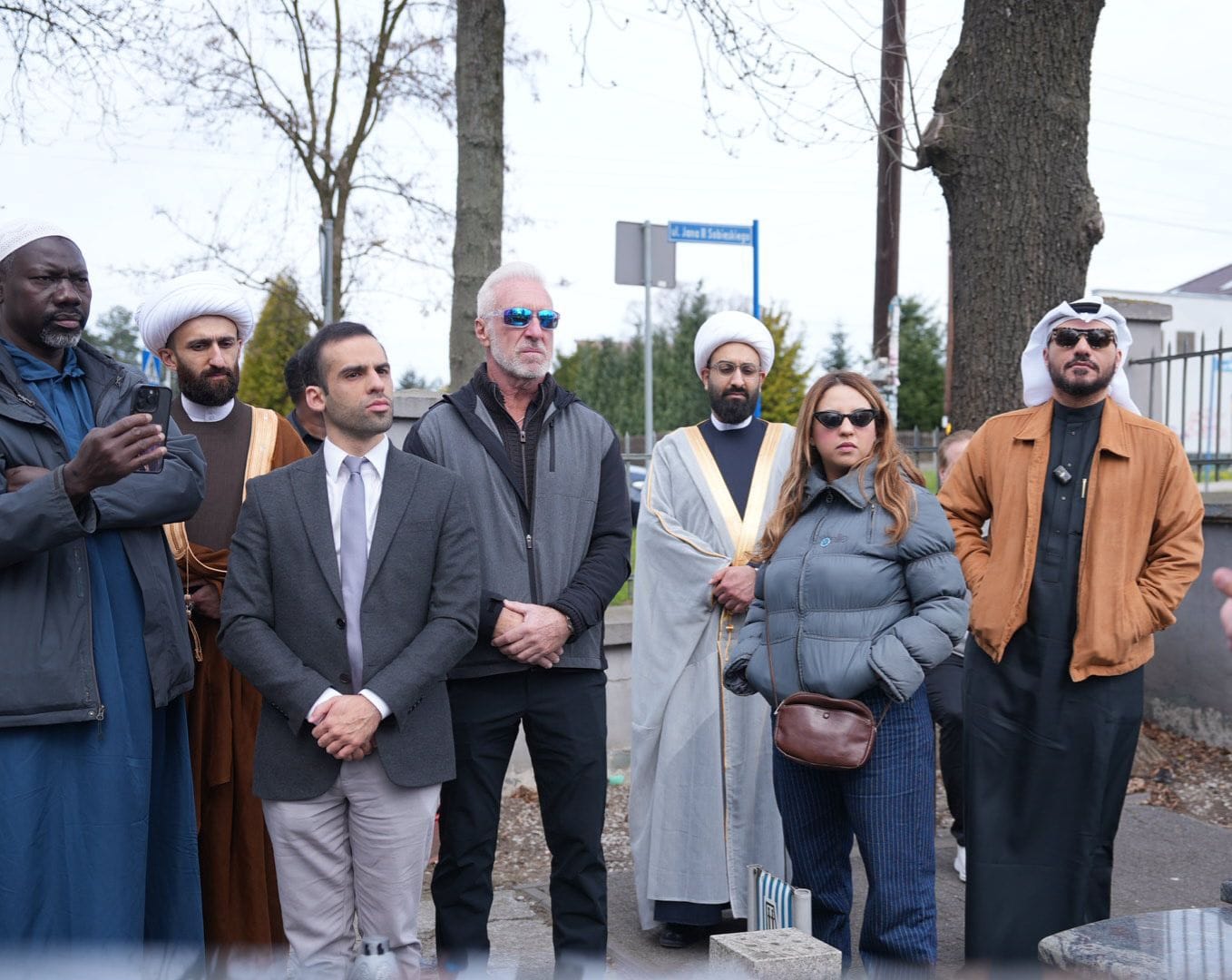
At these very moments, for the first time in my life, I am walking through the gates of Auschwitz as part of the March of the Living. Alongside me walk Muslim leaders and imams from Pakistan, Azerbaijan, the United Arab Emirates, Saudi Arabia, Bahrain, Morocco, Somaliland, the United Kingdom, Canada, and the United States. After we walked the route of the death march. Together, we swear that “Never Again.”
This event is not merely a historical gesture, it is living testimony that even from the greatest darkness, an alliance of peace can emerge.
Amin Drissi from Morocco, a public opinion leader in the Muslim world, traveled before his arrival here to the city of Salé in Morocco, to the grave of Rabbi Raphael Ankawa, one of the greatest sages of Morocco in the last century, and the first Chief Rabbi of Morocco. There, before his grave, he purchased six candles. Three of them he lit on his grave, and three additional candles he brought with him here, to Auschwitz.
This act seems almost inconceivable: a Muslim from Morocco, who lights candles in memory of a Jewish rabbi in his country, and carries this light into the heart of the darkest place in the history of the Jewish people.
In the face of this noble act, one of the most unsettling insights that emerges when examining the history of the Holocaust stands out, relating to the influence that ideas have on human nature.
We tend to think of the Nazis and their collaborators as deranged monsters, possessing an especially evil nature, as if they came from another planet. But the harsher truth is that they were ordinary human beings: they maintained happy family lives, sustained normal neighborly relations, and demonstrated a strong work ethic.
What turned them into murderers on an industrial scale was not their nature, but rather deep and systematic indoctrination that surrounded them in every sphere of life: in literature, in science, in economics, and in the security system. An entire system that taught them to see the Jew as responsible for all the ills of society, as an inferior race that must be eliminated.
In fact, the Hamas terrorists who carried out the atrocities of October 7 do not deviate from this pattern. These are individuals who live routine lives, who returned to their homes, to their wives and children, after brutally massacring entire families. This is the result of profound dehumanization, over decades, in schools, in mosques, and in the media against Jews, one that erases the humanity of the Jew and turns him into the source of all evil in the Arab world.
And precisely from this understanding, hope for the future also emerges.
Just as European society, for the most part, acknowledged the injustices of the Holocaust and embarked on a deep educational process of denazification, so too will a parallel process of profound change be required in the Muslim world: recognition of the legitimacy of the existence of the Jewish people in the world, and of the existence of the State of Israel in the region, alongside the systematic uprooting of inciting content from education systems and the media.
The imams and Muslim leaders who chose to come here, to be exposed to the historical truth and to express solidarity, demonstrate rare courage, which could cost them their lives. Precisely for this reason, they have the power to drive change where it is truly decided: in classrooms, in mosques, and in the consciousness of the next generation in the Muslim world.
If their voices are heard in their countries, this will not be just another symbolic visit to memorial sites, but the beginning of a real transformation in the relations between the Jewish people and the State of Israel and the Muslim world.