A flickering light in an ever-darkening darkness
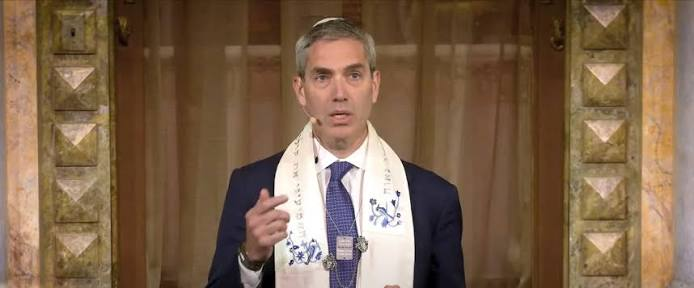
Ever since the passing of Auschwitz survivor and Nobel Peace Prize laureate Elie Wiesel in 2016 and the death of Rabbi Lord Jonathan Sacks four years later, world Jewry has been without a clarion moral voice in the prophetic tradition.
At a critical moment in Jewish history, Rabbi Elliot Cosgrove has emerged as precisely such a voice. Most recently, he zeroed in on the ultimate challenge posed by the results of last week’s Israeli elections. It was not whether the opposition to Prime Minister Benjamin Netanyahu could cobble together the necessary 61 Knesset votes to form a government. Nor was it whether “Netanyahu and his opponents could find a way to form a national unity government, setting aside their differences in the interest of the country.”
Instead, Rabbi Cosgrove discussed the significance of the nineteen Knesset seats now held by the Joint List, a political alliance of Arab-majority Israeli political parties, and Ra’am, a separate politically more conservative Arab party. These parliamentary seats represent hundreds of thousands of non-Jewish, that is Muslim and Christian, Israeli citizens who have roared into Israel’s political reality with a vengeance. “We are here and we’re not on the sidelines,” observed Ra’am head Mansour Abbas as the results were coming in.
As the spiritual leader of New York City’s Park Avenue Synagogue for almost two decades now, Rabbi Cosgrove has long shown exceptional courage in squarely taking on the complex, often politically and ethically divisive issues facing the Jewish community, the State of Israel, and society as a whole. Through his live-streamed sermons and articles published in The Forward and elsewhere, his words and teachings reach far beyond the physical walls of his congregation. (In the interest of full disclosure, he is not only my rabbi but a valued friend.)
A staunch and unapologetic lifelong Zionist, Cosgrove has not shied away from criticizing the Israel government’s policies when they diverged with the values and principles that brought the modern Jewish state into being in the first place. Thus, he was one of the principal speakers at a demonstration outside the United Nations on September 22, 2023, protesting against Prime Minister Benjamin Netanyahu’s proposed scuttling of Israel’s independent judiciary.
“We are here,” he declared on that occasion, “because of our commitment to an Israel, as stated in Israel’s Declaration of Independence, based on freedom, justice, and peace as envisioned by the prophets of Israel . . . . We are here to remind and affirm to the world the principles upon which Israel is founded: A Jewish and democratic state.”
In his sermon this past Shabbat, Cosgrove noted that “that with the exception of Yair Golan and his Democrats, the major Jewish-led opposition parties have rejected the possibility of being in coalition with Arab parties. It is one of the prickliest paradoxes of Israeli democracy: Israel’s Arab citizens have voted in extraordinary numbers, sending nineteen representatives to the Knesset, yet the very parties whose votes could break the political deadlock are the parties that much of Israel’s political establishment refuses to consider as governing partners.”
After laying out the historical and political predicates to the present “dilemma from hell,” including the Oct. 7 and post-Oct. 7 “massacres, the hostages, the war, the continuing grief and fear,” he went on to ask “a question as old as the Jewish people itself: Can the Jewish family find room in its household for those who do not share its Jewish identity? Can we secure our own destiny while acknowledging the presence of another? Can we remain faithful to who we are without casting out those who are also part of our family?”
Therein lies the crux of the crossroads at which Israel finds itself after the elections. One of the opposition leaders, the hawkish Avigdor Liberman who controls a critical seven Knesset seats, refuses to sit in a coalition with either Netanyahu or any Arab party. and rejects the possibility of a minority government backed by Arab parties from the outside. But the inexorable math appears to be that without Liberman’s seven seats, the opposition to Netanyahu cannot command a majority in the Knesset.
Writing in the Los Angeles Jewish Journal, my friend Thane Rosenbaum, with whom I rarely agree on anything political, asks what on its face appears to be a reasonable question: “Can Israel afford to have a Muslim politician who is agnostic about terror serve in the cabinet and attend security briefings?” But Rosenbaum conveniently ignores the corollary to this quandary: can Israel afford to once again – ever again – have the fascist Itamar Ben-Gvir who encourages settler violence against Palestinian civilians in the West Bank “serve in the cabinet and attend security briefings?”
As Cosgrove correctly points out, ”A coalition that includes Arab political representatives would not, by itself, settle the Palestinian question, erase inequality, or address every accusation laid at Israel’s feet. Those determined to hate Israel will continue to find reasons to do so. But imagine what it would mean for the Jewish state’s democratic promise to be reflected not only in the right of Arab citizens to vote, or in the oft-cited number of Arab pharmacists in Israeli society, but in Arab representatives sitting at the very table of government. . . . And for those of us who spend so much of our lives defending Israel in the public square, it is a delicious thought to imagine the dividends such a coalition might have – the message it would send, the assumptions it would challenge, and the possibilities it might open for how Israel is seen by the world.”
Cosgrove’s 2026 sermon echoes the sentiments expressed by Prime Minister Yitzhak Rabin in a television interview only a few days before his assassination: “The question, ‘do you have a Jewish majority?’ is one of the questions that is most outrageous to me because in my eyes, Judaism and racism contradict each other at their core . . . . The Jews were the ones who were persecuted because of their religion, who were discriminated against, and we, in the Jewish state, are going to discriminate?”
Cosgrove emphasized that it is not his place “to advocate for any particular coalition arrangement. I do not live in Israel, serve in its military, pay its taxes, or vote in its elections. It could be the opposition entering into a coalition with Arab parties. It could be Netanyahu doing so. It could be a national unity government. Different as each scenario may be, each would require political leaders to reconsider commitments made before the election. Each would involve difficult compromises, but each also holds the possibility of breaking the deadlock and opening new horizons for Israel’s future. A crossing of red lines, a challenging of long-held assumptions, a reconsideration of what is politically possible.”
And so, he concluded, “It is the great ‘what if’ of our people, from the first Jewish family to the present day. What if Abraham had found a way to keep Hagar and Ishmael in the fold? Tragic as it is to contemplate what might have been, the Torah invites us to imagine what might yet be. We cannot change Abraham’s decision, but we can decide what kind of tents we build today. May Israel’s leaders have the wisdom to recognize the possibilities before them, may its citizenry have the grace to give their leaders room to act, and may all have the courage to build a Jewish and democratic state capacious enough for all its citizens.”
And those of us listening to or reading his words can only add, may Rabbi Cosgrove’s words be a light, however flickering, in what appears to be an ever-darkening darkness May what he envisages as possible indeed come to pass.