Russian-American-Israeli Palestinian. Palestine is Israel.
A Forgotten Hebrew Gem of Motion and Metaphor
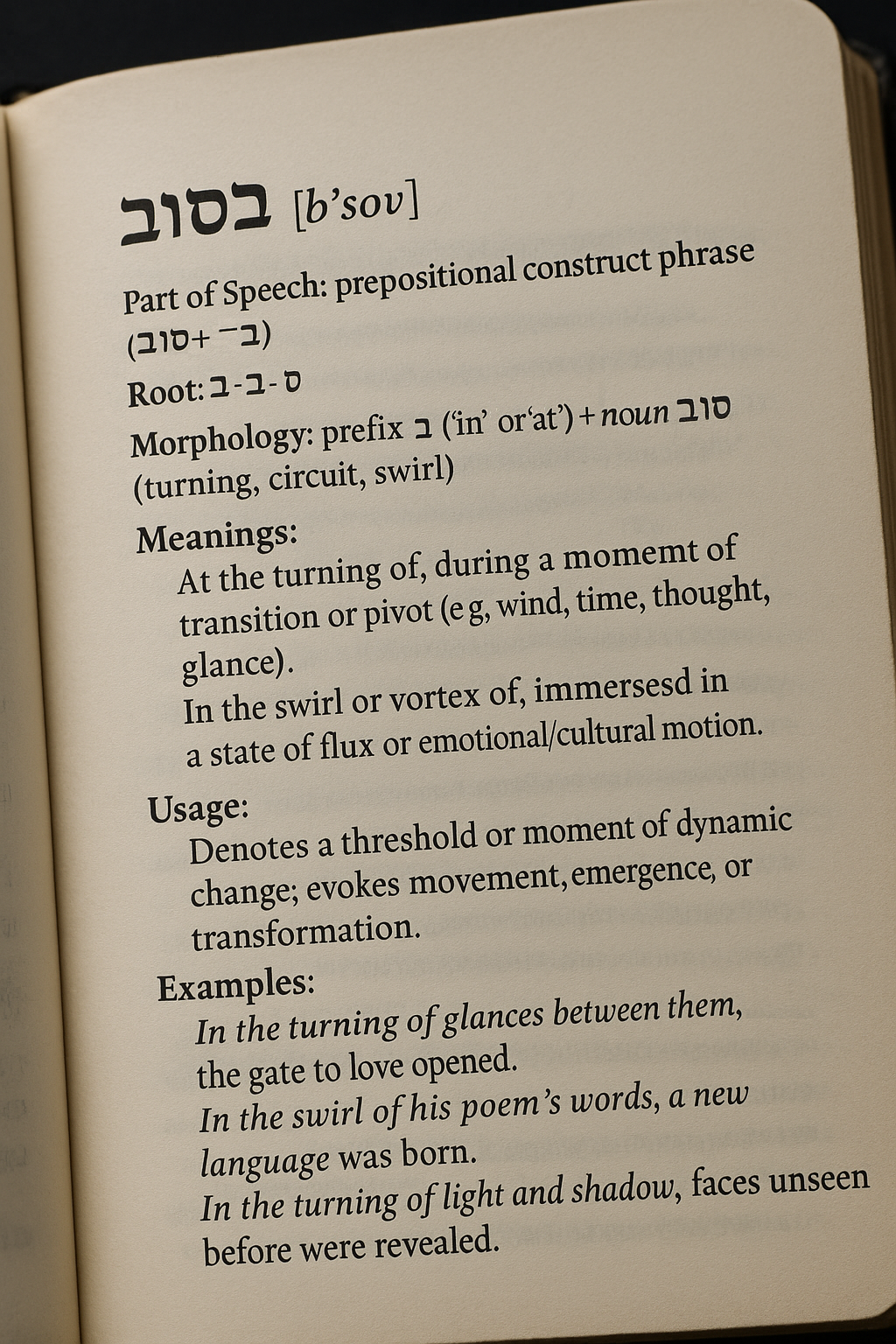
A poetic Hebrew gem: בסוב—capturing moments of turning, transition, and emotional motion. Image © Ivan Bassov, 2025. Licensed under CC BY 4.0.
Reviving a rare, poetic word that captures turning, swirling, and the beauty of transition
The word בסוב (b’sov) is real, rare, and richly poetic—a beautiful anomaly in the Hebrew language. Though largely absent from modern spoken or written usage, it holds a quiet power that deserves revival. Rooted in the biblical verb לסוב (“to turn, swirl, circle”), it offers a vivid way to express motion, transition, and cultural shifts: “in the turn of…”, “at the swirl of…”, or “where things shift.” The original Hebrew is בסוב (without niqqud), or בְּסוֹב (with niqqud), pronounced /bə‑sōv/.
Historical Usage: Nathan Alterman’s “בסוב הרוח”
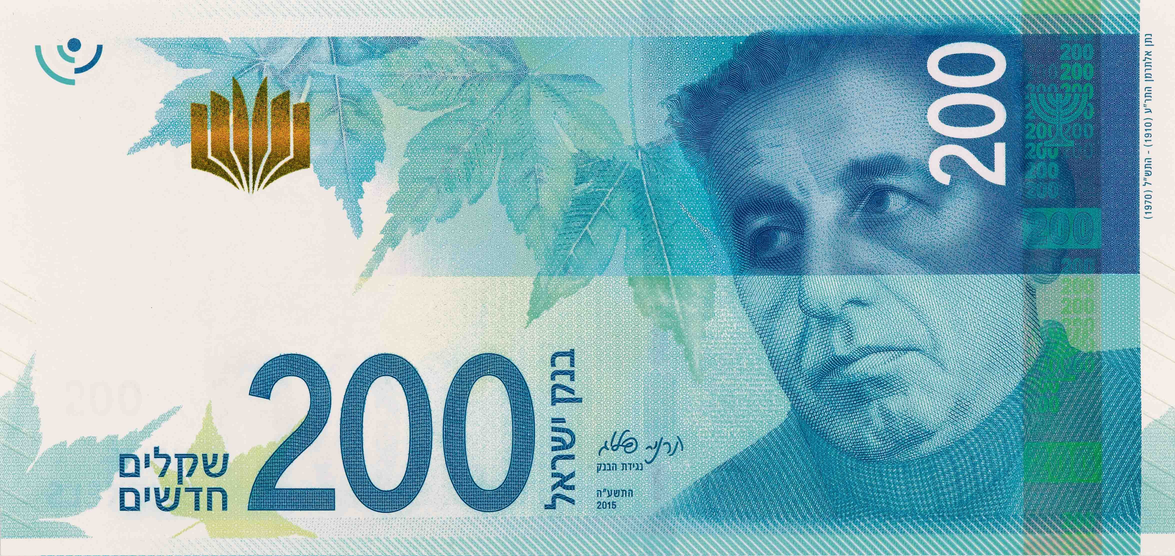
The word בסוב is virtually nonexistent in modern Hebrew, but it makes a notable appearance in 1957 in the poem “בסוב הרוח” (“In the Turning of the Wind”) by Israeli poet Nathan Alterman (1910–1970). This poem is the sixth in his מלחמת ערים (“War of Cities”) cycle, where בסוב evokes ideological upheaval and a poetic storm. The phrase בסוב הרוח (b’sov ha-ruach) appears—translated variously as “in the swirling of the wind,” “as the wind swirled,” or “when the wind turned.” This poetic usage evokes a transitional moment—a shift carried by an invisible force.
Poetic Potential of בסוב
The nature of the word is poetic and archaic—used almost exclusively in high literary or biblical-infused registers.
The elegance of בסוב lies in its ambiguity. It can express:
- Temporal transition: At the turning of events
→ בסוב הדורות (in the turning of generations) - Natural motion: As the waves swirl
→ בסוב הגלים - Emotional flux: In the swirling of the soul
→ בסוב הנפש
Linguistic Foundations of בסוב
בסוב comes from the Hebrew root סב״ב (Samekh–Bet–Bet), which conveys the core idea of turning, circling, or revolving. The word סוֹב (sov) is a verbal form—most commonly the imperative masculine singular—meaning “turn!” or “go around!” It can also carry a noun-like verbal sense, suggesting the act of turning or a swirling movement.
Note that in forms like סוֹב (imperative or noun), the letter ו is part of the vowel structure, not the root—it serves as a vocalization marker, reflecting a typical binyan pattern. This is common in Hebrew morphology: the root letters remain fixed, while vowel patterns and added letters (like ו) shape the specific form and function.
Additionally, while the root סב״ב contains a repeated ב, the word סוֹב shows only one. This is because Hebrew often contracts geminate roots (roots with a doubled final letter) in certain grammatical forms. As a result, סב״ב becomes סוֹב, with the second ב assimilated into the word’s structure without altering its core meaning.
When combined with the preposition ב־ (meaning “in,” “at,” or “during”), the phrase בְּסוֹב (b’sov) can be interpreted as “in the turn,” “amidst the swirl,” or “at the moment of circling.” This gives the expression dynamic connotations—of movement, transition, emergence, or transformation.
Examples from the Root סב״ב:
- סֵבֶב (sévev) – circuit, revolution, turn
- סְבִיבָה (svivá) – surroundings, environment
- סָבִיב (savív) – around, all around
- מַסָּב (masáv) – rotating platform, base
- הִסֵּב (hisév) – he diverted, turned aside
Cultural Example: Sevivon Sov Sov Sov:
In the beloved Hanukkah song “סְבִיבוֹן סוֹב סוֹב סוֹב” (“Sevivón Sov Sov Sov”), the word סוֹב is repeated as a direct imperative, joyfully commanding the spinning top (dreidel) to “turn, turn, turn!” This playful refrain is a classic example of how the root סב״ב embodies motion and circular rhythm in both literal and symbolic ways.
Comparing “בסוב” vs. “בסוף”
One of בסוב’s closest sounding relatives is בסוף (in the end), which marks a conclusion. The similarity is phonetic (and, in certain contexts, semantic) rather than grammatical. While בסוף signals finality, בסוב suggests ongoing movement, transformation, or unsettled turning.
Comparison:
- בסוף
Meaning: At the end
Connotation: Final, fixed, conclusive - בסוב
Meaning: In the turning, during the swirl
Connotation: Fluid, poetic, open-ended
Though they sound similar, they express different worldviews—בסוף closes; בסוב flows.
The Case for Reviving בסוב
בסוב is a word of beauty, motion, and metaphor—unjustifiably overlooked in modern Hebrew. Yet it offers writers, poets, and thinkers a rare and resonant term to express movement, transition, or emotional depth.
Let’s reclaim it.
Here are evocative phrases (with creative contexts) to inspire revival:
- בסוב הגלים – as the waves whirl (ocean motion)
- בסוב המים – in the swirl of currents (flow and depth)
- בסוב הדעת – when the mind spirals (thought, confusion)
- בסוב הלב – when the heart turns (emotion, awareness)
- בסוב הזמן – at the rotation of time (generational cycles)
- בסוב הדור – when a generation shifts (ideological change)
These phrases bring richness and motion to Hebrew expression, offering an alternative to flatter forms like במהלך (during) or בתוך (within).
Grammatical Note on בסוב
בסוב [b’sov]
Part of Speech: prepositional phrase (בְּ־ + סוֹב)
Root: ס־ב־ב
Morphology: prefix ב־ (“in” or “at”) + infinitive construct of the verb סָבַב (“to turn, to go around”)
Meanings:
- At the turning of, during a moment of transition or pivot (e.g., wind, time, thought, glance).
- In the swirl or vortex of, immersed in a state of flux or emotional/cultural motion.
Usage: Denotes a threshold or moment of dynamic change; evokes movement, emergence, or transformation.
Examples:
- בסוב המבטים ביניהם, נפתח השער לאהבה
In the turning of glances between them, the gate to love opened. - בסוב המילים בשירו, נולדה שפה חדשה
In the swirl of his poem’s words, a new language was born. - בסוב האור והצל, גילו פנים שלא נראו מעולם
In the turning of light and shadow, faces unseen before were revealed.
Final Thought
בסוב is more than a rare word—it’s a bridge between eras, cultures, and ideas. Words like בסוב remind us that language isn’t just communication; it’s imagination. It’s how we shape the world. How we express ambiguity, motion, and poetry.
Let’s bring בסוב back—into literature, into lyrics, into thought. It deserves its place not just as a linguistic artifact, but as a living part of Hebrew.
And in that motion—בסוב המילים—may we find new clarity.
Author’s note
My last name is spelled בסוב in Hebrew—a transliteration of Bassov—that, unexpectedly, opened the gates to an entirely new layer of meaning. Once thought to carry only ancestral echoes and etymology, the name now swirls with deeper, symbolic significance.
Post-Review Update (August 2025)
Following the publication of this article, I received a generous and illuminating response from Ronit Gadish — former scientific secretary (1999–2024) and now a full member of the Academy of the Hebrew Language. Her review clarifies several grammatical points and corrects a few interpretive liberties I took, particularly regarding the Biblical Hebrew phrase בסוב and its related forms. I am deeply grateful for her insights, which enrich and refine the discussion above. Readers can find her full review, in English translation, in The Academy of the Hebrew Language Responds.
References on Alterman’s “בסוב הרוח” (Hebrew)
- Prof. Ziva Shamir (2021). מסעו של אלתרמן לביזנטיון (Journey of Alterman to Byzantium).
- Prof. Ziva Shamir (2022). נתן אלתרמן – משוררו של דור המאבק לעצמאות (Nathan Alterman – Poet of the Generation of the Struggle for Independence).
- Prof. Ziva Shamir (2022). “משורר חצר” או “משורר לאומי” (“Court Poet” or “National Poet”).
Related Topics