
A Haberdasher Helped a President Recognize Israel
On May 14, 1948, a US president sat at his desk while the world held its breath.
His secretary of state was opposed to the move.
His military advisers were wary.
War in the Middle East was hours away.
The Cold War was already underway.
Recognition of a Jewish state could cost America oil, alliances, and influence across the Arab world. It could strengthen Soviet positioning. It could destabilize a region the United States barely understood (and still, some would argue, does not).
And yet…
Eleven minutes after the declaration of independence by the State of Israel, the United States extended recognition.
The man in the Oval Office was Harry S. Truman.
But the most compelling part of the story may begin with someone else entirely.
Two months earlier, a middle-aged businessman with no government position walked into the White House.
He was not a diplomat.
He was not a Zionist leader.
He had never held elected office.
His greatest professional distinction was running a men’s clothing store—which went bankrupt.
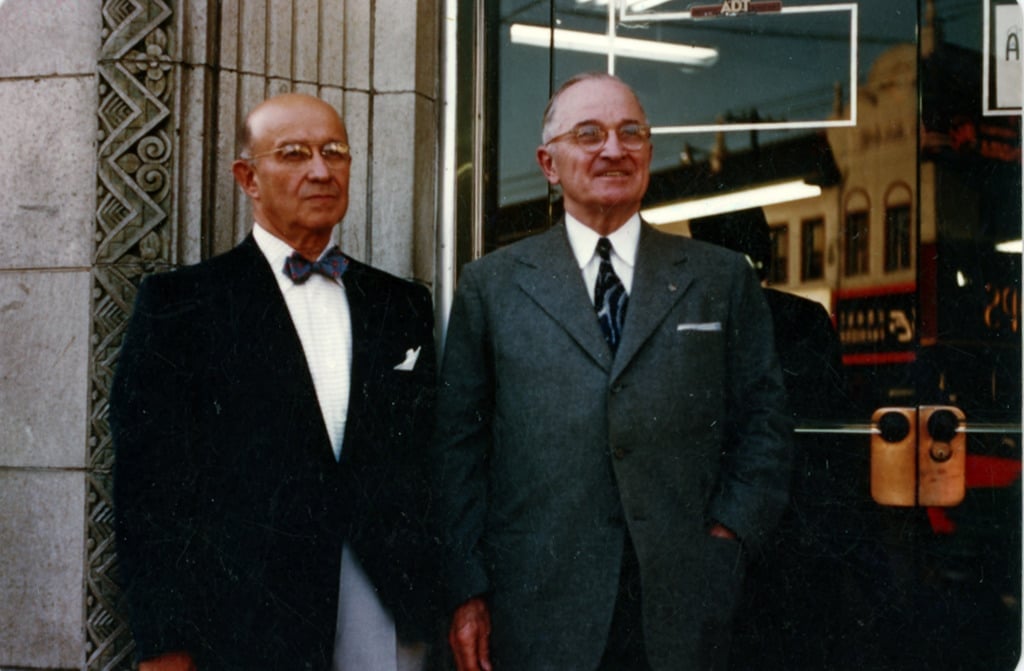
But he was Truman’s old World War I army buddy: Eddie Jacobson.
And without him, a major event in history might have unfolded—if not differently, then at least more slowly. Emphasis on might.
A Bond Forged in War
Harry Truman and Eddie Jacobson met in 1905 in Kansas City, Missouri, and became fast friends.
Later, prior to shipping out to France in World War I, both men were stationed at Camp Doniphan in Oklahoma, where they operated a canteen for the 129th Field Artillery. The experience strengthened a friendship that would endure long after the war. On May 20, 1918, they sailed for France.
Their wartime bond lasted after the war, leading them to open a men’s clothing store together (Truman & Jacobson). The postwar recession crushed the business. They closed in debt.
Many partnerships collapse under that kind of strain.
Not theirs.
In his memoirs, Memoirs: Years of Trial and Hope, Truman wrote of Jacobson:
“He was always absolutely honest with me and I trusted him completely.”
They remained close for decades. Jacobson was one of the few people who could call the future president “Harry”.
That mattered in 1948.
A President Under Siege
By late 1947, the United Nations had voted to partition Palestine. Violence was escalating. British withdrawal was imminent. Zionist leadership was preparing to declare independence.
Inside the Truman administration, however, consensus was nowhere to be found.
The US Secretary of State, the formidable George C. Marshall—he of the Marshall Plan, widely revered and deeply respected by Truman—strongly opposed immediate recognition.
Marshall was already a towering figure—“the organizer of victory,” his integrity all but unquestioned in Washington. Truman’s reverence had been forged in part during World War II, where firsthand experience confirmed what the country already believed: that Marshall’s judgment could be trusted at the highest stakes.
Marshall’s concerns were strategic, not sentimental:
- The United States depended heavily on Saudi oil.
- Arab states threatened retaliation.
- US intelligence warned the fledgling state might not survive an Arab invasion.
- The Soviet Union, for its own Machiavellian reasons, had already signaled support for partition.
Recognizing a state that might collapse militarily, Marshall feared, would damage American credibility.
He was not alone.
Much of the State Department’s Near Eastern bureau opposed recognition. Military officials were cautious. Oil interests were anxious. The region seemed combustible.
Truman was caught in the middle.
For months—late 1947 through May 1948—he wrestled with the decision. This was not a last-minute impulse. It was a sustained internal struggle.
At one point in early 1948, US policy drifted toward supporting a temporary United Nations trusteeship instead of immediate statehood.
Recognition was not inevitable.
In fact, some suggest, it nearly slipped away.
The Door Closes
By March 1948, Truman was exhausted and irritated. Zionist lobbying was intense.
He felt pressured and politically boxed in. Frustrated, he said he would not meet with Chaim Weizmann.
Weizmann was a towering figure—a chemist, statesman, and moral voice of the Zionist movement. His supporters believed a personal appeal might make the difference.
The president refused.
The door appeared closed.
So Jewish leaders turned to someone far removed from Washington’s power structure.
They turned to Eddie Jacobson.
A Day in March
On March 13, 1948, Jacobson came to the White House.
He had no briefing papers.
He carried no diplomatic portfolio.
No constituency. No leverage.
He came as a friend.
They met for roughly half an hour—not a formal policy session, but long enough for something meaningful to happen.
Truman initially resisted. He vented about political pressure. He did not want to reopen the issue.
At one point, Jacobson reminded Truman of his deep admiration for Andrew Jackson—whose portrait hung in the Oval Office.
Jacobson reportedly said, in essence:
“You admired Andrew Jackson. This man (Weizmann) is the Jewish George Washington. He deserves to see you.”
Not a geopolitical argument.
Not about oil or Soviet influence.
About respect.
About history.
About dignity.
And from a man Truman trusted. Completely.
Something shifted.
Truman agreed to meet Weizmann—quietly.
Five days later, the meeting took place.
The door reopened.
A Clash at the Top
The internal debate did not disappear.
On May 12, 1948—just two days before independence—a dramatic confrontation took place in the White House.
Presidential counsel Clark Clifford argued forcefully for recognition.
Marshall was furious and, as later recounted, warned he might not support Truman in the coming election. He never followed through. But for a president who held him in near-reverence, the warning itself was seismic.
For Truman, this was no small moment.
And yet, when the decision came, he decided.
Eleven Minutes
On May 14, 1948, as David Ben-Gurion declared independence in Tel Aviv, the United States prepared its response.
Eleven minutes later, Washington extended recognition.
The speed was deliberate.
Truman later described it as one of the proudest decisions of his presidency.
History often reduces the moment to a bold stroke of leadership. But leadership is rarely solitary.
Behind the decision was months of doubt, argument, strategic anxiety—and one quiet conversation between two old friends.
The Man Who Went Home
And what of Eddie Jacobson?
He did not seek office. No ambassadorship.
No leveraging his access for power.
He went home.
He later visited Israel and was warmly received. He died in 1955.
At the Harry S. Truman Presidential Library and Museum, there is no statue of the two men sitting side by side.
Nor has any sculptor cast them together on a bench in say, Independence, Missouri.
But it is not hard to imagine them there—Truman listening, Jacobson insisting—just as they once were when it mattered most.
The “What If”
Would Truman have recognized Israel without Jacobson’s intervention?
Historians debate the degree of influence. Truman was already sympathetic to Jewish refugees and deeply moved by the Holocaust.
But in March 1948, the issue was drifting. The president was refusing to see Weizmann. The policy machinery leaned toward delay.
Jacobson did not dictate foreign policy.
He reopened a door.
Sometimes, that is enough.
Postscript
I love this story. I first encountered it in The Prime Ministers by Yehuda Avner.
There is something profoundly human in it.
The most powerful man in the world was still reachable by an old friend from World War I—and their failed haberdashery.
Still capable of being moved not by strategy, but by trust.
In an era of grand strategy, oil calculations, Cold War alignments, and military forecasts, a half-hour conversation between two World War I vets (possibly) helped shape the diplomatic birth of a nation.
History often turns on ideology.
Sometimes it turns on loyalty.
And sometimes, it turns because one friend calls another by his first name and says, simply:
“Harry.”
Despite Eddie Jacobson’s pivotal role in one of modern Jewish history’s defining moments, there seems to be no widely recognized public monument, statue, or memorial to him in Israel today. (At least that’s what my online searches say – I could be off).
While Jacobson’s contribution is recounted in essays, books, and documentary histories, and commemorated through archival plaques in the United States—such as at the Harry S. Truman Library—his legacy in Israel lives primarily through the stories historians tell rather than in stone or bronze.