
"I'm the spokesman for the OK Boomer generation"
A House Divided Against Itself Cannot Stand
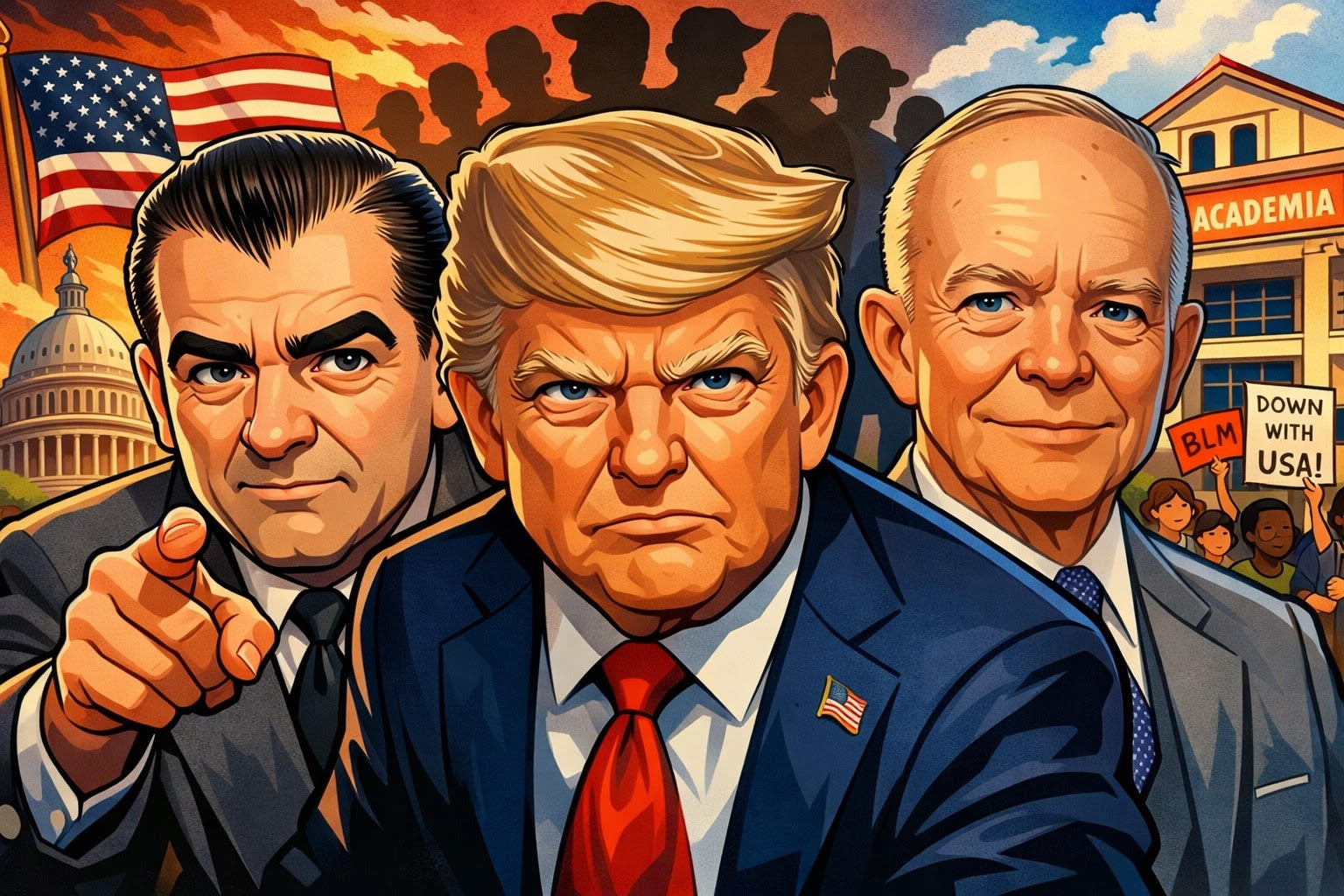
Photo: Tony Senatore: all rights reserved
What links Senator Joseph McCarthy, President Donald Trump, and the late President Dwight D. Eisenhower is their differing approaches to perceived threats within the American system. My mother, who is ninety years old and smarter than most of my friends, recently made me watch a YouTube video about McCarthy, and I was struck by both the clear parallels and sharp contrasts. Whereas detractors argue McCarthy’s anti-communist campaign harmed many innocents, both he and Trump justified aggressive, norm-breaking tactics as necessary to defend the nation from communist agents or, in Trump’s view, a “deep state.” Yet Eisenhower stands apart, embodying a competing approach: preserving institutional legitimacy over sacrificing norms. The central question becomes how leaders choose to address internal threats, and at what cost to American democracy.
McCarthy’s rise in the early 1950s rested on claims that history partially confirmed but never fully justified: Soviet spies and sympathizers had infiltrated the US government. The Venona project, a secret Army effort during World War II, decrypted Soviet cables and revealed espionage. Figures like Alger Hiss and Harry Dexter White were implicated. Venona’s 1995 declassification complicated the idea that McCarthy chased only phantoms.
Eisenhower likely knew about Venona at McCarthy’s peak. As an Allied commander and later president, he was involved in national security affairs. Most historians agree that he withheld evidence to protect intelligence rather than to avoid doubt. He viewed McCarthy’s methods as reckless and corrosive, and preferred quiet containment and risk mitigation over public confrontation.
This had major consequences. McCarthy, denied crucial evidence, relied on rumor, inference, and guilt by association. His tactics included public accusations, shifting numbers, intimidation, and disregard for due process. These ruined careers and eroded public trust. Some argue that, even if McCarthy’s hunches were partly correct, his methods were destructive. In contrast, Eisenhower valued institutional legitimacy over drama, even if that meant letting a threat destroy itself.
Trump plays a similar role in a new context. He sees the government as infiltrated by an enemy: the “deep state.” Unlike McCarthy’s focus on espionage, Trump claims that bureaucratic resistance, ideological capture, and elite protection undermine the government rather than foreign spy rings. Still, both suspect unseen forces undermining democracy.
Like McCarthy, Trump uses confrontation to provoke, destabilize, and force exposure. He attacks the FBI, intelligence agencies, courts, and press as fundamentally illegitimate. Innocents like civil servants, judges, election workers, and allies are often caught up in it. Defenders argue, as McCarthy did, that extraordinary threats demand extraordinary means and some collateral damage is unavoidable.
The comparison between Eisenhower and Trump is particularly revealing, as it highlights their sharply contrasting approaches to perceived internal threats. Eisenhower believed that even genuine dangers should be managed through disciplined, elite-controlled processes, prioritizing the preservation of long-term institutional trust. Trump, in contrast, rejects this premise and adopts a different method. Where Eisenhower saw the greatest risk as demagoguery undermining institutions, Trump reverses that, believing the greatest risk is infiltration from within those same institutions. Eisenhower trusted that institutions could self-correct if handled quietly, while Trump asserts that they are so compromised that only public confrontation and personal dominance are effective. This contrast in their core assumptions and leadership styles clarifies the foundational difference between their responses to internal threats.
This parallel has urgent implications. Trump is more methodologically aligned with McCarthy but possesses Eisenhower’s executive authority, thereby amplifying the stakes of confrontational tactics. When senators accuse, institutions can push back; when the president does, institutions risk fracture. The central issue is not the reality of past communist infiltration or the present existence of a “deep state,” but the cost of responding to perceived internal threats through suspicion and disregard for norms. America’s survival as a functioning democracy rests on upholding institutional legitimacy, even in ideological conflict. If parallel realities and competing claims to legitimacy prevail, the country risks undermining the very rules that guard self-government. Once rules are abandoned in the name of saving the republic, its core principles are already compromised.
Related Topics
Related Posts