The views expressed herein are solely mine.
Maduro Fell. Hezbollah’s Venezuelan Network Lives
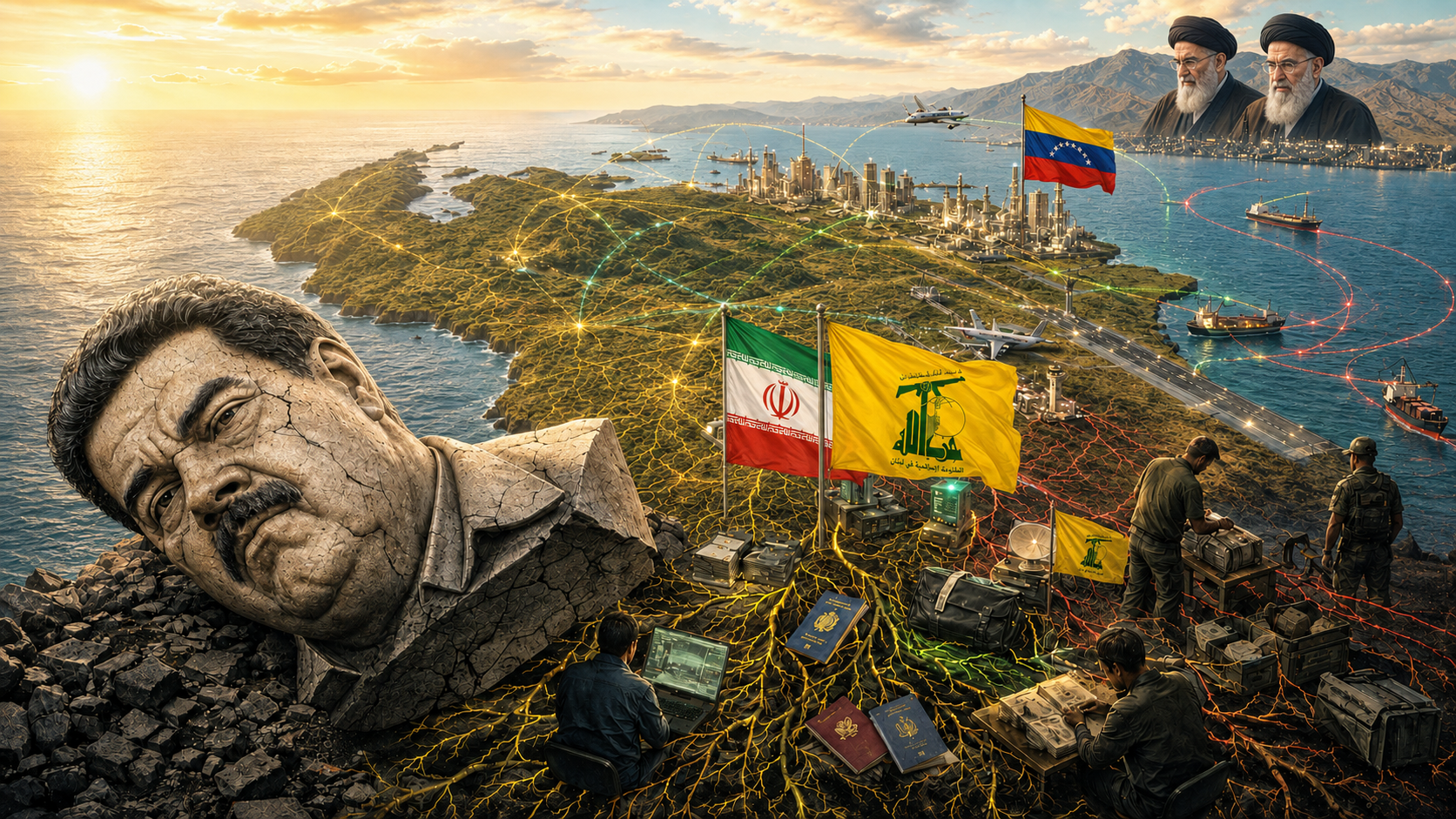
Credits: AI-Generated Image.
When arsonists torched four ambulances belonging to the Jewish emergency service Hatzola in London’s Golders Green on March 23, 2026, the initial reaction from the British authorities followed a painfully familiar script: caution, bureaucratic hand-wringing, and a desperate hope that the attack was an isolated hate crime. A front group calling itself the Islamic Movement of Companions of the Right claimed responsibility, but British security agencies, allergic to escalation, hesitated.
Subsequent intelligence exposed the naivety of that timidity. By July, 2026, London finally grew a spine, sanctioning the organization after concluding what should have been obvious from day one: the Islamic Revolutionary Guard Corps (IRGC) Quds Force “almost certainly” directed the cell. Granted, Tehran does not deploy its own uniformed operatives to commit daylight terrorism in Western capitals. Instead, it hires local thugs, deploys criminal proxies, and counts on Western bureaucratic inertia to escape accountability.
Europe is only now waking up to a strategy that the Islamic Republic has spent decades perfecting in America’s backyard. Tehran understands that it does not need conventional military bases to project power. Give the IRGC diplomatic immunity, fraudulent passports, lax airport security, and a few well-placed, corrupt local officials, and it has all the infrastructure it needs to finance terror, surveil Western targets, and move operatives with impunity.
The capture of Nicolás Maduro in January 2026 should have been a death blow to Iran’s most permissive sanctuary in the Western Hemisphere. Instead, Washington is on the verge of snatching defeat from the jaws of victory. The State Department is making its classic, fatal mistake: confusing the removal of a single dictator with the destruction of the rogue system he built.
While Interim President Delcy Rodríguez says all the right things to American diplomats and attempts to distance herself from Maduro’s toxic legacy, the reality on the ground is unchanged. The Chavista military, intelligence, and patronage networks remain fully intact. Rodríguez has kept notorious senior regime figures in power, and Diosdado Cabello—one of the criminal state’s chief enforcers—still pulls the strings from the shadows. Bureaucracies engineered over twenty years to facilitate Iranian and Hezbollah penetration do not simply vanish because a new politician changes the portrait on the office wall.
Look no further than Salman Raouf Salman to understand the cost of Washington’s short memory. Salman, better known as Samuel Salman El Reda, was a primary architect of the 1994 AMIA Jewish community center bombing in Buenos Aires, which slaughtered 85 people. More than thirty years later, he remains a free man.
Salman did not retire after Buenos Aires. According to the U.S. Justice Department, he spent the subsequent decades recruiting and managing operatives for Hezbollah’s Unit 910—its external operations wing—dispatching assets to Thailand, Peru, and Panama. In 2012, he even ordered surveillance on the Panama Canal and the American embassy in the Central American nation. Today, Washington offers a $7 million bounty for his capture. Yet the fact that a terrorist mastermind has operated freely for three decades sends a message to Tehran louder than any State Department press release: Western attention will always shift, political willpower will fade, and bureaucratic exhaustion will eventually replace justice.
For decades, Venezuela provided the diplomatic armor that made this impunity possible. In 2008, the U.S. Treasury Department exposed Ghazi Nasr al Din, a Venezuelan diplomat stationed in Damascus who actively facilitated the travel of Hezbollah operatives into Caracas. This was not a case of a rogue actor slipping through the cracks; the Venezuelan state actively employed him.
State sponsorship transforms Hezbollah from a mere transnational gang into a strategic nation-state threat. Cartels can move drugs and launder money, but they cannot issue sovereign passports, manipulate state flight manifests, or grant diplomatic immunity to fugitives. Venezuela gave Hezbollah the ultimate prize: access to the legitimate international financial and transit system.
Maduro’s ouster gives President Donald Trump a historic opportunity to dismantle this apparatus without firing a shot. But Washington must reject the temptation of cheap diplomatic wins, as it has been doing until now. The White House should immediately freeze every oil license, sanctions waiver, and financial concession to Caracas. Normalization should be conditioned on one metric: the verifiable, root-and-branch eradication of Iranian and Hezbollah assets in Venezuela.
Rodríguez must purge every official compromised by Tehran, hand over all secret security pacts signed with Iran, cancel every fraudulent passport, and open Venezuela’s biometric immigration databases to U.S. investigators. Furthermore, Iranian state enterprises operating under front companies in Venezuela must face immediate forensic audits. Washington must not reward promises; it must only reward verified results.
Simultaneously, the Pentagon and Treasury should quit fighting bureaucratic turf wars and establish a dedicated Hezbollah and Quds Force targeting cell inside Joint Interagency Task Force South (JIATF-South) in Key West. This command already excels at tracking drug submersibles and smuggling routes. By embedding Treasury analysts, FBI agents, and intelligence liaisons from Argentina, Colombia, and Israel, the U.S. can map the precise intersection where Latin American narcotics trafficking meets Middle Eastern terrorist logistics.
Finally, the Justice Department must dust off its dormant indictments and turn them into aggressive international manhunts. If rogue regimes refuse to extradite these fugitives, they should face secondary sanctions that cripple their airlines, banks, and maritime shipping. Concurrently, MI6 and the CIA must expand their intelligence-sharing dynamics in this area. The IRGC uses the same operational blueprint whether it is recruiting gang members in London or buying off politicians in Caracas.
Golders Green and Buenos Aires are not separate events; they are coordinated campaigns. Tehran intentionally exploits the Western policy establishment’s tendency to over-compartmentalize its networks, betting that Washington will waste time debating where transnational crime ends and state-sponsored terrorism begins.
Maduro may be gone, but the Iranian terror infrastructure he hosted is simply waiting for the storm to pass. If the United States trades its current leverage for cheap oil or diplomatic convenience, Tehran will lock in a forward-deployed attack network on our doorstep. The White House must make sanctions relief conditional on total dismantlement. Removing Maduro is a headline; forcing Venezuela to purge the IRGC is how the United States actually restores deterrence.
Related Topics
Related Posts