
A Jewish Army: The Book and the Sword
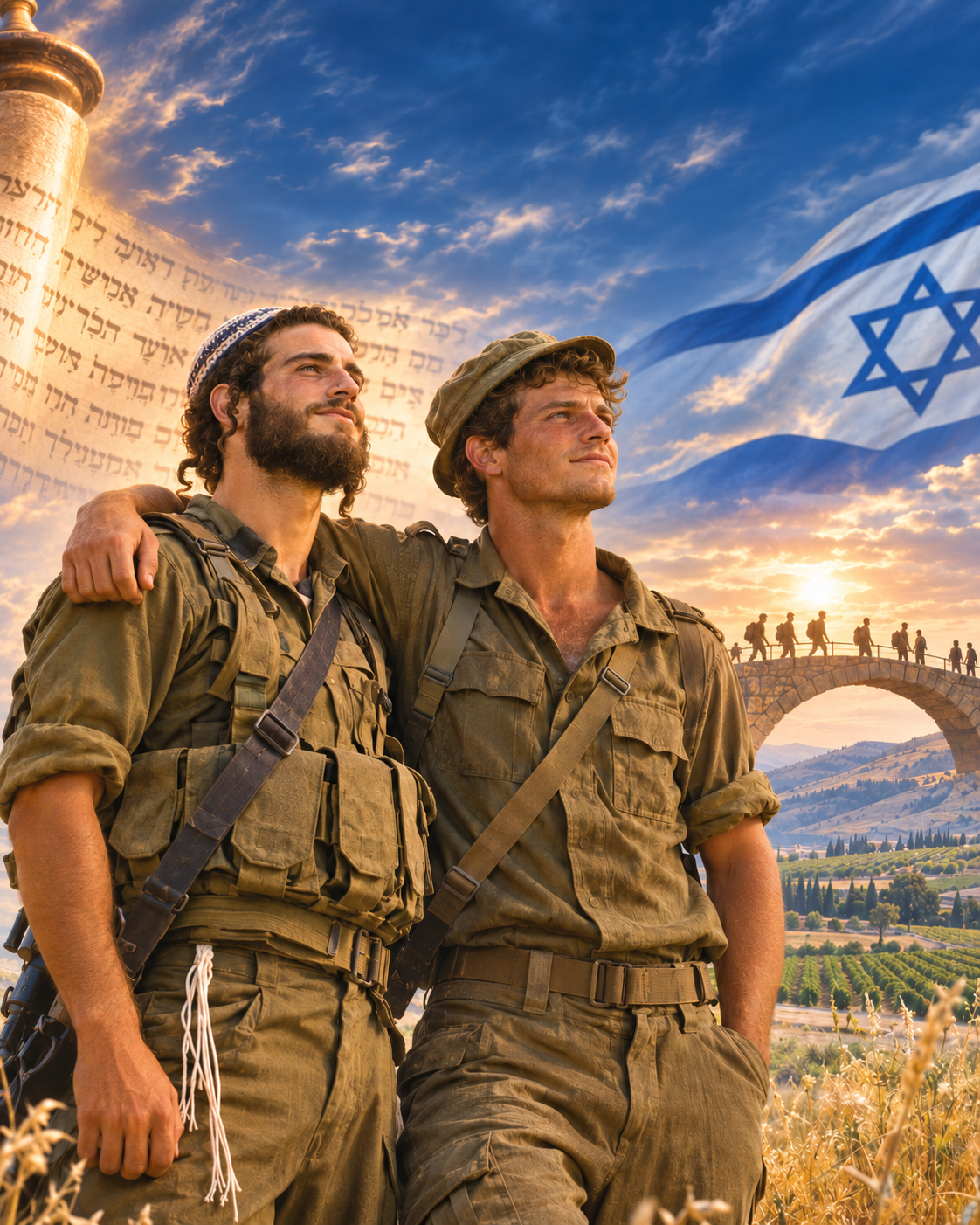
One of the deepest divides in Israeli politics, sharpened by three years of war and the recent elections, concerns the continued non-service of most Haredi men while Israel fights wars of national survival. After simmering for decades, the dispute has reached fever pitch because the inequality in sacrifice has become impossible to ignore. The need for a resolution is clear. The path toward one is not.
Israel cannot wait for a calmer age to settle this dispute. The army is where questions of obligation, identity, religion and sacrifice become impossible to evade. The conscription crisis is therefore more than a dispute over manpower. It is a test case for a larger national reconciliation Israel will eventually need.
Middle Israel, secular, traditional and national religious, serves and sacrifices. Its sons and daughters enter the army, give valuable years of their lives, carry the burden of reserve duty and, increasingly, bury friends and family. They cannot accept that one large community should enjoy a general exemption from the obligations that sustain the country, least of all in wartime.
For the Haredi world, another set of values stands at the center: Torah study and religious continuity. Talmudic study is held to be indispensable not merely to Israel’s security but to the survival of the Jewish people and, in a larger theological sense, the world itself. Alongside that conviction stands a deeper fear. A young man may enter the army immersed in Torah and leave less observant than when he entered. But the anxiety is larger than observance alone. Military service places him for formative years inside an institution that competes with the yeshiva, family and rabbinic authority over who shapes his habits, loyalties and understanding of the good life. For a community built on dense institutions of transmission, that is a question of continuity.
That is the value clash at the center of the conscription debate. Political power, state funding and institutional inertia have hardened it. But if the dispute over values remains untouched, every political compromise will be temporary. If the moral argument can be reconciled, the political ground begins to shift.
Avigdor Lieberman recently made headlines by signaling his willingness to sit in a coalition with Haredi parties and make compromises. I recall a rather different Lieberman at the Knesset podium just a few years ago, challenging what he saw as an obvious contradiction. How, he asked, could men devoted to Torah revere Joshua, Saul and David, yet regard military service as somehow beneath religious life?
These were warriors who did not use the study hall as a shield from national responsibility. The argument is powerful, but insufficient. A Haredi listener can answer that Saul lost his kingship when he placed human calculation above the command of God, and that David was denied the privilege of building the Temple because of the blood on his hands. Jewish scripture offers no simple cult of the warrior. Yet inside these same figures, and particularly Joshua, lies the beginning of a way out.
Joshua was one of Jewish history’s great commanders and, according to tradition, Moses’s supreme student, chosen to lead the conquest as a man formed by Torah. As God commands him to begin the conquest, the opening chapter of the Book of Joshua sets out the condition of his success:
“This book of the Torah shall not depart from your mouth; you shall meditate upon it day and night, so that you may observe to do according to all that is written in it, for then you shall make your way prosperous, and then you shall have good success.”
Joshua is being ordered into war. He will command armies, seize territory and administer justice. Yet Torah study remains indispensable to his mission. The same chapter establishes the obligation to fight. Though Reuben, Gad and half of Manasseh had already received their inheritance east of the Jordan, their warriors were required to fight alongside their brothers. Moses had asked bluntly: “Shall your brothers go to war while you sit here?” Joshua thus unites two obligations, Torah study and a shared burden of national defense. Israel should recognize Torah scholarship as a national value, preserving limited exemptions for exceptional scholars selected by recognized yeshivot and rabbinic authorities under a statutory ceiling. Everyone else must serve, with refusal carrying the same legal consequences as for any other citizen.
The more important change is what service itself should mean. The debate centers on religious accommodation, but on November 3, IDF Chief of Staff Eyal Zamir set the bar too low when he told Haredi yeshiva students: “Our goal is for you to enter the military as Haredim and leave as Haredim.” The ambition should be greater. Soldiers committed to Torah should leave the army stronger in their religious practice than when they entered. The IDF already invests in Zionist education; Torah development deserves equal standing.
Existing Haredi frameworks, particularly the Hashmonaim Brigade with its daily Torah study and rabbinic guidance, already offer the beginnings of this model. The IDF should make it doctrine rather than a specialized accommodation. The band of brothers could become a network of chavrutot, studying the halachot of danger, rescue, Shabbat, command and mutual responsibility. A foxhole or overnight patrol raises religious questions no yeshiva classroom can reproduce. Across the biblical heartland, soldiers could study and pray with leading scholars at sacred sites they have known through Tanach, encountering the land and its history firsthand while deepening their religious practice. Acts of chesed in nearby communities would further bind service to Torah.
The army need not become a yeshiva or define proper religious development. Its task is to let serious religious life deepen alongside military excellence. Done well, it would allow a Haredi parent to believe that a son entering such a unit may return more learned, more observant and more disciplined in his practice, not less.
There is an obligation on secular Israel as well. A reconciliation worthy of the name cannot consist of one side surrendering while the other congratulates itself. Accommodation is easy when religion is treated as a private preference. The Joshua model asks something harder of secular Israel: to recognize Torah study as a national good worthy of serious investment. In return, the Haredi world must recognize that protecting the Jewish state cannot remain somebody else’s religious obligation.
Joshua was Moses’s student and Israel’s general, carrying the sword without abandoning the book. On his yeshiva visit, Zamir invoked safra ve-sayfa, “the book and the sword.” The Talmud originally cast them as opposites. “If the sword, not the book; if the book, not the sword.” Modern Israel has turned that opposition into an aspiration, that the same Jew might carry both. A Jewish state cannot endure if one community carries the rifle while another claims permanent exemption. Nor can it reconcile the divide by forcing Haredim into institutions that treat their deepest religious commitments as obstacles to be managed.
A limited number of exceptional scholars should remain in full-time study. The majority should serve, whether in the military or in serious forms of civilian national service. The Haredi soldier would then no longer be asked to leave the world of Halacha for the world of Israel. He would be asked to follow Joshua into both.