NAnews - Nikk.Agency Israel News
A ‘Jewish’ Region in Russia Is Now Paying for Putin’s War
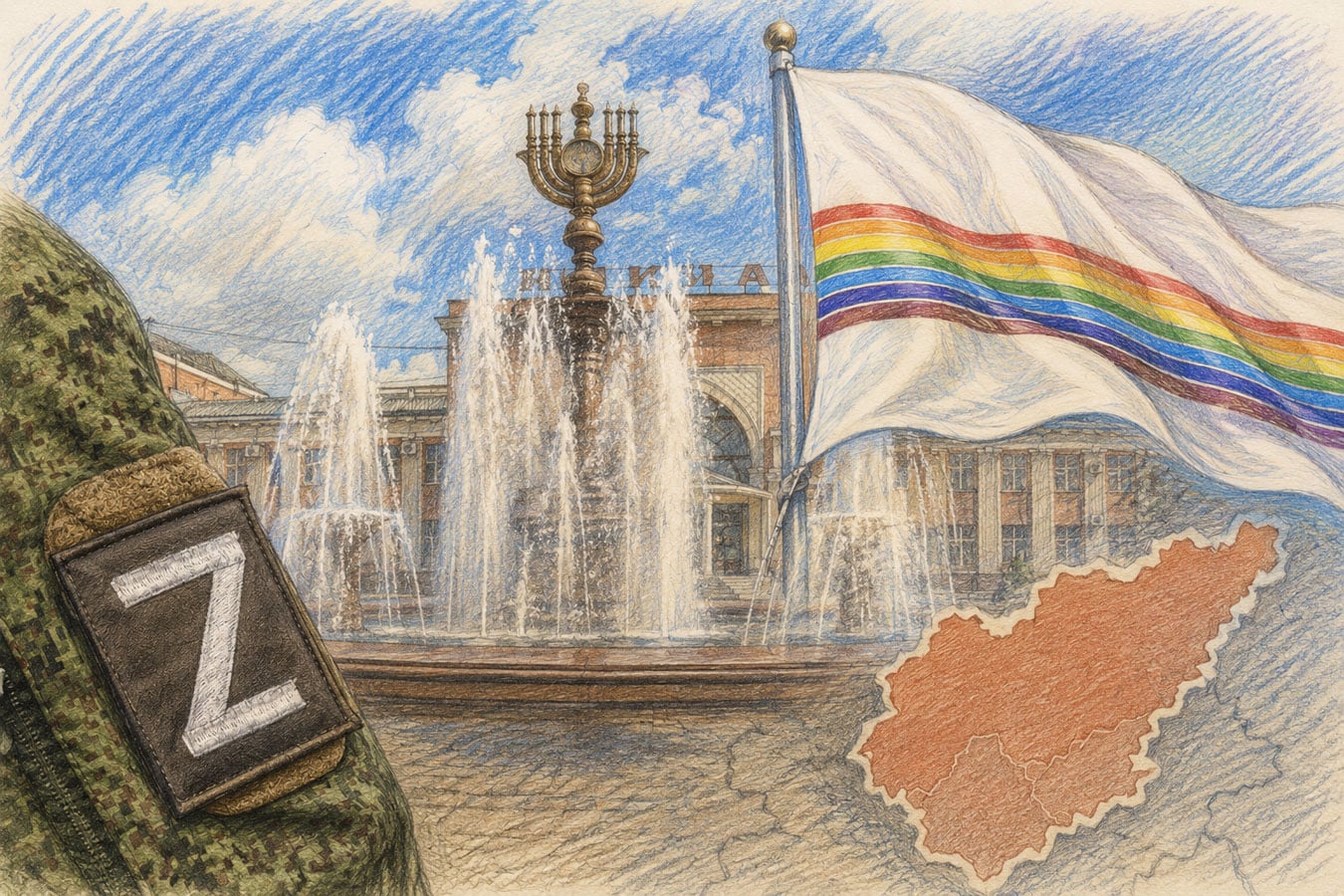
A “Jewish” Region in Russia Is Now Paying for Putin’s War. The image was created using AI.
For Israeli readers, the name “Jewish Autonomous Oblast” may sound almost unreal.
A Jewish autonomy inside Russia? A region with a menorah, a rainbow-like flag, and Birobidzhan as its administrative center? At first glance, it may look like a strange historical footnote from the Soviet past. But today, this remote region on Russia’s Far Eastern border with China has become something else: a warning sign of how Vladimir Putin’s war against Ukraine is eating into the ordinary life of Russia itself.
According to Russian business media citing the operational report of Russia’s Accounts Chamber for January–March 2026, budget deficits were recorded in 56 “regions” in the first quarter of the year. In the first quarter of 2025, there were 46 such regions. In the first quarter of 2022, before the consequences of the full-scale invasion of Ukraine had spread through the entire system, there were only six.
This is also why the story matters beyond Russian domestic economics. As NAnews — Nikk.Agency Israel News noted in its original analysis, the number “56 out of 89” must be read carefully: it reflects the logic of Russian official reporting, which includes not only internationally recognized Russian regions, but also temporarily occupied Ukrainian territories. In that sense, Moscow’s own budget language exposes the cost of occupation. The Kremlin presents expansion as power, but its financial reports show something different: war and occupation are becoming a growing burden on the state, on the regions, and on ordinary civilian life.
That is the first important point.
The war is no longer only a military story. It is no longer only about the front line, missiles, mobilization, military factories, or Russia’s external confrontation with the West. It is becoming an internal financial strike against Russia’s own regions.
And one of the most symbolic victims of this process is the Jewish Autonomous Oblast.
The Jewish Autonomous Oblast was created as one of the strangest projects of Soviet national policy. Located in the Far East, near the Chinese border, it received the status of Jewish autonomy in 1934. The Soviet authorities promoted Birobidzhan as a “Soviet alternative” to the Jewish national home.
But there was always a contradiction inside this project: Jews never formed a majority there.
At the moment of the autonomy’s formation, there were about 8,000 Jews in a population of more than 50,000. The highest recorded Jewish share came in 1939, when 17,695 Jews made up 16.2% of the population. After that, the numbers declined. In 1959, Jews were 8.8% of the population. In 1989, 4.1%. In 2002, 1.2%. In 2010, about 1%.
According to the 2020/2021 census, only 837 Jews remained in the Jewish Autonomous Oblast — around 0.6% of the population.
So today, the Jewish Autonomous Oblast is not a real center of Jewish life. It is mostly a historical and political symbol.
That makes its current financial condition even more striking.
In the first quarter of 2026, the Jewish Autonomous Oblast was reported to be in the worst position by relative deficit: around 50.5% of its own tax and non-tax revenues. This does not mean it had the largest deficit in ruble terms. Larger industrial regions may have bigger holes in absolute numbers. But for a small and economically weak region, a deficit of this size relative to its own revenue base is extremely painful.
It means dependence.
Dependence on federal transfers. Dependence on debt. Dependence on decisions made far away in Moscow. Dependence on a state that is spending enormous resources not on hospitals, roads, schools, water systems, or regional development, but on war.
This is how Putin’s war returns home.
Not through slogans.
Not through television speeches.
Not through patriotic ceremonies.
It returns through broken roads, postponed repairs, weakened hospitals, reduced local programs, and a shrinking ability of regional authorities to maintain normal civilian life.
The Jewish Autonomous Oblast is important here not because this is a “Jewish problem.” It is not. This is a Russian state problem. But for Israeli and Jewish readers, the symbolism is impossible to ignore.
A region that still carries the word “Jewish” in its official name, that still preserves the memory of a Soviet experiment in Jewish autonomy, is now among the weakest points in Russia’s regional budget system.
Even its flag tells a story of symbolic contrast.
The current flag of the Jewish Autonomous Oblast was approved on November 27, 1996. It is a white rectangular field with a horizontal stripe of seven colors across the center: red, orange, yellow, green, light blue, blue, and violet. Visually, it really does resemble the LGBT flag, although its official explanation is different. The rainbow is described as a symbol of peace, hope, renewal, and the number seven is connected to Jewish tradition and the menorah.
So the region has a Jewish name, a menorah, and a rainbow-like flag.
But behind these symbols stands a poor, remote, underpopulated region whose Jewish population is now less than one percent — and whose finances are being pulled into the consequences of Putin’s war.
This is the deeper meaning of the story.
Putin did not destroy the Jewish Autonomous Oblast in one direct act. He did not need to. The system he built did it gradually: by centralizing power, weakening local autonomy, turning regions into administrative extensions of Moscow, and finally forcing the entire country to serve the logic of war.
In this system, regions do not decide their future. They absorb the decisions of the Kremlin.
Moscow starts the war — regions pay.
Moscow announces mobilization — regions manage the social consequences.
Moscow tries to integrate occupied Ukrainian territories into its budget system — regions and the federal budget carry the burden.
Moscow speaks about “stability” — local budgets show deficit.
This is especially important because Russia’s official statistics include not only internationally recognized Russian regions, but also temporarily occupied territories of Ukraine. In Russian budget reporting, these territories appear under occupation names: the so-called “Donetsk People’s Republic,” the so-called “Luhansk People’s Republic,” the so-called “Zaporizhzhia Oblast,” and the so-called “Kherson Oblast.” Russia also includes occupied Crimea and Sevastopol.
In other words, even Russia’s own financial reporting shows that occupation is not a success story. It is a burden.
Among those territories, the largest first-quarter 2026 deficit was reported in the so-called “DPR” — around 17.4 billion rubles. The so-called “LPR” had a deficit of around 9.4 billion rubles, and the so-called “Kherson Oblast” around 4.8 billion rubles. Occupied Sevastopol also showed a deficit of roughly 0.7 billion rubles, while Russian data showed a surplus for occupied Crimea.
This means that the war is draining Russia twice.
First, through direct military spending.
Second, through the cost of maintaining occupied territories and forcing them into the Russian administrative and budget system.
For Israel, this is not just an economic issue.
Russia remains connected to the Middle East, to Iran, to Syria, to anti-Western alliances, and to global destabilization. The question of how long Moscow can finance war, military pressure, propaganda, occupied territories, and foreign influence operations is not only a Ukrainian question. It also matters for Israeli security.
But there is another lesson here.
Authoritarian systems can keep fighting for a long time by pushing pain downward. From the center to the regions. From elites to ordinary people. From military budgets to civilian life. From imperial ambitions to local hospitals and roads.
That is what is happening now.
The Kremlin sells the war as greatness.
The regions receive the bill.
And the Jewish Autonomous Oblast — once presented by the Soviet Union as a symbolic answer to Jewish national aspirations — now stands as one of the clearest examples of that bill.
A place created as a political symbol has become a budget warning.
A region with Jewish imagery has become evidence of Russian imperial exhaustion.
And behind all the symbols, one fact remains simple: Putin’s war against Ukraine is not only destroying Ukrainian cities. It is also hollowing out Russia’s own regions from within.
Related Topics
Related Posts