A Jewish Welcome to Magnifica Humanitas
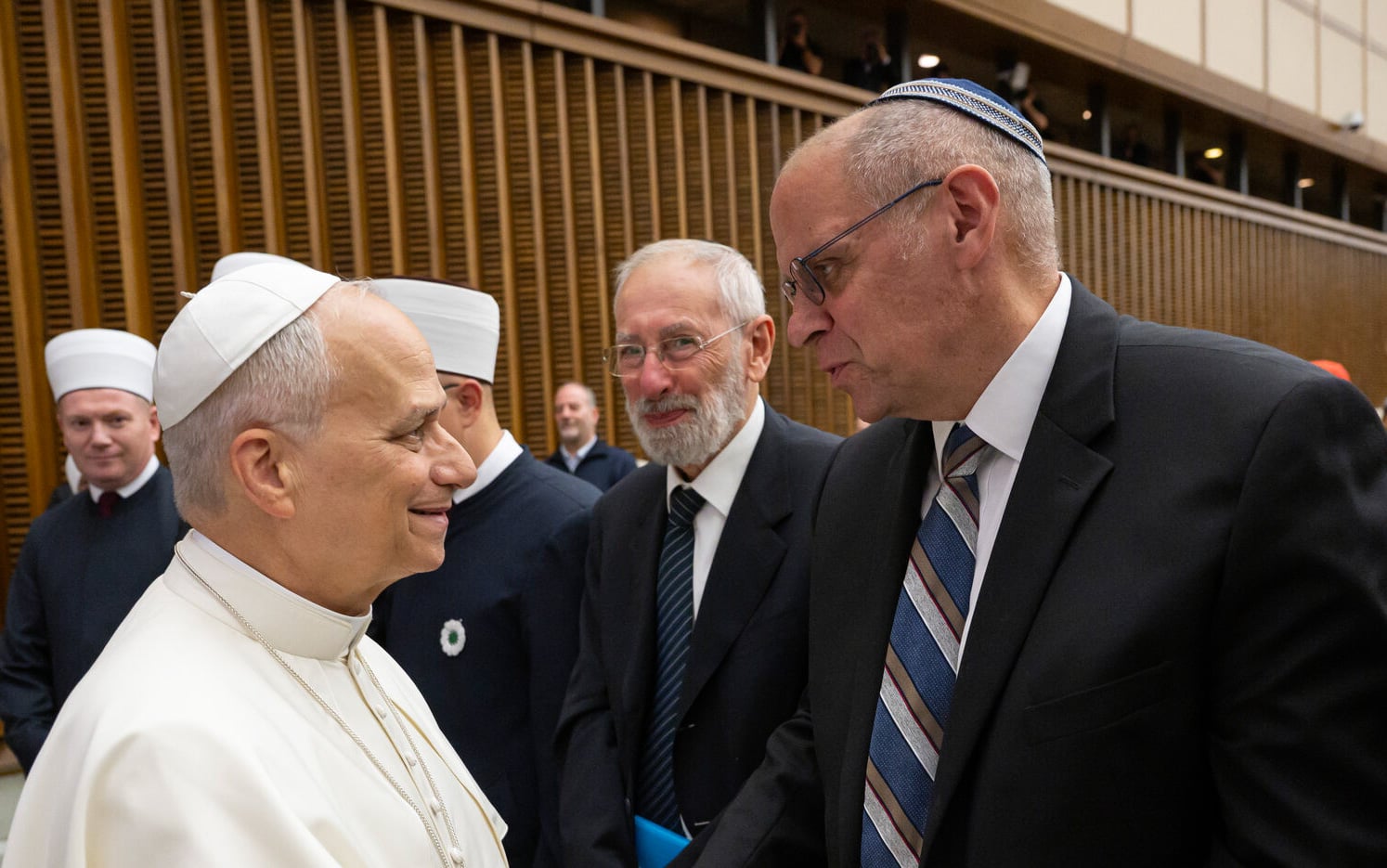
Pope Leo XIV’s first encyclical, on artificial intelligence and the human person, was released on May 25. Magnifica Humanitas asks whether the age of artificial intelligence will become another Tower of Babel or a city in which the dignity of every person is safeguarded.
Leo takes the contrast from Genesis. The builders of Babel, he writes, set out to “make a name” for themselves with “a single language, a single technology, a single direction,” but the project “sacrifices human dignity for efficiency” and reduces the person to “data and performance.” The counter-image in the encyclical is the rebuilding of Jerusalem under Nehemiah, where each family and each artisan takes a portion of the wall and the city rises through shared responsibility. The question is which of these construction sites the age of AI will turn out to be.
The encyclical is concerned that human beings might come to see themselves and one another as systems to be optimized, persons to be processed, or templates whose differences can be smoothed away in the name of efficiency. That concern is a Jewish one as well.
Rabbi Joseph B. Soloveitchik gave the Jewish tradition its sharpest modern reading of this problem. In The Lonely Man of Faith, published in Tradition in 1965, Rabbi Soloveitchik distinguished between two accounts of the human in the opening chapters of Genesis. Adam the first, the Adam of Genesis 1, is the majestic Adam, made in God’s image as a creator. He is called to subdue the earth, to have dominion, and to extend the reach of his hands through every tool and technology he can devise. He lives in the dignity of mastery and the discipline of progress. Adam the second, the Adam of Genesis 2, is the covenantal Adam, formed from the dust and animated by the divine breath. He knows himself in his loneliness, in his vulnerability, and in the encounter with another who draws him into community and relationship. Adam I builds the world. Adam II asks what he is in it.
Rabbi Soloveitchik’s argument is that both Adams are commanded by God. The technological Adam is not a fall from grace and the covenantal Adam is not a retreat from the world. We are both. The danger of our time is not that we have become Adam I. The danger is that we have become so successful as Adam I that we have lost the capacity to be Adam II. The work itself has become so loud that we no longer hear the questions that matter. Who am I? Who is the person next to me? What is being asked of us?
This is the situation Magnifica Humanitas takes up. Leo worries about a “technocratic paradigm” that reduces everything to efficiency and calculation. He defends human limit and weakness as features of the human condition rather than defects to be engineered away. He insists that moral judgment involves conscience, personal responsibility, and the recognition of the other as a person. Rabbi Soloveitchik’s categories are not identical to Leo’s. Adam I is a vocation; Leo’s “technocratic paradigm” is a distortion. But the two frameworks illuminate each other, and the encyclical’s argument reads, to Jewish ears, as a defense of Adam II in an hour of unprecedented Adam I success.
The danger has been named before. Henry David Thoreau, writing in Walden in 1854, observed that “men have become the tools of their tools.” His worry was that the apparatus we build around our needs eventually governs us; that we have, in his phrase, “settled down on earth and forgotten heaven.” A century later Abraham Joshua Heschel saw the same reversal from his own angle. In The Sabbath, published in 1951, he wrote that “we have fallen victims to the work of our hands” and that “the forces we had conquered have conquered us.” What both saw is the same reversal. Leo XIV now identifies it as the challenge of artificial intelligence. The tool which begins as a servant does not stay a servant unless we keep it one. One of our tradition’s answers is the Sabbath: one day in seven on which the tools are made to stop, so that the people who use them can remember they are not defined by them.
Pope Leo warns against what he calls the “complete delegation of important and sensitive decision-making” to systems that have never seen a human face. He gives examples: employment, credit, public services. The warning deserves Jewish endorsement and Jewish amplification. Leo names this delegation a “new form of power” that “risks discriminating against the weakest.” A human being whose application is rejected, whose loan is denied, whose name is flagged, or whose case is closed, by a system no person can be held to account for, has not been given the dignity both our traditions assume every person is owed. None of this is an argument against the building. We are commanded to build, and the building of artificial intelligence is one more chapter in the long story of human ingenuity. It is an argument about what must be preserved as we build.
These are conversations Jewish-Catholic dialogue is well prepared for. The framework Rabbi Soloveitchik articulated in his 1964 essay “Confrontation” identified the moral and communal questions our two peoples face together as the necessary ground of our shared work. Few questions are more squarely on that ground than what we are doing to ourselves with the tools we are now building. The encyclical also raises questions that will require further conversation between our communities. Some of those questions touch areas of urgent concern to the Jewish people, and IJCIC will take them up with our Catholic interlocutors.
For now, I want to welcome Magnifica Humanitas for what it does. It puts the human person at the center of the AI conversation, not at its margins. It refuses to let the conversation be conducted in the language of efficiency alone. And it does so in a moment when those who have built these tools, and those who are now deploying them, urgently need to hear that voice. The Catholic Church is owed thanks for raising the question this clearly. Jewish tradition has resources to bring to the conversation Leo has opened. Let us bring them.