
An Aging Jewish Feminist
Featured Post
A life examined: Yitro, Moses, and me
My upcoming move has me reviewing every scrap of my existence, pondering what to save, and reckoning that I shouldn't do it alone. Even the prophet of record had help
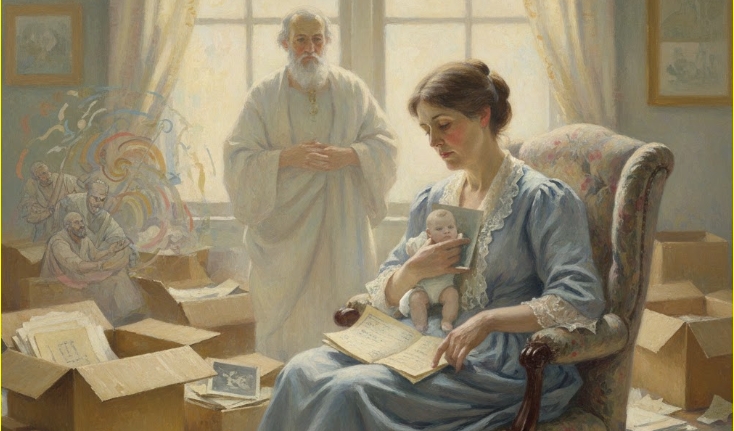
Gemini image in style of Mary Cassat for Parshat Yitro
Every piece of paper in my house seems to be asking a question of me.
Not metaphorically — literally. A report card. A letter. A photograph. Each one demands a verdict: Keep me. Save me. Pass me on. Or let me go. As I prepare to relocate, I find myself standing in judgment over my own life, item by item, memory by memory. It is exhausting. And it is lonely.
One of the hardest parts of relocation is not the logistics but the reckoning. You do not simply throw the past into the garbage. Each object requires thought: Should I take this with me? Store it? Show it to the kids and let them decide? Or make the decision myself and live with it? And as if my own accumulated history weren’t enough, I am also sorting through my mother’s — her carefully preserved past, sealed in a box for twenty-seven years. A life within a life. A burden within a burden.
This is when I start to think about Moses in this week’s Parshat Yitro.
Moses, too, was overwhelmed. He was surrounded by people demanding answers. He sat alone as magistrate from morning until evening while the people stood before him, waiting. Every dispute came to him. Every question required his judgment. Moses was doing what felt necessary, what felt responsible. After all, someone had to decide. And he did it alone.
But then Yitro arrived — and saw what Moses himself could not see.
Yitro did not ask whether Moses was capable. He did not question his authority or devotion. Instead, he named the cost of doing everything alone:
“What you are doing is not right. You will surely wear yourself out — and these people as well. The task is too heavy for you; you cannot do it alone.”
Moses explains himself, of course. He always does, as many overwhelmed people do. The people need him. The questions come to him. This is his role. But Yitro reframes the problem. Leadership, he teaches, is not about carrying every burden — it is about knowing which ones must be shared. He offers Moses a system, a structure, and most importantly, permission to delegate. And Moses listens.
That, to me, is the miracle of the story — not that Yitro had the insight, but that Moses accepted it.
Which brings me back to my boxes — packed and unpacked. And I can’t help wondering: where is my Yitro?
Fortunately, I have friends who have reached out. I finally called a mover. A date is set. My bed will be delivered. There is a plan — for the big things. But the smaller decisions are overwhelming me, and there is no one to whom I can delegate them.
I am drowning in details that feel too trivial to ask for help with, yet too meaningful to dismiss. Report cards going back to first grade. A list of every boy I dated, every movie and play I saw, starting in high school. A meticulous record of the 52 books I read my sophomore year — one a week, at a teacher’s urging. I found a beautiful letter from my rabbi to my mother-in-law, returning the check she sent to pay him for officiating at our wedding. There are my mother’s citizenship papers. My father’s literacy examination from the 1930s. A disintegrating album my mother put together with all of the condolences sent to her when my father died in 1974. Coincidentally, I discovered this only two days before my father’s yahrzeit. Letters of apology my sister wrote to my mother when she was angry with her. Notes from my husband asking my mother to buy him all sorts of things — shoe glue for his running shoes; a keyboard for his Atari — in the 1980s, when few people knew about personal computers.
And then there are the photographs. How does one discard pictures of an infant daughter? Or of that daughter holding her own newborn son? My oldest grandson!
These are not “major disputes,” and yet they carry enormous weight. They are the minor cases that still require judgment, and they are wearing me down.
Oh, Yitro, help me.
Examining my life — deciding what remains and what must be released — is painful and time-consuming. My job offers; letters of recommendation. Mementos of a starring role in a Gilbert and Sullivan operetta. For years, my guiding principle has been simple: what would I want my children to find when I am no longer here? Perhaps that is why Moses wrote his final book, Deuteronomy — to tell his story in his own voice, to shape the memory he would leave behind.
But now I wonder whether I am too close to my own past to judge it wisely. Should I really be the sole magistrate of my life? Am I, like Moses before Yitro arrived, assuming that responsibility requires solitude?
Moses did not fail by needing help. He succeeded because he accepted it.
So I ask myself, with less than three weeks left to decide: Who will be my Yitro — the one who can see the whole picture when I am buried in details? Who will step in — not to pack boxes or move furniture — but to help me decide what matters? Who will help me separate what should be saved from what can be discarded?
And like Moses, I suspect the real challenge isn’t the work itself — but recognizing that I cannot, and should not, do it alone. On the other hand…
Related Topics