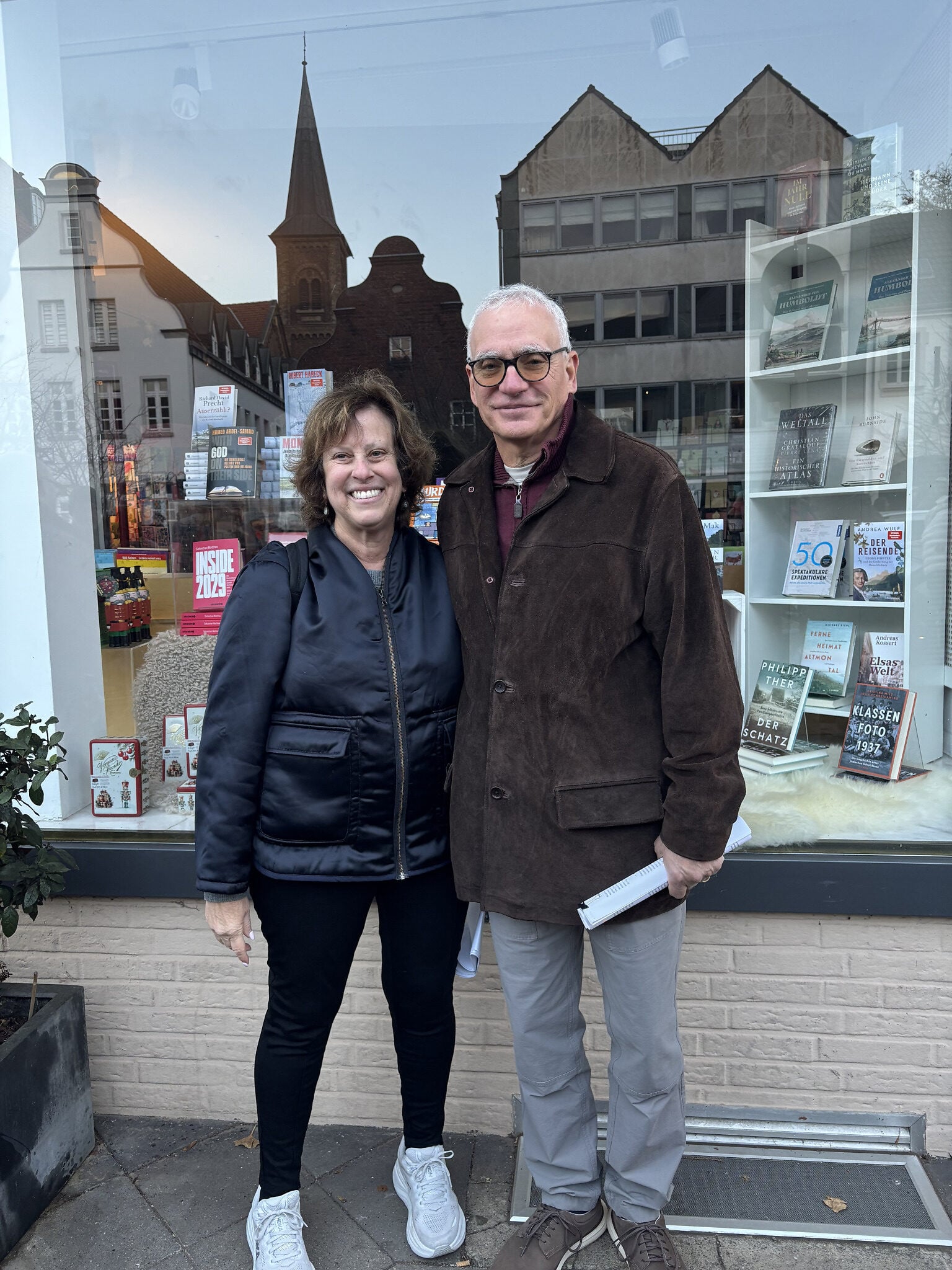
Judy and Joseph Baumgarten photo by Susan Borofsky
When the political noise of the world becomes overwhelming, the lessons of history and the courage of a new generation can restore a measure of hope.
It has been a horrible week for me, and for Jews everywhere.
The Israeli elections are deadlocked, with too many parties competing to have their respective ideologies prevail. It is something of a wonder that so many different factions can have a voice, but, as the saying goes, too many cooks can spoil the soup. I find myself wishing that Israel could form a grand coalition, find common ground, and get on with the business of balanced, intelligent government and governing as one nation with a common purpose and a shared future.
Then again, the American two-party system has hardly provided a shining example of political harmony. The anger and division are exhausting. Germany’s coalition politics have hardly fared better, with coalitions imploding and seemingly nobody happy with any political party.
Hands up in the air. Frustrated and powerless.
The American elections sent a deafening message: pay attention to people’s wallets, don’t get entangled with foreign adversaries, and proceed gently. Yet the consequences of that message, particularly for Jews and supporters of Israel, have been deeply unsettling. In my opinion, we have become collateral damage.
Journalist Gil Troy, writing in the Jewish Journal, called it the “The Naza Election”. His opinion piece begins:
“Jews and Israel-supporters beware. An election that had little to do with us, is being reframed as the Jews’ fault by some Republican losers and as a repudiation of Israel, by most Progressive winners.”
He makes an important point. An election can be about many things, but that does not prevent others from turning it into an opportunity to blame Jews or question their place in the political landscape.
I recently had an almost surreal conversation with a family member whose son had once been friends with Abdul El-Sayed, the senator-elect of Michigan who grew up in West Bloomfield, Michigan. This is the same community where a Jewish Community Center and synagogue were attacked. The family member recalled that El-Sayed had spent time in their kosher Jewish home. How, I was asked, could he possibly be antisemitic? They had been on the same basketball team.
Speechless
Apparently, sharing a basketball court or a meal in a Jewish home is now being offered as evidence that someone cannot harbor antisemitic views.
At this point, hundreds of hands-over-the-face shock emojis would be appropriate.
It has been a bad week.
And then something happened yesterday. My village of Kaiserswerth, just outside Düsseldorf, held a memorial ceremony honoring the Jewish residents who once lived here and were deported and murdered during the Shoah.
We are fortunate to have Stolpersteine -the small brass memorial stones embedded in the pavements throughout Germany marking the last freely chosen addresses of victims of Nazi persecution. In Kaiserswerth, just north of Düsseldorf our community decided to do something more: to bring the lives and stories of these former neighbors back into the consciousness of the village.
The persecution began in 1933. It accelerated dramatically with the November pogroms of November 9-10, 1938, Kristallnacht, and continued through the systematic deportation and murder of millions of Jews. The memorial was conceived, organized and carried out by four local schools.
Yesterday, my husband and I joined more than 600 people walking through the cobblestone streets of our village. We stopped at different locations, listening to the stories of Jewish people who had once lived among us. We heard about their families, their homes, their businesses, their hopes, and the terrible things that happened to them.
The same buildings. The same Rhine River. The same cobblestones.
But yesterday, those streets carried a different kind of history. Teenagers and elementary school children stood before us and told these stories. They educated us, moved us and perhaps most importantly reminded us that remembering is not enough. Their message was clear: Do not be a bystander. Do not allow this to happen again. We have learned and we must remain vigilant against antisemitism and racism.
These were not simply children reading from history books. They had spent months researching, learning and immersing themselves in the lives and experiences of the people who could have been their neighbors. Their teachers had guided them, their families had supported them and the wider community had shown up. Local shopkeepers had even created educational and memorial displays in their shop windows.
I was deeply moved.
At one point, I noticed a young woman wearing a hijab among the crowd. I approached her and said in German, “Toll, dass du hier bist. Ich wohne hier und bin jüdisch.” How wonderful that you are here. I live here, and I am Jewish.
She turned red, visibly taken aback. It was a small encounter, but it felt important. I wanted her to know that I had noticed her presence and that it mattered. We were standing together, in a German village, remembering what happens when hatred is allowed to take hold. It was the right thing to do.
As all this was unfolding, I was also thinking about the prospect of a woman becoming mayor of Berlin, following a campaign in which, anti-Israel rhetoric played a prominent role. I find this deeply troubling. In my view, this is no less disturbing than the rhetoric coming from the political right. A friend in Kaiserswerth remarked that Berlin was lost. Thank goodness, she said, not Kaiserswerth.
I don’t know whether any place can ever declare itself immune to the political and social currents sweeping through the world. But yesterday I saw something that made me believe that our little village understands what is at stake.
It was the end of an awful week. I had also learned that my beloved cousin had died in North Carolina, z”l. Grief, frustration and worry had accumulated, and I was feeling the weight of it all. Yet I walked home with a different feeling.
I had witnessed young Germans – educated, thoughtful, sensitive young people taking responsibility for remembering the Holocaust. They were not looking away. They were not treating history as something remote, belonging to another generation. They had invested months of their lives in understanding what had happened in their own neighborhoods and communicating the humanity of the people who had been destroyed.
Yesterday, I was proud to be German. Proud to live in Kaiserswerth.
There was one more encounter that brought the past and present together.
Judy and Joseph Baumgarten visiting from New York, had been invited to attend the memorial by the City of Düsseldorf. Judy’s great-grandmother had grown up in Kaiserswerth as part of the Bornheim family. Judy exists because one member of that family managed to escape to the United States. The rest perished in the camps.
I had the opportunity to speak with them. Naturally, we covered Jewish geography and inevitably, politics.
Joe told me that he wanted Judy to obtain her German passport “just in case.”
Those three words stayed with me.
Just in case.
For a long time, the idea that an American Jew might need a German passport as a precaution would have seemed unimaginable. Yet as reports emerged of bicycles being ridden through Philadelphia targeting Jewish-owned shops, I understood the anxiety behind his words. The concern about antisemitism is no longer confined to Europe nor can American Jews assume that the protections and security they once took for granted will always be there. Perhaps that is what made yesterday’s memorial so meaningful.
A descendant of a family nearly erased from this village had returned. Their presence was a reminder that Jewish life did not simply disappear, even when those who sought to destroy it came frighteningly close to succeeding.
And here we were, walking those same streets, speaking openly in German, remembering, teaching and refusing to be silent.
I cannot solve the political problems of Israel, America or Germany. I cannot reconcile the factions, change the rhetoric, or make the world less complicated. But yesterday I saw something that I can believe in.
I saw children who understood that history is not just about what happened to someone else, somewhere else a long time ago. I saw teachers who understood their responsibility. I saw shopkeepers who opened their windows to remembrance. I saw hundreds of people who chose to participate rather than look away. And I saw a young woman in a hijab standing among them.
Perhaps that is where hope begins.
Not in political coalitions or election results, not in grand declarations, but in the everyday decisions people make about how they treat one another, what they choose to remember and whether they have the courage to stand up when it matters. Antisemitism is not a Jewish problem. It is a societal problem. And the responsibility to confront it belongs to all of us.
This week, the world felt frighteningly divided. Yesterday, in a small German village beside the Rhine, I witnessed something different.
I live in Kaiserswerth. I am Jewish. I am German.
And yesterday, I was grateful to be all three.
About the Author
Susan Borofsky is a community leader, cantor Jewish educator and writer based in Düsseldorf, Germany. Born in New York, she holds degrees in voice performance and English from the University of Michigan and an MFA in Theatre from USC. She performed with New York City Opera, on Off- Broadway and throughout Europe. She has several recordings. Susan leads and is the founder of the Egalitarian Minjan in Düsseldorf. Susan is a Global Leadership Fellow for the WUPJ.