London based entrepreneur, cybersecurity analyst doing a PhD in AI
A Loaf of Bread in the Shadow of War.
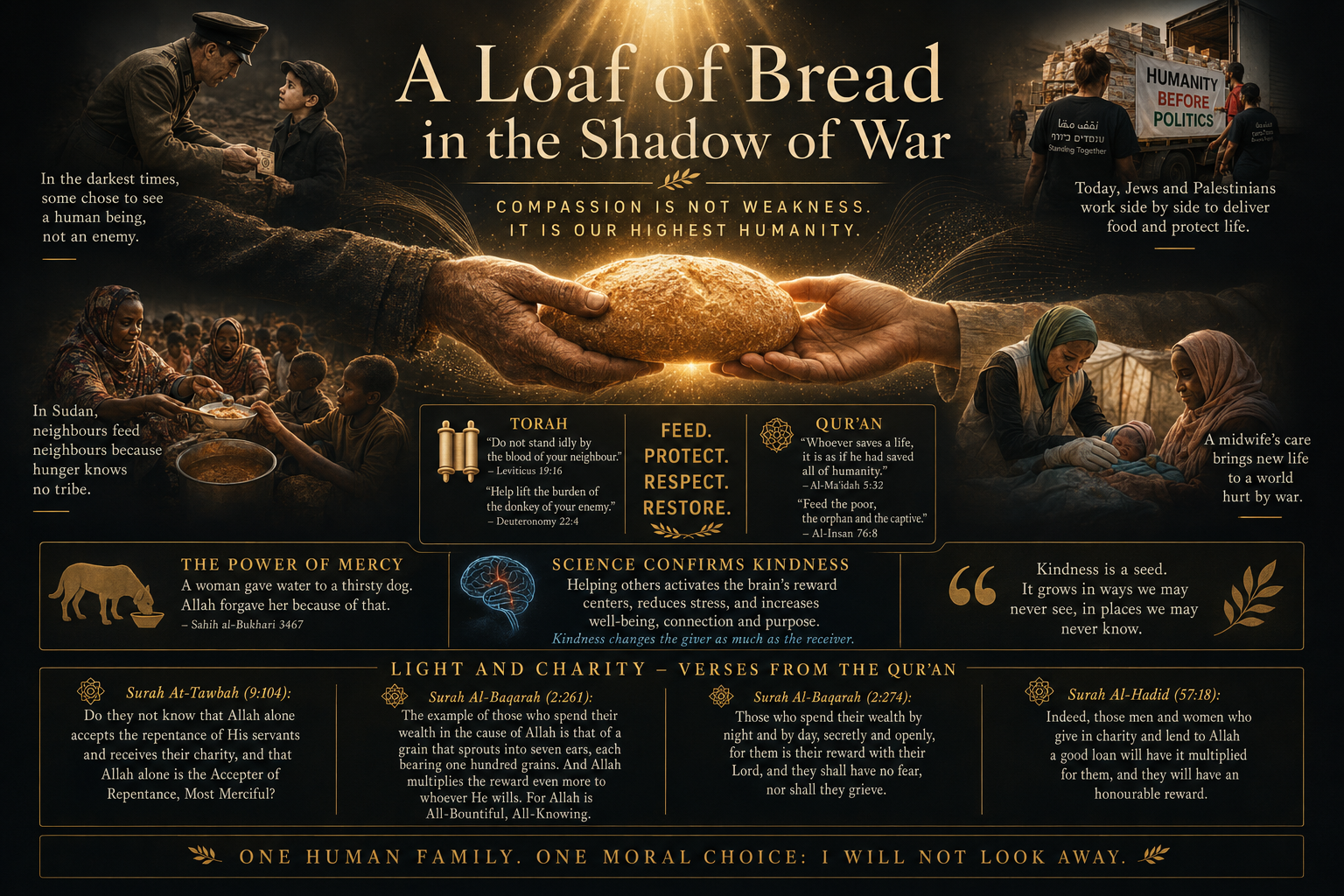
What the Torah, the Qur’an and the neuroscience of hope teach us about kindness when hatred becomes easy
Sometimes societal change begins with a loaf of bread.
A ration card passed secretly across a table. A false identity written onto a document. A cup of water carried to someone who cannot reach the well. A stranger hidden for the night. A doctor who continues treating patients while shells fall. A Jewish volunteer walking beside a Palestinian shepherd. A Sudanese neighbour cooking one more pot of food because somebody, somewhere, has not eaten.
These acts appear small beside war.
War is measured in armies, territory, casualties, governments and weapons. History records generals and treaties. Television shows explosions and maps.
But human beings do not live inside maps.
They live from one encounter to another.
And sometimes the moral character of an entire age is preserved in a moment so ordinary that history almost misses it:
one person sees another person suffering and decides not to walk past.
That decision may also contain something else.
Hope.
Not optimism in the shallow sense that everything will somehow turn out well.
Hope in a much deeper psychological and religious sense:
the conviction that what exists now is not the only thing that can exist next.
A loaf of bread cannot end a war.
But to a hungry person it says:
You have not been completely abandoned.
And perhaps that is where hope begins.
The moral code
The Torah and the Qur’an share an extraordinary feature.
Neither assumes that human beings will always love one another.
Both understand enemies.
Both understand poverty.
Both understand resentment, war, strangers, captives and tribal loyalties.
Their moral achievement is therefore more demanding than simply telling friends to be kind to friends.
They establish obligations that remain after affection has disappeared.
First: if life can be saved, do not merely watch
Leviticus commands:
“Do not stand idly by the blood of your neighbour.”
Rashi refuses to treat this merely as beautiful language. Drawing upon earlier rabbinic tradition, including the Sifra and the Talmudic discussion in Sanhedrin, he understands it concretely: if another person is drowning, under attack or otherwise endangered and you possess the ability to help, you may not simply remain a spectator.
The command transforms morality from a feeling into an obligation.
It is not enough that I personally did not push the person into the river.
If I can throw the rope, there is now a question about whether I did.
The Qur’an gives human life an equally dramatic moral weight. In recounting what was ordained for the Children of Israel, it declares that whoever saves a life is as though he has saved humanity altogether.
Classical tafsir does not mean that one physical rescue literally changes the population of the world. The idea is moral: whoever understands the inviolability of one innocent life has recognised the principle upon which the safety of every innocent life depends.
One person cannot be reduced to a statistic merely because millions exist.
The victim remains a world.
Second: the enemy remains human
This is where both traditions become even more demanding.
The Torah presents an almost deliberately uncomfortable example.
If you encounter the wandering animal of your enemy, return it.
If you encounter the donkey of someone who hates you collapsing underneath its burden, you are required to help lift it.
Notice what the Torah does not say.
It does not pretend that the man is your friend.
It explicitly calls him your enemy.
Hatred is acknowledged.
But hatred is denied absolute sovereignty over behaviour.
Rashi effectively asks: how can you see the burden and simply abandon it?
Rabbeinu Bahya notices something even more beautiful. Exodus describes the animal as belonging to your enemy; elsewhere Deuteronomy speaks of helping the animal of your brother.
He sees a moral progression.
Perhaps through the act of helping, the enemy may become a brother again.
That is an astonishing idea.
Kindness does not merely relieve suffering.
It can reopen a relationship that hatred had declared permanently closed.
The Qur’an reaches almost exactly the same psychological territory:
“Do not let the hatred of a people cause you to depart from justice. Be just; that is nearer to righteousness.”
— Qur’an 5:8
The verse is powerful precisely because it acknowledges hatred.
It does not say:
You will never experience hostility.
It says:
Your hostility is not permitted to determine what is just.
Classical commentators including Ibn Kathir place the verse within the obligation to uphold justice even when dealing with people toward whom one feels animosity.
Elsewhere the Qur’an goes further:
“Repel evil with that which is better, and then the one between whom and you there was enmity may become as though he were a devoted friend.”
— Qur’an 41:34
Again there is that extraordinary possibility.
The enemy need not remain the enemy forever.
Kindness creates another future.
And that is already a psychology of hope.
Third: feed people
The third principle gives this essay its title.
Feed people.
Not only your friends.
Not only people who can repay you.
Not only members of your tribe.
Deuteronomy warns against hardening the heart or closing the hand when another person becomes poor.
The language becomes insistent:
Open your hand.
Give sufficiently for the need before you.
Do not allow resentment to corrupt the act.
And the Torah attaches blessing to such generosity.
The Qur’an similarly praises those who:
“give food, despite loving it, to the poor, the orphan and the captive.”
— Qur’an 76:8
The inclusion of the captive is crucial.
Classical commentators including al-Baghawi transmit the understanding that captives in the early Muslim community could themselves be non-Muslim opponents.
Yet they were to be fed.
That destroys a dangerous moral illusion.
A person can be your prisoner and still be hungry.
A person can be your political opponent and still be thirsty.
A person can belong to another nation and still have children.
A person can be foreign and still bleed.
Political identity does not abolish the stomach.
Fourth: do not humiliate the person you help
Scripture understands another human weakness.
Sometimes we give—and then use the gift to elevate ourselves.
We photograph poverty.
We remind the recipient repeatedly of what we did.
We turn dependence into humiliation.
We make the recipient pay psychologically for what we gave materially.
The Qur’an attacks this directly.
It warns that charity can be spiritually destroyed by reminders of generosity and injury to the recipient:
“Kind words and forgiveness are better than charity followed by injury.”
— Qur’an 2:263
The dignity of the recipient therefore matters almost as much as the transfer itself.
Jewish thought reaches a strikingly similar conclusion through Maimonides’ famous hierarchy of tzedakah.
Anonymous giving is elevated because embarrassment is reduced.
But the highest form goes further still.
Help the person so that he may no longer need help.
Provide employment.
A loan.
A partnership.
A means of livelihood.
Strengthen his hand before he falls completely.
The highest charity is therefore not permanent dependency.
It is restored agency.
And that brings us unexpectedly close to modern psychology.
Hope means restoring agency
When most people hear the word hope, they imagine an emotion.
“I hope things get better.”
Psychology developed a more rigorous idea.
Martin Seligman’s early work helped establish the concept of learned helplessness: after repeated exposure to events perceived as uncontrollable, organisms may eventually stop attempting escape even when possibilities later appear. His subsequent work on explanatory style, learned optimism, resilience and positive psychology examined how people interpret adversity and how those interpretations affect future behaviour. The University of Pennsylvania’s Positive Psychology Center describes Seligman as a leading researcher on learned helplessness, optimism, resilience and well-being. (Positive Psychology Center)
This gives war a psychological dimension beyond physical destruction.
War can destroy buildings.
But prolonged violence can also attack a person’s belief that action matters.
The refugee stops imagining home.
The hungry parent stops believing tomorrow can differ from today.
The persecuted minority begins to believe nobody will come.
The prisoner concludes that every door is permanently locked.
This is psychological devastation:
not merely suffering, but the loss of perceived possibility.
And that is why one act of kindness can carry a significance completely disproportionate to its material size.
A loaf of bread says:
Someone responded.
A forged document says:
There may still be a way out.
A doctor appearing at the bedside says:
Your life is still being fought for.
A stranger protecting you says:
You are not completely alone.
The event has changed.
And therefore perhaps the future can change too.
The psychology of hope: the will and the ways
Here it is important to distinguish Seligman’s work from another major psychological tradition.
The classic modern psychological theory specifically called Hope Theory was developed by C. R. Snyder and colleagues.
Snyder described hope not as wishful thinking but as two interlocking capacities:
Agency — the sense that I can move toward a goal.
And:
Pathways — the belief that there are routes by which the goal might be reached.
Research on Snyder’s Hope Scale established these two components as central to hopeful goal-directed thinking. (PubMed)
This is immensely important.
Hope is not:
Everything will be fine.
Hope is closer to:
There is somewhere worth going, and there may still be a way of getting there.
That difference matters enormously in war.
A Sudanese volunteer cannot promise that the war will finish tomorrow.
But she can create a pathway between hunger and tonight’s meal.
A midwife cannot promise a displaced mother a peaceful country.
But she can create a pathway from a dangerous pregnancy to medical care.
A German rescuer during the Holocaust could not promise the collapse of Nazism.
But a forged identity could create a pathway from capture toward another day of survival.
A Jewish activist cannot settle the Israeli-Palestinian conflict by accompanying one Palestinian shepherd.
But she can create a pathway between fear and one safer journey home.
These are acts of hope construction.
Did hope survive inside Nazi Germany?
The Holocaust is one of history’s most severe tests of this question.
Did anyone living within Germany—or operating within German institutions or German-controlled territory—continue to recognise Jewish people as neighbours when the state was systematically stripping them of legal and human standing?
Yes.
Not enough.
Never enough.
The rescuers were exceptions. Their existence must never be turned into a comforting story that diminishes German participation, collaboration or indifference.
But exceptions have enormous moral significance.
They prove that another choice remained possible.
Gertie Siemsen lived in Berlin.
She helped Jewish musician Konrad Latte and his family survive underground by providing food-ration cards, money, work and places to sleep. After Latte’s parents were deported to Auschwitz and murdered, she continued helping their son and assisted him in living under a false identity.
A piece of paper became a pathway.
Someone whom the state had effectively told:
There is no future for you here
received another message from an ordinary human being:
Perhaps there is still a way.
Anton Schmid was an Austrian sergeant in the German Wehrmacht stationed in occupied Vilna.
He secretly supplied Jews with food, helped arrange documents, hid people, transported Jews in military vehicles and assisted the underground.
The German military discovered his actions.
He was executed.
Schmid did not defeat Hitler.
He did something both smaller and enormous:
he refused to let the uniform make every moral decision for the man inside it.
Wilhelm Hosenfeld offers an even more complicated lesson.
He had joined the Nazi Party.
Yet his diaries reveal increasing horror at the persecution around him. He helped the Jewish survivor Leon Warm and later helped Władysław Szpilman survive among the ruins of Warsaw.
Then there was Oskar Schindler.
He did not begin as the hero later remembered by history.
He was a Nazi Party member, an opportunist and a businessman who originally went to occupied Poland expecting to profit.
Yet something changed.
He eventually used his factory, money, influence, bribery and deception to protect more than a thousand Jews.
The lesson is uncomfortable because we prefer morality to arrive neatly packaged.
History rarely cooperates.
Sometimes conscience awakens late.
But late is different from never.
And that itself is a doctrine of hope.
A human being is not necessarily imprisoned forever by the worst thing he once believed.
Gaza, the West Bank—and the decision not to look away
Historical comparison requires discipline.
Gaza is not Auschwitz.
Israel is not Nazi Germany.
The Holocaust was a distinct programme of racial persecution and extermination, and collapsing radically different histories into one another weakens moral analysis.
The comparison worth making concerns something else:
individual moral choice.
What happens when fear, trauma, nationalism or anger tells me that the suffering of somebody outside my group should no longer matter?
There are Jewish and Palestinian citizens of Israel answering that question through practical action.
Standing Together has organised Jewish and Palestinian activists around humanitarian assistance for Gaza and opposition to attacks on aid.
Rabbis for Human Rights explicitly grounds its work in Jewish moral teaching. Volunteers accompany Palestinian farmers and shepherds, assist with olive harvests, deliver necessities and provide protective presence to communities exposed to violence.
This matters.
A Jew does not have to cease being Jewish in order to defend a Palestinian.
Jewish moral teaching can itself provide the reason.
Exodus describes the burdened animal belonging to the enemy.
The command is not:
First settle the entire political dispute.
It is:
Help lift the burden.
The large political questions remain.
But an immediate moral question arrives first:
There is somebody vulnerable in front of me. What can I do now?
Sudan: hope without headlines
The same question appears in Sudan.
The ongoing conflict has devastated communities, displaced millions, destroyed healthcare capacity and generated severe hunger.
Yet Sudan has also produced an extraordinary form of civilian organisation: the Emergency Response Rooms.
Ordinary Sudanese volunteers built neighbourhood networks to keep people alive when formal systems could no longer reliably function.
They established communal kitchens.
Found medicines.
Distributed food and water.
Restored local services.
Arranged transportation.
Helped evacuate people.
The work is striking partly because of how ordinary it is.
Someone has rice.
Someone has a pot.
Someone knows where medicine can be found.
Someone has a vehicle.
Someone knows which road remains passable.
Together these fragments become something larger.
They become a pathway.
And that is hope in Snyder’s psychological sense.
The goal is survival.
The pathways are improvised.
The agency comes from deciding:
we are not powerless yet.
There are also Sudanese midwives working among displaced women.
Imagine what that means psychologically.
Around you is a war concerned with death.
And in the middle of it a woman is helping another woman bring new life into the world.
There can be few clearer symbols of hope.
The war says:
destruction is the future.
The birth says:
the future has arrived anyway.
A woman, a well and a thirsty dog
Islamic tradition contains a story that may express this entire theology more beautifully than any abstraction.
The Prophet Muhammad ﷺ told of a woman from the Children of Israel who had been a prostitute.
She encountered a dog desperately circling a well.
It was almost dead from thirst.
Nobody would have blamed her socially for walking past an animal.
Nobody was filming.
There was no reputation to be gained.
There was no repayment.
She simply saw suffering.
She removed her shoe.
Lowered it into the well.
Drew water.
And gave the dog something to drink.
The Prophet ﷺ said that Allah forgave her because of it.
The account is found in Sahih al-Bukhari.
Consider how radical this story is.
The giver is someone society might have labelled morally compromised.
The recipient is not a scholar.
Not a righteous person.
Not even a human being.
There is simply thirst.
And mercy.
The hadith warns us against reducing a human life to its worst chapter.
Someone with a broken past can still perform a beautiful next act.
That is hope.
Schindler had a past.
Hosenfeld had a past.
The woman at the well had a past.
None of those pasts made the next moral decision impossible.
The door to the next good deed remained open.
Allah receives the charity
Islam adds another extraordinary dimension.
Charity does not merely travel horizontally from giver to recipient.
The Qur’an describes it as something received by God.
“Do they not know that Allah accepts repentance from His servants and receives their charities, and that Allah alone is the Accepter of Repentance, Most Merciful?”
— Qur’an 9:104
The theological psychology is profound.
The person placing bread into another person’s hand may appear to be losing something.
But revelation tells the giver that the transaction is not exhausted by what the eye sees.
The Qur’an gives the image of a grain:
“The example of those who spend their wealth in the cause of Allah is that of a grain that sprouts into seven ears, each bearing one hundred grains. And Allah multiplies even more for whoever He wills.”
— Qur’an 2:261
One seed disappears into the earth.
From the surface, it looks lost.
Then something grows.
Elsewhere:
“Those who spend their wealth by night and by day, secretly and openly, will have their reward with their Lord. They will have no fear, nor will they grieve.”
— Qur’an 2:274
And:
“Indeed, the men and women who give in charity and lend to Allah a good loan—it will be multiplied for them, and they will have an honourable reward.”
— Qur’an 57:18
The imagery repeatedly overturns ordinary economic intuition.
What leaves your hand is not necessarily lost.
What appears small may multiply.
What nobody sees may still matter.
What seems to disappear into darkness may emerge as light.
The neuroscience of hope
Science cannot verify divine reward.
An MRI scanner cannot measure barakah, forgiveness or the Hereafter.
But neuroscience and psychology can ask another question:
What happens inside human beings when they retain hope, exercise agency and help one another?
The evidence is intriguing.
Research on prosocial behaviour finds a modest but consistent association between helping others and well-being.
Giving can engage neural systems involved in reward.
Providing social support has been linked with activity in reward- and caregiving-related regions, including the ventral striatum, while some research suggests caregiving processes may also modulate stress-related responding. (PubMed)
This does not mean kindness is medicine for every illness.
Nor does it mean every charitable act automatically produces happiness.
Human motivation matters.
Circumstances matter.
But the broader picture is important:
the human brain is not constructed only to experience reward when the self receives.
Another person’s welfare can itself acquire value.
That is extraordinary.
From helplessness to hope
Seligman’s work makes the connection particularly powerful.
Learned helplessness develops when repeated uncontrollable adversity teaches an organism that its actions no longer matter. Seligman’s research programme eventually helped stimulate a wider interest in resilience, optimism and the conditions under which people flourish rather than merely avoid pathology. (Positive Psychology Center)
War creates almost ideal conditions for helplessness.
You cannot stop the bombardment.
You cannot restore your home.
You cannot control the border.
You cannot resurrect the person who died.
You cannot guarantee food tomorrow.
The danger is that uncontrollability in one domain begins to infect everything else.
Nothing I do matters.
That thought is psychologically catastrophic.
Hope interrupts it.
Not by pretending that the bomb did not fall.
Not by telling the hungry person to “think positively.”
Real hope requires contact with reality.
The American Psychological Association summarizes contemporary hope research in precisely this way: hope is not denial or passive wishing; it involves goals, agency and finding pathways forward. (American Psychological Association)
That makes the loaf of bread more significant than it initially appears.
The bread does not announce:
The war is over.
It says:
Something can still be done.
And psychologically that distinction is enormous.
Hope is not fantasy
This is worth emphasizing because “hope” is often confused with naïveté.
Psychological hope does not mean believing every desired outcome will occur.
Snyder’s theory specifically concerns finding workable routes toward meaningful goals and maintaining the motivation to pursue them. Subsequent research has continued to treat agency and pathways as central elements of the hope construct. (PubMed)
Hope can therefore coexist with grief.
You can know that somebody has died and still have hope.
You can recognise injustice and still have hope.
You can acknowledge that a war is terrible and still have hope.
Hope simply refuses the conclusion:
Because this is terrible, nothing meaningful remains possible.
Recent research continues to associate greater hope with psychological resilience. A 2025 meta-analysis covering 129 studies found a moderate inverse association between hope and trait anxiety, with longitudinal evidence also pointing in the same direction. That does not prove hope alone causes lower anxiety, but it reinforces its importance as a resilience-related psychological resource. (PubMed)
Hope is not the denial of darkness.
It is the refusal to conclude that darkness is all that exists.
War attacks hope before peace has even arrived
This may be one of war’s least discussed injuries.
Before a society can be physically reconstructed, people must recover the idea that reconstruction is possible.
A child needs to imagine adulthood.
A student needs to imagine graduation.
A displaced family needs to imagine somewhere called home.
A pregnant woman needs to imagine her baby’s future.
A farmer needs to plant something he will not harvest today.
A society without hope eventually stops investing in tomorrow.
This is why kindness has political significance beyond sentimentality.
A community kitchen is not merely calories.
It says:
Our community still exists.
A school operating under extraordinary conditions says:
There will be a generation after this one.
A doctor continuing to treat says:
Life remains worth preserving.
A Jew protecting a Palestinian neighbour says:
Our identities need not determine permanent enmity.
A Muslim helping a person of another faith says:
Compassion exceeds tribal boundaries.
A stranger sharing bread says:
The social contract has not completely died.
These are small rehearsals for peace.
War attacks empathy too
Hope is not the only psychological system endangered by conflict.
War encourages a division between us and them.
Once that division hardens, suffering can become morally discounted.
Their children.
Their dead.
Their hunger.
Their grief.
Their fear.
Language often changes first.
People become labels.
Enemies.
Traitors.
Invaders.
Infidels.
Vermin.
Collateral.
Eventually the individual disappears behind the category.
That is why the Torah’s donkey is psychologically brilliant.
The text forces you back into physical reality.
There is a burden.
There is an animal collapsing.
There is a human being beside it.
You may still call the person your enemy.
But now help him lift.
And that is why Qur’an 5:8 is so sophisticated.
It does not require the impossible fiction that hostility never exists.
It places a moral regulator between emotion and action:
Hatred exists. Do not allow it to govern justice.
Civilisation depends upon that space.
Kindness is not enough
None of this means that private charity can replace public justice.
A loaf of bread cannot end famine.
A compassionate German could not redeem Auschwitz.
A Jewish activist walking beside a Palestinian farmer cannot alone resolve Israel and Palestine’s political future.
A Sudanese community kitchen cannot end Sudan’s war.
A midwife cannot replace a functioning health service.
Structural suffering requires structural solutions.
Law.
Accountable government.
Humanitarian access.
Healthcare.
Diplomacy.
Justice.
Peace.
But institutions themselves are inhabited by human beings.
And every cruel system eventually requires enough ordinary people to learn a simple sentence:
Not my problem.
That is why individual mercy matters.
Not because it replaces justice.
Because it preserves the psychological and moral material from which justice can eventually be rebuilt.
A loaf of bread
Imagine Berlin in 1943.
A Jewish musician cannot safely use his own name.
A German woman gives him ration cards and false documents.
For one moment, the machinery of persecution encounters something it cannot entirely control:
a human conscience.
Imagine Vilna.
A Wehrmacht sergeant brings food to people his own military system has marked for destruction.
He cannot end the war.
But he can decide what his own hands will do.
Imagine Gaza.
Someone makes sure flour reaches civilians.
Imagine a hillside in the West Bank.
A Palestinian shepherd walks with his flock.
An Israeli activist walks beside him because her presence may make violence less likely.
Imagine Sudan.
The communal kitchen is running low.
Someone divides what remains and cooks anyway.
A pregnant woman fails to arrive for an appointment.
The midwife goes looking for her.
Imagine the ancient well.
A woman sees a dog dying from thirst.
She lowers her shoe into the water.
Different centuries.
Different wars.
Different faiths.
Different histories.
They should never be collapsed into one another.
But beneath them is the same moral decision:
I can see suffering.
Something can still be done.
I will not walk past.
Rashi says: do not stand idle while another person’s blood is in danger.
The Torah says: when the burden belongs to your enemy, help lift it anyway.
Rabbeinu Bahya sees within that act the possibility that an enemy might become a brother.
The Qur’an says: do not allow hatred to corrupt justice.
It praises feeding the captive.
It protects the dignity of the recipient.
It tells us that Allah receives charity.
It tells us that one grain can become hundreds.
The Prophet ﷺ tells us of a sinful woman whose mercy toward a thirsty dog became the occasion of divine forgiveness.
Maimonides tells us that the greatest charity restores a person’s ability to stand.
Snyder tells us that hope requires agency and pathways.
Seligman’s work warns us about what happens when human beings learn that nothing they do matters—and positive psychology asks what allows people not merely to survive but eventually to flourish. (Positive Psychology Center)
Perhaps these are not unrelated insights.
Despair says:
Nothing can change.
Hope says:
Something can still be done.
And kindness is one of the ways human beings prove it.
One forged document becomes another day of life.
One ration card becomes another meal.
One protected aid truck becomes flour.
One communal kitchen becomes hundreds of dinners.
One midwife becomes one safer birth.
One person refusing hatred becomes evidence to another that hatred is not compulsory.
One act of mercy tells someone watching:
the world is not entirely what the violence says it is.
Cruelty travels.
Fear travels.
Hatred travels.
Helplessness travels.
But so can courage.
So can compassion.
So can hope.
And perhaps that is why, when history becomes unbearably large, morality returns us again and again to something small.
A cup of water.
A hand beneath a burden.
A door opened in the night.
A light left burning.
And sometimes, in the shadow of war,
a loaf of bread.
Related Topics